Royal Swedish Opera 2026-27 Review: Melancholia
Mikael Karlsson & Royce Vavrek’s Representation of Von Trier’s Iconic Film Stands Comparison
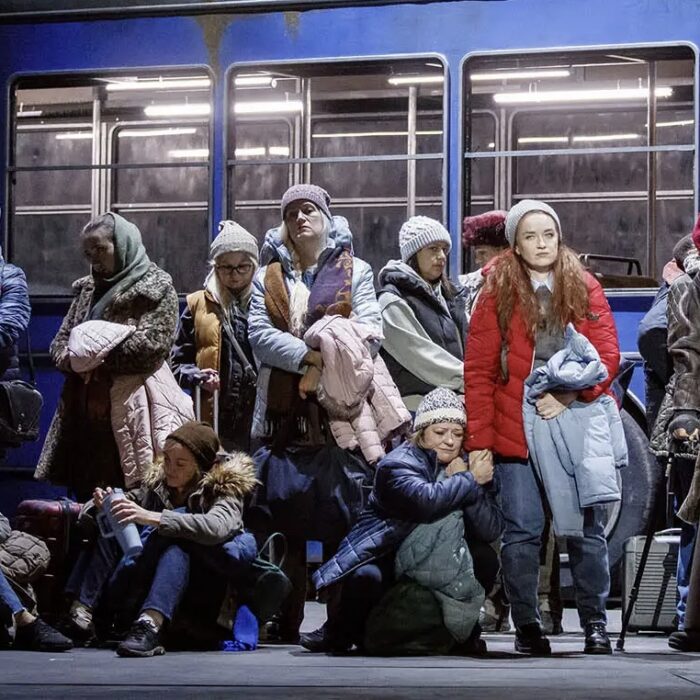
By Alan Neilson(Photo: Kungliga Operan/Sören Vilks)
For obvious reasons, writing a new opera based on a well-known and successful film, especially one with such a reputation as Lars von Trier’s iconic “Melancholia,” is fraught with dangers, not least owing to the unavoidable comparisons to which it will inevitably give rise, but this is exactly what composer Mikael Karlsson and librettist Royce Vavrek decided to do. Their work premiered in 2023 at the Royal Swedish Opera to positive reviews and has been reprised for the company’s 2026-27 season.
Von Trier’s Film Transformed
What is particularly surprising about the production is the degree to which the narrative of the opera follows the film. There is no attempt to add extra events or characters to facilitate the stage presentation, nor did it try to introduce a different perspective. Rather, it is a straightforward retelling of the story, albeit through a very different medium, in which Karlsson’s music is used to carry a significant amount of the atmospheric, emotional and psychological weight – important aspects that the film so convincingly presented through its visual and verbal detail, as well as through its frequent use of the prelude to Wagner’s “Tristan und Isolde.”
The story concerns two sisters, Justine and Claire, who possess very different personalities burdened by unhealthy pathologies. While Claire is seeking a well-ordered, organized life that borders on the obsessional, in which any deviations are likely to result in bouts of intense anxiety, Justine, who suffers from severe depression, is struggling to assign meaning and value to events and relationships.
The work follows their final days over an unspecified period of time that begins on Justine’s wedding day, which she manages to completely destroy through her seemingly random behavior. Her relationship with Michael, her husband for only a matter of hours, is brought to a crashing end when she has sex on the golf course with a guest she barely knows, sending Claire, who has organized the perfect reception at her large rural mansion, into an emotional tailspin, while her controlling husband John tries to ensure that his perfect life is not disrupted. Justine also manages to lose her well-paid job when she decides to tell her boss, Jack, who also happens to be married to her mother, Gaby, exactly what she thinks of him. Gaby is yet another dysfunctional character, who adds more discord to the social gathering with her own demanding, egotistical behavior.
It all takes place against the background of a rogue planet, called Melancholia, which has entered the solar system on a collision course with the Earth, forcing the sisters to face up to their impending annihilation. It is an event that Justine is able to accept with a calm indifference while Claire’s anxieties increase as she struggles to face up to her inevitable doom. Michael has long since departed the scene, while John, who initially had decided that Melancholia would not collide with Earth, has taken the coward’s way out and committed suicide when he realized that in fact the collision was inevitable, leaving his wife and Justine to comfort his son Leo as the rogue planet approaches.
The film’s collection of complex, multi-layered characters is underpinned by many philosophical, psychological and symbolic references that require a deep and thoughtful engagement with the material on the part of the audience if a satisfying and meaningful understanding is to be had. It is, therefore, perhaps not surprising that its interpretative challenges have captured the interest of many film-goers.
Obviously, Karlsson and Vavrek had to make certain compromises, especially with regard to the amount of dialogue, which had to be trimmed, and the scenery that could not be expected to match the detail nor scope of the film. Yet, very few events, even of minor significance, were omitted, and if that made comparisons even more likely, Karlsson and Varek’s expertly crafted score and libretto certainly did not fall short!
Karlsson’s Captivating Score
Karlsson’s music was brilliantly designed to provide an atmospheric framework that not only supported and enhanced the emotional and pathological complexities of the characters in a way that words cannot necessarily communicate but also ensured that Melancholia’s presence was never allowed to retreat into the background. After all, even the slightest possibility of a planet crashing into the Earth would severely impact everyone’s thoughts and behavior.
It is a score with plenty of variety that moves between exciting, agitated, and calm passages, broken by periods of disturbance caused by electronic vibrations that could be felt through the frames of the audience’s seats, that one immediately associated with Melancholia’s approach. Although the music occasionally settled, the overall effect was one of insistent movement towards the inevitable doomed climax, in which, despite its unsettling tonal and atonal shifts, it had an internal coherence that gave it an almost symphonic feel and neatly managed to meet the dramatic needs of the stage. Karlsson’s ability to create strong, troubling sections that also captured the majestic power, even beauty, of Melancholia was particularly impressive, as was the use of glissandi effects to suggest the slippery nature of existence and our perceptions of reality. He employed an imaginative orchestral palette throughout that gave the piece beautiful harmonic qualities and an interesting textural fabric, which he enhanced with occasional repetitive verbal and non-verbal sounds from the chorus that were particularly effective in promoting a heavy atmosphere and heightening its related tensions. His use of percussion to create wild hypnotic dance rhythms allowed choreographer Charlotta Öfverholm to devise manic dance routines that added to the sense of madness, which comes with the acceptance that the end of time is upon us.
The Soloists Successfully Define their Characters’ Pathologies
The music for the voices was finely crafted to reveal the characters’ emotional and psychological pathologies, without ever descending into clichéd writing; the vocal line did not automatically abound with random inflections, move rapidly and jaggedly, or sit in the upper register for long periods. Everything was far more nuanced and related to the specificities of their individual personalities.
The first Act, set during the wedding reception, was dominated by Justine, who was played by soprano Kerstin Avemo. Almost immediately, she made it clear that her relationship with Michael was not particularly close when she completely ignored the offer of his hand. There was no anger or feeling of any kind, just distraction and disinterest. For most of the Act, she either remained in this vacant state, blank-faced, singing her lines with a hollowed-out demeanor, emotionally distant and alienated from her inner self, or indulging in strong emotional outbursts, as in her verbal attack on her boss, in which her passion was clearly in evidence. Only for her nephew, Leo, did she display any obvious emotional sympathy. In the final scene, as Melancholia was about to crash into the Earth, it was Justine who took hold of Leo’s hand, and not his mother, Claire, who was unable to free herself from her anxieties. It was a fine performance from Avemo, one that brilliantly captured Justine’s pathologies, both physically and vocally. Her singing was strong and versatile and moved easily between registers, in which there were many beautiful musical moments; her upper register had a surety and sparkle that was able to draw in the listener. The only reservation being the quality of her English, which was not good; often her words were unintelligible.
Her sister, Claire, played by mezzo-soprano Ida Ränzlöv, had a relatively low-profile role in the first Act, although it was enough to establish her anxious, fussy personality. In the second Act, however, she became the central character alongside Melancholia, whose presence increasingly imposed itself. She was given a number of powerful monologues, in which she successfully used her vocal versatility and emotional expressivity, replete with well-placed inflections, to present a picture of her rising insecurity and anxieties. She was completely overwhelmed by her forthcoming annihilation, which was exacerbated by finding her husband hanging in a noose. In the final scene, she was standing isolated, next to Justine and Leo, who were holding each other’s hand. It was a fabulous performance from Ränzlöv, who expertly maneuvered from a focused, organized obsessive to a hollowed-out shell, unable to connect even to her own son. Unfortunately, like Avemo, her English was not particularly strong.
Mezzo-soprano Anne Sofie von Otter, possessed a strong voice with a distinctive tone. She produced a convincing, clearly defined portrait of Gaby, whom she portrayed as totally self-absorbed, and generally insulting without any concern for the occasion or those about her. In an impressively delivered aria, she dismissed the wedding and the reception as “fucking rituals,” which, while being obviously offensive, had an amusing side to it.
Baritone Jens Persson Hertzman presented Michael as a rather pathetic, forelorn figure as he desperately tried to secure the love and attention of his new wife, in which his failures simply increased his frustrations and provoked more extreme behavior to the point that he ended up throwing himself about in a random fashion, not knowing what to do. His singing was clear, articulate, and expressively convincing, which he used successfully to capture Michael’s pain. Before he departed, however, he was availed of the opportunity to show off the grace and style of his voice in a beautifully sung aria.
Claire’s husband, John, was played by bass-baritone Markus Schwarz. He created a boldly drawn portrait of a demanding, controlling individual underpinned by an unbending mentality that had to have its way. Ultimately, he was wholly egocentric, so when proved to be wrong about Meloncholia’s trajectory, his suicide became an inevitability. Schwarz sang with a confident swagger that reflected his character’s personality.
Baritone Johan Edholm excelled in the role of Jack with a compelling chracterization that left no doubt as to his power and status. He was a man that was used to be being obeyed. He stood center stage, oozing confidence, and projected his lines as orders, although he was also capable of lyrically pleasing singing. He dominated the stage. Everyone looked up to him, apart of course from Justine.
Tenor Michael Axelsson produced a solid performance in the relatively small role of Tim, who had to suffer the indignity of having the wedding party watch him and Justine copulating on the eighteenth hole.
High praise has to be given to Andreas Romanitan in the role of Claire’s child Leo. It was not a simple part with a few easy lines; far from it. Not only was the vocal line often left exposed, but he also had to perform a significant duet with Justine. And he was not found wanting, rising to the occasion admirably with a confident, well-sung performance.
The Chorus of the Royal Swedish Opera had a large role that added depth to the narrative. Their chanting and uncomfortable choreographed movements were used to point fingers; in what were powerfully constructed scenes, they were occasionally presented as the outsiders watching on and passing judgement on the main characters’ behavior. Their singing was energetic and forceful and demanded to be heard. It had something to say!
The conductor Andrea Molino produced a detailed, vibrant reading from the Orchestra of the Royal Swedish Opera that successfully supported the onstage drama and sensitively helped to reveal the characters’ extreme emotional states. His management of the disparate musical forces that included recorded electronic sounds and a substantial role for the chorus impressed, while his connection with the singers was carefully coordinated.
Daubnerová Strong Reading with a Mesmerizing Climax
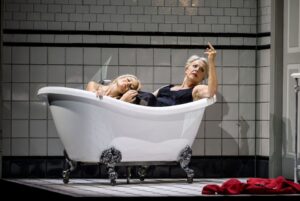
The director, Sláva Daubnerová, supported by scenographer Boris Kudlička, costume designer Chrisi Kavronides-Dushenko, and lighting designer Tom Visser, along with Bartek Macias’s videos of Melancholia, presented each Act with its own distinct aesthetic. Act one, set during the wedding reception, was presented in a realistic manner. The stage was divided into two levels joined by a central staircase with rooms to either side. When a scene took place in a certain room, such as the bathroom, the room would be propelled to the front of the stage. Apart from occasional images of Melancholia projected onto a transparent curtain, it was a functional set without much to note, but it served its purpose. It allowed for large gatherings and dance scenes with plenty of movement yet also ensured that the characters could find more intimate spaces, away from the gathering when necessary, and thus ensured the narrative was clearly conveyed.
Act two moved to an outside location. The stage was reset to suggest a garden or a large open green space. A few relevant objects, such as a telescope, were positioned randomly. Halfway through the Act, a screen in the middle of the stage parted to reveal John’s hanging body. Melancholia appeared far more frequently than in the first Act. It also took on a more menacing aspect, forcing everyone, including the audience, to face their mortality.
The ending, in which Melancholia and the Earth collide, had to be the musical and visual climax of the opera; anything else would have been a theatrical disaster. And it was suitably spectacular! Justine, Claire, and Leo stood on an empty platform that rose from the floor of an empty stage. A black circle span with increasing speed as it increased in size in front of them. Electronic vibrations pounded through the theater while the sound of a chanting chorus against the background of primeval sounding drums increased in intensity. Justine and Leo clenched each other’s hands, and Claire stood transfixed. The jet black circle finally engulfed the three of them, and the music came to an abrupt halt as they disappeared into the abyss.
“Melancholia” is a thoroughly disturbing yet gripping piece of theater. Although I must admit to having doubts before the show as to whether it would stand in comparison to the film, it did so admirably. True, it was unable to match the philosophical depth or the visual symbolism of the film, but through its music it was able to accentuate the psychological and emotional states of the characters in a way that words alone cannot express. It was the same narrative from the same perspective but presented through a different medium and successfully opened up as much as it lost.