Royal Ballet and Opera 2025-26 Review: Rigoletto
By Mike Hardy(Credit: ©2026 Marc Brenner)
“There’s a storm brewing…it’s going to get darker,” observes assassin Sparafucile. How right he is! Moments later, he’s stuffing the pure and innocent, murdered Gilda into a body bag downstairs while his sister is gyrating on top of the dastardly Duke of Mantua upstairs; pretty much as dark as it gets.
‘Manosphere’ and ‘Toxic Masculinity’ are the buzzwords of the moment, and there’s plenty of material in Oliver Mear’s production of Verdi’s “Rigoletto” at the Royal Ballet and Opera to fuel plenty of deliberation and discourse for those who like to opine on such themes.
Production Details
Chauvinism, female exploitation, kidnapping girls from their bed for fun, abusive power, misogyny, dishonor, oppressive paternity, vengeful torture, not to mention the bullying and social exclusion of the physically deformed…all get a turn in this cornucopia of social ills that go into what is widely considered to be a pivotal masterpiece in Giuseppe Verdi’s “middle period.”
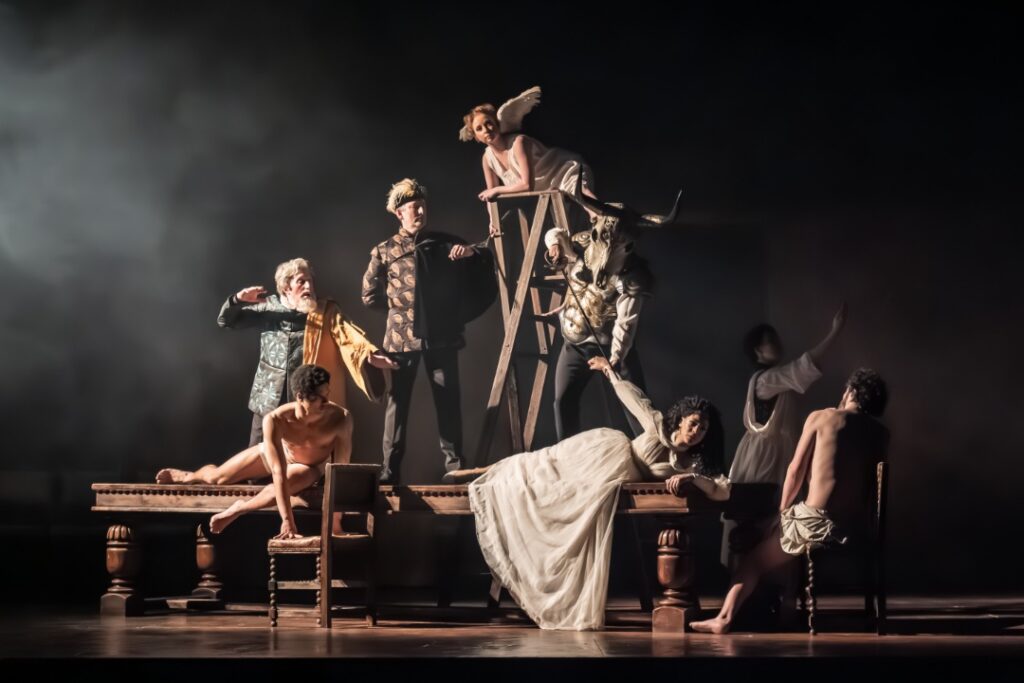
Verdi’s foreboding-laden overture is suitably premonitory as the curtain rises on the most effective and superbly contorted performers in a convincing statuesque tableau. In fact, Simon Lima Holdsworth’s sets, together with Fabiana Piccioli’s lighting designs create some of the most effective and impactive visuals I’ve seen at Covent Garden.
Huge, pseudo-erotic, Rubenesque type projected murals adorn the walls of the duke’s residence in Acts one and three, illustrating his salacious propensity for exotic ‘art’ collecting, further emphasized when we see him leafing through some semi pornographic prints. A dark, dried-blood red ochre expansive building façade with an upstairs large square window with net curtains for Gilda’s bedroom depicts the residence of the titular, hunch-backed character in the second scene of Act one, and the third and final act displays the home-cum-tavern-cum-brothel of Sparafucile and his sister, Maddalena, against an astonishingly striking backdrop of oppressive, moving clouds. All very, very dark indeed.
(Credit: ©2026 Marc Brenner)
Stellar Cast
Alas, there is much LIGHT in the form of a quite magnificent and vocally resplendent cast which brings much needed beauty to such an ugly world. Rigoletto is widely considered the most demanding baritone role in the Italian repertoire. Verdi shifted the baritone tessitura higher for this role, requiring the singer to test the limits of his range at a sustained level.
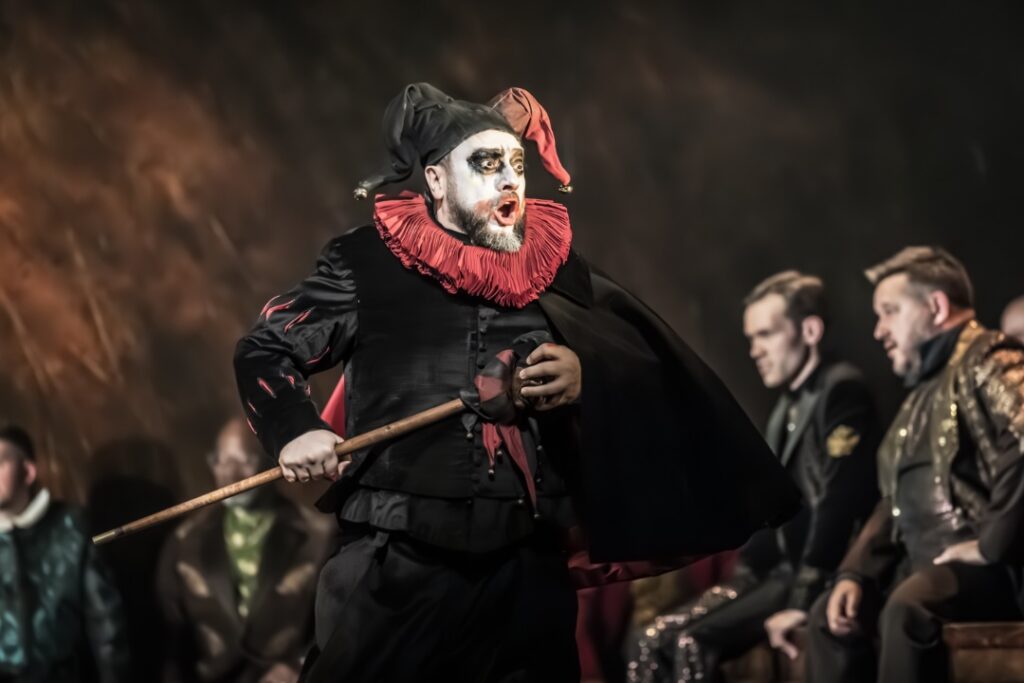
I found Romanian baritone George Petean MORE than up to the task and to be utterly mesmerising, vocally replete and remarkably gifted in his acting ability. Operawire previously reviewed him in the role of Germont in “La Traviata” where he impressed the audience when he took a ‘B flat’ at the cessation of his aria at the end of Act two, but this was on a whole other level. Visibly encumbered by virtue of his prosthetic hunch-back, he nonetheless cut a hugely imposing figure, such was the authenticity and conviction inherent in his acting. By turn, browbeaten, then stoic, then flashing a hint of menace and malevolence, before frequently being in despair; he amply conveyed all by both his demeanor and physicality, and by virtue of his rich, colorful, enveloping baritone voice.
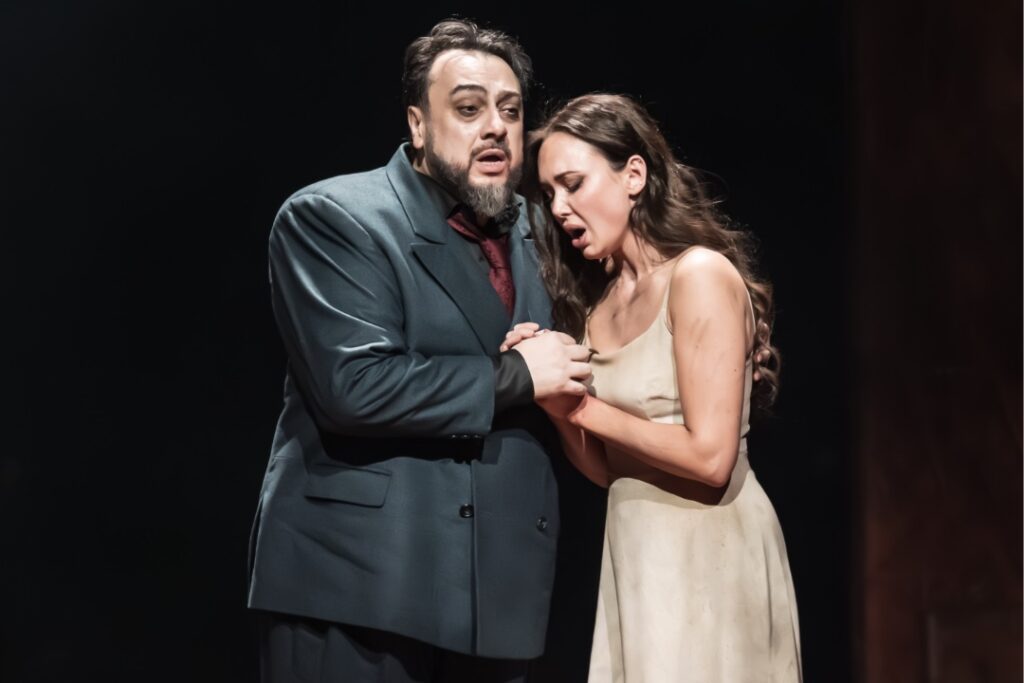
His “Pari siamo!” from Act one was bitingly sardonic where he considers his misfortunes. His “Cortigiani, vil razza dannata” where he, by turn, was enraged and threatening, finally resorting to pitiful pleading for the return of his daughter, was hugely emotive. But for me, his finest and most impactful work was when with his daughter, Gilda, most notably “Piangi, piangi, fanciulla.” Beautifully rendered with a soft, rich timbre, I found this to be the most spellbinding and emotionally laden part of the performance.
(Credit: ©2026 Marc Brenner)
Curiously, his Gilda, performed by Aida Garifullina, also shared the stage with Petean in the above-mentioned “La Traviata” review. In an interview with Garifullina at that time I asked her what dream role she aspired to sing, she responded: “To be honest, I’m singing it at the moment…‘Traviata’ is my favorite opera.”
She started proficiently, albeit it marginally subdued, interacting with her father, Rigoletto, in the first act “Oh quanto dolor! che spremere sì amaro pianto può?” with almost child-like innocence. But she just got better and better as the evening progressed.
Her aria, the signature “Caro nome” was divine, sung with an almost ethereal quality. Her final notes, while reclining on her bed; a heady mix of trills and elaborate coloratura combined with incredible breath control evoked the warmest applause from the audience.
Conversely, her finest work was when with her Rigoletto, “Tutte le feste al tempio,” confessing to her father her involvement with the duke and her subsequent dishonoring. She sings with an exquisite, wide-ranging palette, infused with creamy tones, in addition to being a sublime actress who manages to convince while seemingly conveying little. I consider her to be one of the leading sopranos of her generation with a truly enchanting voice and persona, and I would love to see her take on more roles.
(Credit: ©2026 Marc Brenner)
Iván Ayón-Rivas as the Duke
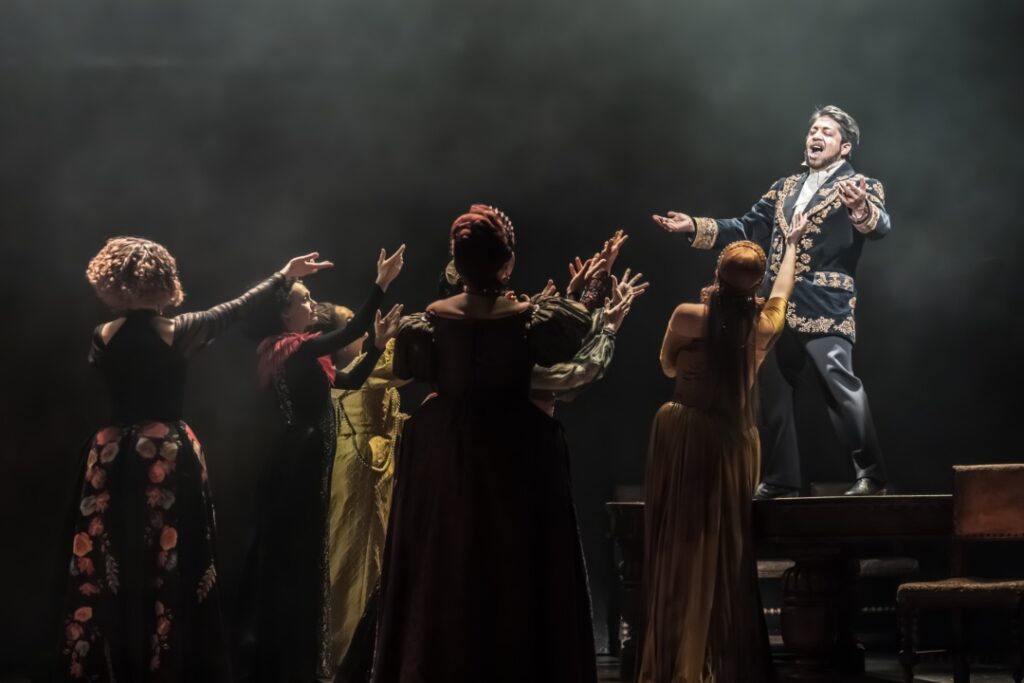
The homme fatale, so to speak, the Duke of Mantua is performed by Peruvian tenor Iván Ayón-Rivas for his Royal Opera debut. He strutted around the stage with palpable confidence and licentiousness. But then, this is a part he has sung many times and is considered one of his signature roles. His “Questa o quella,” where he asserts his unchivalrous approach towards women was accomplished, if somewhat measured and restrained.
It’s often opined that a significant number of an opera houses’ patrons go to see “Turandot” predominantly for “Nessun Dorma,” and I’m equally sure that many go to see “Rigoletto” for “La donna è mobile.” Ayón-Rivas opted to sing the aria in a considered, introspective manner from the corner of the stage, adopting a contemplative manner, rather than in the traditional, ebullient, vainglorious form and, it was all the more impactful because of it. He produced a very resonant and powerful final “pensier!” at the aria’s cessation, much to the delight of the appreciative audience.
Despite the duke’s obvious, unpalatable character, Ayón-Rivas managed to infuse the role with an element of endearing charm, and his “Parmi veder le lagrime” in Act two, where he expresses sentiment towards his missing conquest, Gilda, was genuinely moving; surprisingly so, given the circumstances. Likewise, despite the obvious betrayal of Gilda in his seduction of Maddalena, his “Bella figlia dell’amore” was sensational. He sang with a beautifully expressive timbre and had a bright, polished gleaming top. He has accrued extensive experience over a diverse array of roles and is unquestionably an exciting talent. I look forward to reviewing his future performances.
(Credit: ©2026 Marc Brenner)
More Illuminating Cast
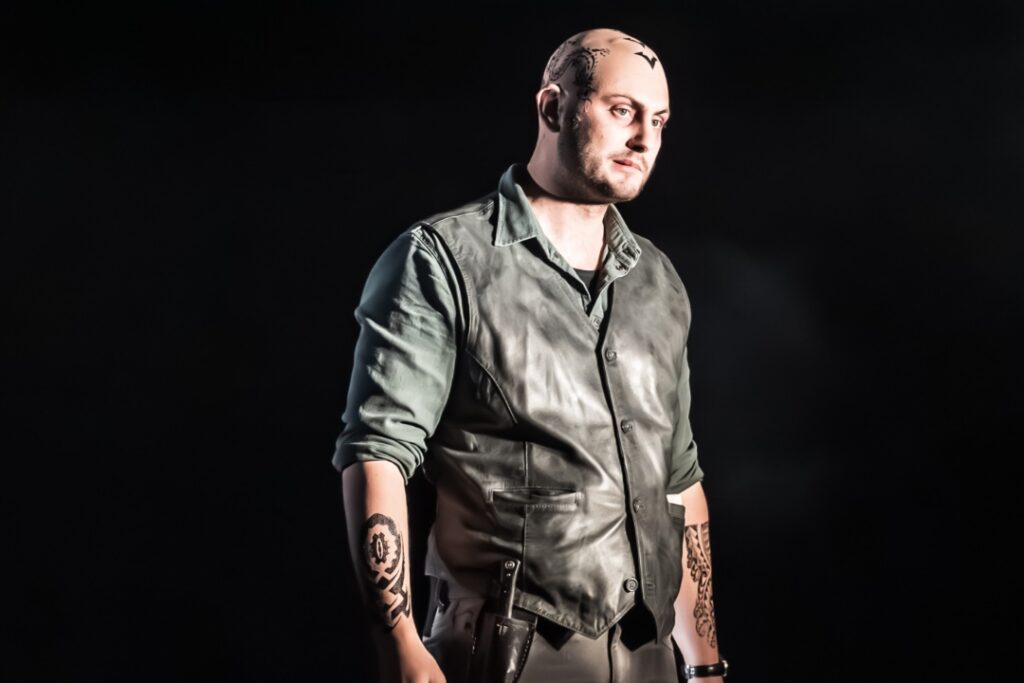
British bass William Thomas plays the part of assassin and part seedy tavern owner Sparafucile. Tall in stature, he moves with suitable brooding menace and exudes gangster vibes in abundance. His instrument is mellow, well-rounded and pleasingly supple and he is wholly convincing as a rather macabre looking pedlar of sex and death.
Playing his sister, in the role of Maddalena, was Anne Marie Stanley who played no small role in saving the nescient Duke. She positively smoldered with rich, husky tones, particularly in the lower register.
Blaise Malaba as the nobleman Monterone, whose curse upon Rigoletto and the Duke set in motion the subsequent tragic events, had great stage presence. He possessed a full, enveloping base instrument. I would love to see him in more substantial roles.
Special mention must go to Jette Parker artist, Jingwen Cai in the role of Giovanna, Rigoletto’s housekeeper and guardian to Gilda. I have heard her sing several times now, each time leaving me wanting to hear her sing more. This occasion was no exception. She possessed a pulsating and positively vibrant mezzo-soprano voice of inarguable beauty. She matched, if not outshone Gilda in their brief interactions in the second act where they discussed the duke.
(Credit: ©2026 Marc Brenner)
Creative Moments
Ilona Karas opted for a wide variety of costumes. The opening act had the artists in a range of costumes, some from periods past, some more contemporary and flamboyant, others hinting at the late 20th century but many having a curious mafiosi flavor, something made more convincing by the demeanor and gaits of the assembled cast. Even Rigoletto himself looked like a Mafia Don in his suit.
But, stage creativity-wise, the biggest plaudits here have to be reserved for Italian lighting designer Fabiana Piccioli. Not only for her skillfull deployment of highlighting spots and eerie, atmospheric fills, but the final act’s thunderstorm. It was depicted by forked and sheet lightning flashes that maybe should have carried an epileptic trigger warning, as they illuminated and crackled with such violence and intensity, accompanied by floods of teeming rain falling on the stage. This was one of the most arresting visual moments I have ever witnessed in an opera house.
It goes without saying that the Royal Opera Chorus was exceptional, both vocally and in their orchestrated movements; sometimes creepy, often providing a much-needed flash of comic relief, courtesy of some clever creation by movement director Anna Morrissey.
Conductor Sir Mark Elder is currently celebrating 50 years with Royal Opera, fittingly enough, where his first appearance in the Covent Garden pit was his command of “Rigoletto” in 1976. He skillfully guided his orchestra, seemingly effortlessly, and elicited some exquisite music from them, most notably from the woodwind section. More saliently, his control was such that at no point did the orchestra overpower the artists on stage.
Written in 1851, Verdi said, “[‘Rigoletto’] is my best opera. I conceived ‘Rigoletto’ without arias, without finales, as an unbroken chain of duets. It is the best, the most effective subject I have so far set to music…It has very powerful situations, variety, brio, pathos.”
To which I might add that while it may prove an uncomfortable watch for some, it serves as a suitable commentary on modern day life–absolute power and corruption leads to tragic consequences and privileged individuals like the Duke of Mantua abuse their power without consequences, leaving the Rigolettos of this world to suffer. As is so viscerally illustrated at the end of the opera, when the duke moves on to his new conquests, reiterating his “La donna è mobile,” Rigoletto gets left behind, cradling his dead daughter in his arms.