Review: Salon Music’s ‘8 Romances for Tenor & Orchestra’
By Bob DieschburgNew Yorkers might remember tenor Petr Nekoranec from his participation in the Met’s Summer Recital Series. That was in 2017, when he performed repertoire staples (think “La donna è mobile”) across all five boroughs—just a few months before making his proper house debut in “Cendrillon.” Since then, his career has largely evolved overseas, and U.S. audiences must rely on his discographic output to fully apprehend the sfumature of his wonderfully cultured instrument.
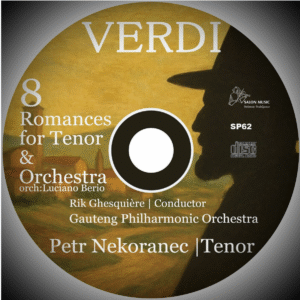
Nekoranec’s first album, “French Arias,” was released in 2019; amid the tenor’s “cornucopia of technical abilities,” OperaWire praised his “commitment to the elegiac lyricism of French Romantic opera.” Now, in his second solo recital, he turns his attention to Verdi’s rather neglected “Romanze,”orchestrated—ex post—by Luciano Berio.
“Eight Romances for Tenor & Orchestra” is indeed a hybrid. While the songs retain the melodic profile and structural outlines of Verdi’s original compositions for voice and piano, they appear filtered through Berio’s aesthetic of aural memory, which deploys musical effects that are not extraneous to their tonal identity per se but add a subtle modernist inflection.
In “L’Esule,” for example, Berio introduces high strings in sustained harmonies explicitly reminiscent of “Lohengrin.” The effect left me quite staggered at first, given that “L’Esule” was originally composed in 1839—a decade before Wagner wrote his Romantic masterpiece.
Similarly, Berio transforms Verdi’s “Brindisi” (neither from “La Traviata” nor “Otello” or “Macbeth”) into a slightly ironic showpiece, imbued with a distinctly modern sense of self-awareness. Irony—or perhaps more precisely, restraint—also pervades the other six romances, notably “Il poveretto” and “In solitaria stanza.” Based—through the intermediary of Andrea Maffei—on Goethe’s “Betrachtet, wie in Abendsonne-Glut” (from “Faust”), “Il tramonto” is the most expansive track in terms of orchestration, though its translucent harmonies firmly anchor it within Berio’s soundscape of expressive restraint.
The program is conducted by Rik Ghesquière at the helm of the Gauteng Philharmonic Orchestra. The ensemble’s transparency—particularly in the strings—is perfectly unassuming. If anything, it evokes Berio’s mnemonic ideal, in which a contemporary idiom overlaps with Verdi’s early and stylistically conservative “Romanze.”
And what of Nekoranec himself? His timbre is honeyed as ever: shaded, even chiaroscural, yet entirely even across the registers.
The songs require sustained mezzo-piano singing, which Nekoranec achieves with considerable ease. The voice also proves elastic in the rather exposed acuti of, for instance, “Il Poveretto” and “L’Esule.” These are short vocal plateaus rather than markers of heroic tessitura—but Nekoranec negotiates them with considerable assurance.
My only (tentative) reservation is that Berio’s call for restraint may at times efface some of Nekoranec’s personality. He phrases carefully—politely, even—and in circular pieces such as “In solitaria stanza” this results in a certain uniformity, where one might have expected greater incisiveness or contrast. Still, Nekoranec offers a remarkably polished rendition throughout, and it would be unfair to press this criticism too far.
One final caveat: the sound quality is somewhat subpar, with the voice in particular lacking definition. Better acoustics would surely have done greater justice to the artistry of the musicians in this Verdi/Berio rarity. Released on the Salon Music label, “Eight Romances for Tenor & Orchestra” is currently available for online listening; a CD pressing does not appear to exist.