Q & A: Soprano Larissa Rosanoff, From Financial Analyst to World Traveler to Opera Singer
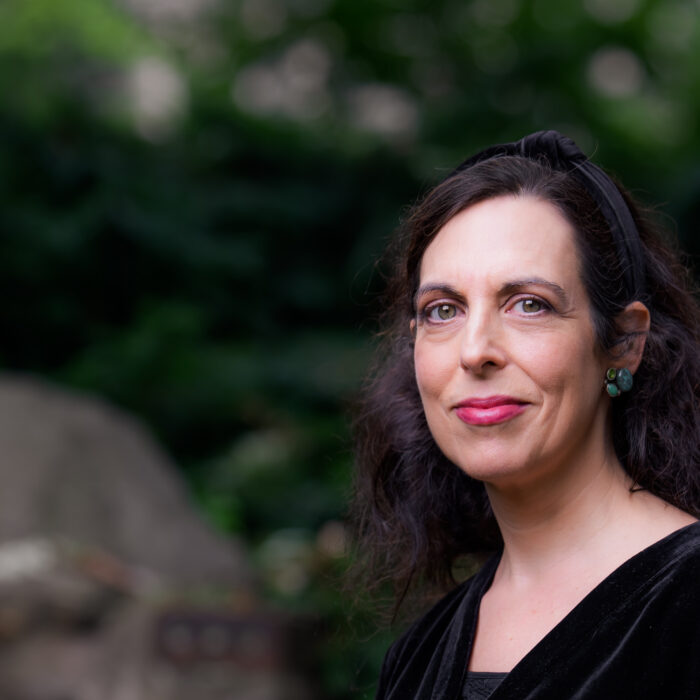
By Nancy Spada(Photo: Philippe Palma)
Larissa Rosanoff spent seven years in Moscow studying piano at the Gnesin Academy of Music where she began, at the young age of five, her voyage in music. There she acquired the necessary base for continuing professional studies in Switzerland. The memories of having performed in such prestigious venues as the Tchaikovsky Hall or the Grande Hall of the Moscow Conservatory have remained with her as she says, “The musical education I received in Moscow between the ages of five and twelve is firmly anchored in my veins.” But she resolutely believes that it is French-speaking Switzerland that made her a professional musician today.
She studied at the Lausanne Conservatory simultaneously with her University studies and then continued to her beloved Haute École de Musique in Geneva. Her university studies in finance initially superseded her musical aspirations. But, not for long, only until her music teachers pushed her toward a professional path.
With the Radio Suisse Romande at the Studio Ansermet in Geneva, she recorded works that were particularly close to her heart, including Shostakovich’s famous Opus 127 ‘Seven Songs on Poems by Alexander Blok.’ A second recording was dedicated to the ‘Melodies and Airs’ by Sviridov, Rimsky-Korsakov, Letouchkov, Britten, Rachmaninov, Dargomijsky, and Glinka.
On the stage, she has interpreted the roles of Musetta in “La bohème,” Clorinda in “La Cenerentola,” both Pamina and Papagena in “Zauberflöte,” Sophie in “Werther,” Fiordiligi in “Così fan tutte,” Micaela in “Carmen,” Stéphano in “Roméo et Juliette,” Virtù in “L’incoronazione di Poppea,” Frasquita in “Carmen,” Annina in “La traviata,” Donna Elvira in “Don Giovanni,” Fiorella in “Les Brigands,” and Tatyana in “Eugene Onegin,” among many others.
Along with her opera career, Larissa loves to create special projects with friends and colleagues from both the Conservatory and the opera world. With the baritone Sacha Michon she created the “Transsibirskaia” show presented at the Les Salons Theater in Geneva for the Cercle Romand Richard Wagner, where she performed roles from “The Snowmaiden” by Rimsky-Korsakov, “Ruslan and Lyudmila” by Glinka, and “Prince Igor” by Borodin. Larissa, together with pianist Irina Shkurindina and soprano Alida Barbasini, created a show called “Les Napolitaines” around classical and traditional Neapolitan songs and arias by Rossini, Donizetti, Tosti, Denza, and Cardillo. It has been very popular, garnering much success among the public and with critics with over fifty shows in Switzerland and France to date.
Among her travels during her sabbatical year, Larissa visited thirty-six countries which included some trekking and singing in Australia.
OperaWire: You were born in Moscow and entered the Gnesin Russian Academy of Music to study piano at the age of five. At that time, do you recall being particularly adamant about studying music?
Larissa Rosanoff: I was born in Moscow, but had lived in Switzerland from the age of one to five and started regular school here, so my first language was French. I recall listening to classical music, mostly Mozart, as soon as I understood how the LP player worked. I was probably three or four years old, and I wanted to be a classical dancer. I began studying music while waiting for the ballet school entrance exams because I wanted to play all of the ballet music on the piano. I also kind of forced my parents to let me go to the music school, as they didn’t want me to pursue a career in either ballet or music.
OW: At what age did you leave Moscow and where did you go from there?
LR: I lived in Moscow in between our trips to Switzerland. My dad had regular contracts with the European Organization for Nuclear Research so we kept going back and forth. The only time I lived continuously in Moscow was from five to twelve. During this period I studied music quite intensively and also attended, with my mother, every possible concert, ballet, and opera performance in town. I met some fabulous teachers and listened to incredible musicians during these years. This is why I’m saying that my basics in music come from this particular period as it most likely is for every child.
OW: Where do you live now?
LR: From the age of twelve I have lived in Geneva, Switzerland but with quite a bit of traveling both for work and leisure.
OW: How many languages do you speak?
LR: About six. But fluently, French, English, Russian and Italian plus some Spanish and German when I go to those countries. I do, however, sing in any language as we had three years of phonetics courses at the Conservatory, so I already sang in Czech, Hungarian, Japanese, Latvian, and even in Swahili.
OW: Are there any musicians in your family?
LR: My Grandfather was an opera singer so when I decided to become a professional, he really spent a lot of time with me and gave me precious advice. His voice is always with me when I rehearse or perform.
OW: Your father is a physicist. Could you give some insight into how it was to grow up with a father in that profession?
LR: Dad is a great physicist; he was part of the Higgs boson discovery team. He still works at the European Organization for Nuclear Research (CERN) and will probably never retire. Physics are his passion. When I was small he was working almost seven days a week so I spent most of my time with my mother. But he does love sports and history, so he put me on skis in Zermatt when I was three and we took some long hikes when I was around six. We traveled, as well, to visit many museums and historical buildings. Today my love for sports, travel and history is probably his legacy. Scientists and musicians are quite close in the sense that both work like crazy and working hours do not exist in our professions.
OW: Your university studies were related to finance but did you study singing simultaneously?
LR: When I was sixteen, I had already seriously considered entering the Conservatory, but it was a clear “no way” from my parents who thought it was best to do another university diploma first. So I looked through the subjects. Economy was a three year diploma and I could be free afterwards. So I completed my first university degree when I was nineteen and entered the Conservatory in Lausanne that same year. Six years later I completed my voice degree in Lausanne and that’s when my teachers told me I had to make a professional choice and become more serious about music. I did the admission exams at La Haute école de musique de Genève, was accepted, and switched to music.
OW: Why did you begin your working career as a financial analyst instead of choosing the world of opera right away?
LR: I was only 19 when I graduated in finance from the University of Geneva and my voice had to be built. It was not ready for a professional opera career. So I entered the Conservatory of Lausanne and used my university diploma to finance my musical studies. I was at the Conservatory almost every evening and had time to build my voice at a steady pace instead of rushing it. I was in a real hurry but my teacher always restrained me forcing me to sing a lot of baroque and sacred repertoire. Today I am deeply thankful to her as opera came as quickly as a hurricane when my voice was ready for it.
OW: When did you realize or decide which of your interests, music or finance, would become your profession?
LR: It just became obvious when I became technically ready as a singer, and when my teachers had decided so. Once I got my teachers’ approval, the rest followed naturally. You really can’t pursue both careers at a highly professional level and, to be totally honest, finance was becoming boring! Music was a challenge. I had the impression that I had mostly seen it all in the financial analysis field.
OW: How did you know you wanted to become an opera singer or who or what inspired you to enter into this career?
LR: I didn’t know. First, I wanted to be a classical dancer but then I studied piano because I loved classical music. One day a friend of mine showed me a guitar and while learning guitar I began to sing. I entered an a cappella choir as a teenager and the choir director was an opera singer. I deeply admired his beautiful powerful bass voice and he was a great director too. He probably inspired me the most. I had natural ease with high notes, but the classical technique itself had to be developed so I began that long and tedious work out of love for music without any further plans.
OW: How do you manage the stress and maybe even performance anxiety of singing in front of an audience?
LR: I am lucky to have what in sports is called eustres; positive stress that enhances your performance. Through the years I’ve also noticed that having no stress is much worse as you lose your focus, and that’s exactly when you forget the text.
OW: Was working as a financial analyst more stressful or perhaps less so than singing opera?
LR: Stress in finance comes either from your superiors, your clients, the misperformance of your analysis, or your portfolio. Stress in opera comes either from your director, the audience, or a mistake in the musical text so it can be in some way similar. Opera singing is all about presenting your work to a large public, which is rarely the case for financial analysts although it can happen, so music is probably closer to sports.
OW: Did you find it difficult to change?
LR: No, it was obvious.
OW: What, if anything, did your family think about you taking up singing as a profession?
LR: They rightly considered it a difficult life choice. Finance was the easy one but I never liked easy paths.
OW: Do you sing because you love this art form and you can’t imagine yourself doing anything else?
LR: I love music in general. I also love acting and dancing so opera has it all. For me sitting at the piano for eight hours a day was far more difficult. I needed to move so in this sense opera suits me perfectly. I have a lot of skills, and I certainly won’t be singing till my 70’s, or maybe I will together with other retirement home residents! Today, apart from my career, I’m helping my fabulous accompanist Irina Shkurindina with her festival to promote young musicians, and I am also involved with other musical associations and foundations to help out others and promote music. I don’t see my future without this fundamental work, and here all my musical, language, and financial skills are very useful.
OW: Did you have any teacher who particularly inspired you or that you feel guided you in the right direction?
LR: I am deeply thankful to all my teachers but in particular to my singing teachers Erika Bill Geiger, Maria Diaconu, and Valentin Chaplin. I am also grateful to all my Conservatory teachers of music history, solfège, piano, harmony, sight reading, contemporary music, chamber music, and so forth. Without these subjects one can’t be an accomplished musician. I love learning, so I learned as much as I could from every teacher.
OW: What was your very first opera role?
LR: Virtù in “L’incoronazione di Poppea” by Monteverdi.
OW: Which of the roles, if any, that you have performed so far is most similar to you, and why?
LR: Musetta in “La bohème” by Puccini. She is joyful and generous.
OW: Do you have a role that you would particularly like to perform that you have not yet done?
LR: Juliette in “Roméo et Juliette” by Gounod. I sang all arias and duets in concerts and I performed Stéphano in this opera too, but never even auditioned for Juliette.
OW: Which role of your extensive repertoire is your favorite?
LR: I like Manon a lot. She is a complex character. I like all of the “Zauberflӧte” girls: Pamina, Papagena, and First Lady. By now I’ve sung all of them. I really enjoyed singing Fiorella in “Les brigands” by Offenbach which was a lot of fun but “La bohème” remains my favorite opera.
OW: How do you approach a role?
LR: One thing I never do is to listen or watch other interpretations! I always want to find my own character. I want it to be unique. So I usually begin reading through the text, the story, and then my part, reading the text in rhythm. Once you get the rhythm and the text, the music is usually the easy part. Then you go through the role with your coach and the director to understand the musical intentions. Somewhere during this process, you learn the part by heart hopefully one or two months before the rehearsals. But it happened once that I had to learn a whole role by heart in 72 hours! Then you work on the character with the stage director, his assistant, by yourself, and with your partners.
OW: You also have many other interests. For example, how did you get started as a Producer?
LR: I feel the need to create my own projects with people I highly appreciate. I like original projects that mix music, theater, various languages, or other arts. I always have new ideas and thus needed a producing structure to present these projects.
OW: What inspired you to create and produce “Transsibirskaia?”
LR: “Transsibirskaia” was a request from the Richard Wagner Circle. It’s an imaginary journey across 19th century Russian music undertaken at full steam on a train where in the end an actor even ventures to stage the impossible reconciliation between a Cossack woman and her drunken husband. It’s quite an old project now that we performed many times between 2014 and 2019. But since then we’ve produced five other projects, including ‘Music in Swiss Poetry’ in four languages including Romansh, ‘Pouchkine in Music’ which is the story of the great poet told through words and music, ‘Les Napolitaines’ around traditional Neapolitan music that influenced classical Italian opera composers such a Rossini and Donizetti, ‘Musique française’ a show around French known and lesser known duets for soprano, mezzo and violin with our own arrangements, and ‘Gubaidulina/Shostakovitch’ in homage to the recently deceased composer who was a student of Shostakovich. We have also produced a theater piece in French based on the Markowicz translation of ‘Pouchkine,’ called ‘Fragments pour Oneguine.’ It was created in Geneva and received marvelous critical acclaim.
OW: Could you elaborate on your sabbatical world tour during which you visited thirty-six countries?
LR: That would be a long story, but in few words, it was my husband’s idea to travel the world as backpackers, and it was probably the best thing I’ve ever done to change my perceptions, open my mind, learn new languages, step into the unknown, get out of my comfort zone and leave material thinking behind. I came back as a completely changed person and I am deeply thankful for that experience.
OW: Why did you decide to take up such a seemingly overwhelming enterprise?
LR: I was the follower!
OW: When you took a sabbatical from singing did you notice any changes in your voice when you returned?
LR: Of course. I missed a whole year of study so I had to catch up but I did sing almost everywhere we went in Australia and won a local competition along the way!
OW: Quite recently you decided to climb to the summit of Mount Kilimandjaro. How did that turn out?
LR: Together with my guides, I arrived at the top of Mount Kilimandjaro where I sang some opera with the team at the summit and it looks like I’ve beaten the Guinness World Records of the highest altitude opera singing ever. I honestly didn’t think about it at all when climbing the mountain!
OW: Your plans for future performances?
LR: Among my immediate 2025 projects are the Rachmaninov recital at the festival ‘Les Schubertiades’ with the Swiss Radio and Television and the recording of the works of one of the great 20th century composers Sofia Gubaidulina with the Ukrainian violinist Oleg Kaskiv, Swiss cellist David Pia, and pianists Irina Shkurindina and Aleksandr Shaikin. Then I will work on the festival ‘Les primeurs musicales’ helping out with young artists. Right after, I have all of the Christmas concerts, including the traditional Victoria Hall Christmas Concert in Geneva and then a new production of “Eugene Oneguine” singing Tatyana Larina, followed by “Carmen” singing Frasquita. So that’s quite a busy year. We are already scheduling 2026.
Categories
Interviews