Pinchgut Opera 2025 Review: Messiah
By Gordon Williams(Photo credit: Anna Kucera)
In his notes on the work, Erin Helyard, conductor of Pinchgut Opera’s recent “Messiah,” states that there are “about 10 identifiably different versions of ‘Messiah’ that Händel appears to have approved, developed, or tolerated following its composition in 1741.”
“Why perform the first version,” he asked, posing a question by which to judge this, Pinchgut’s final offering for 2025, at Sydney’s City Recital Hall, Angel Place.
Of Helyard’s two answers, the first to do with the immense scholarship that has taken place in recent years, it was the second that provided a tangible frame to assess this performance. It had to do with the size of Händel’s orchestral and vocal resources in Dublin where the work was premiered in 1742. It was, said Helyard, “much smaller and arguably more fleet” than later versions.
Many listeners have probably heard the massive versions that might better suit a larger auditorium, including some post-dating any possibility of the Baroque Era Händel’s approval. As Helyard maintains in his essay: “The freshness and vitality of the 1742 Dublin version thus presents a welcome contrast to the more dramatic and heavier large-scale versions of ‘Messiah’ that audiences routinely hear in Australia.”
Performance Highlights
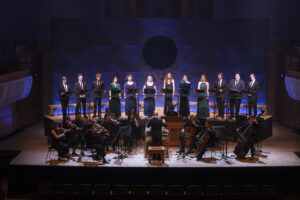
On Thursday, November 27, Pinchgut supplied modest forces for this end of year offering, including an orchestral ensemble of 17, mostly strings and continuo, and 12 singers, featuring three of each voice type, soprano, mezzo-soprano, tenor and bass. The size of ensemble encouraged close listening and rewarded the listener with a sharper elucidation of meaning. “Freshness and vitality” indeed!
Such modest forces guaranteed greater precision and clarity, a more effective carriage of the specific details of the words and therefore of the work’s message of Redemption, as the audience remained intellectually engaged rather than swamped by the monolithic jubilation we might experience from “more dramatic and heavier” versions of this Christmas classic.
There was a sense of tight ensemble in this version, even unanimity and urgency in messaging. Tenor Jacob Lawrence’s opening numbers, the recitative “Comfort ye” and air “Ev’ry valley shall be exalted,” were exceptionally clear. In close-matching of verbal clarity and dynamics it felt very apparent that Lawrence was addressing the audience with words of real consolation: the recitative preluding a message of faith affirmed by Lawrence’s sturdy delivery of “saith your God.”
Many of the familiar and larger-scale “Messiah’s” have featured only four soloists. Helyard made up for the small size of his forces by selecting his 11 soloists from the vocal ensemble, varying the color from within.
Overall, additional meaning was conveyed by fantastic vocal casting, decisions aided by Helyard’s study in London of the wordbook for the original performance in which some anonymous listener had scribbled the names of Handel’s singers against the various numbers. In Pinchgut’s production, this bore fruit in illustrative contrasts such as the as-direct-as-speech edge of Edward Grint’s bass in “Thus saith the Lord” and “But who may abide the day of His coming?” heard in reasonably close proximity to the darker hue of Andrew O’Connor’s more introspective bass selected to sing “For behold, darkness shall cover the earth…”
Nearly all members of the small 12-voice chorus took turns at singing solos, with mezzo-soprano Ashlyn Tymms assigned the solos originally sung by Susannah Cibber in the very first performance in 1742. Helyard divided the roles originally taken by ‘Mrs. Maclean’ between soprano Miriam Allan for Parts one and three and soprano Myriam Arbouz for Part two. Mezzo-soprano Olivia Payne was featured at the end, as if to emphasize perhaps a concluding sense of victory over death and its “sting,” as asserted in the final duet which bears that word. Payne joined with tenor Sebastian Maclaine, another voice held in reserve for this special moment.
More Musical Details
The ranging of the chorus across the back of the orchestra provided opportunity for delightful antiphonal effects, as when the various voice-types reported to each other in “And He shall purify the sons of Levi…” – an oral analog of widespread acclamation.
So many of Helyard’s artistic decisions and details also contributed to increased vividness of the score. Drama was created by tempo setting, such as an almost-galloping pace for “He gave His back to the smiters.” At other times, the promptness of segues and tempo changes heightened the drama of key changes. Particularly dramatic was the articulation of the chorus “Surely, He hath borne our griefs…,” where the short 32nd note was almost elided in such a way as to make the word ‘surely’ two accented and aspirated syllables, rendering its effect as one of demand, if not pugnacious challenge.
The timpani and trumpets used sparingly in a few choruses, such as “Hallelujah,” and the bass number, “The trumpet shall sound…,” felt constrained against their more festive natures. They offered something more along the lines of subtle if apt underlining, where the traditional listener might have expected them to “let rip.” But the smaller, more intimate scale of forces occasionally allowed more acute, pleasing gesture, such as Orchestra of the Antipodes leader Matthew Greco’s manipulation of dissonance in exquisite cadences.
Some interpretational choices might have surprised, such as a seemingly-languorous, less emphatic beat for “The trumpet shall sound,” but there were other delights such as the burred effect that made the Pastoral Symphony sound so much more than usually rustic and evocative of a Nativity scene.
Pinchgut usually presents a staged opera, but Damien Cooper’s lighting enhanced the stage-worthiness of the evening from the very beginning with Jacob Lawrence emerging from the mist. This performance was intellectually engaging with some of the magic of theater–a production that rewarded Helyard’s deep study.