Orchestra I Pomeriggi Musicali 2025-26 Review: Marina
By Bernardo Gaitan(Photo: Lorenza Daverio)
How is it possible that, until five years ago, nothing was known about Italian composer Umberto Giordano’s first work? This is the question that inevitably arises upon learning about the program that prompted this article. The answer seems simple if one considers that it was Giordano himself who chose to withdraw it from public life, as it represented not only an exercise from his formative years but also the memory of an apparent early-career failure.
In 1888, the famous Sonzogno Composition Contest took place, a competition devoted to one-act operas that would ultimately mark a turning point in the history of Italian melodrama. The outcome is well known: first prize went to “Cavalleria rusticana” by Pietro Mascagni. Among the 73 candidates submitted that year, “Marina,” by the young Umberto Giordano, stood out. He composed it at just 20 years of age, making him the youngest participant. The result, however, was not what he had hoped for: he placed sixth and, as a consequence, put the score away in a drawer, forgetting it for the rest of his life. There is no mention of “Marina” in his correspondence, nor any evidence of attempts to stage, orchestrate, or publish it. It was never performed, and parts of its music were later reused by the composer himself, which contributed to the work disappearing from the repertoire and, over time, being considered lost or, at best, a youthful exercise without theatrical future. Despite not receiving a prize, the composition attracted the attention of the publisher Edoardo Sonzogno, who recognized Giordano’s promising talent and immediately incorporated him into his catalog. The direct result of this editorial interest was the commission of a new opera: “Mala vita,” the work that would mark the composer’s true stage debut and his early association with the verismo movement. In that process, “Marina” was officially set aside.
The situation changed radically in recent years when the autographed score of “Marina” was located in the Beinecke Rare Book and Manuscript Library at Yale University, within the Koch Collection. Following this discovery, composer and conductor Andreas Gies, together with musicologist and librettist Emanuele d’Angelo, undertook a rigorous reconstruction and critical edition that restored not only the music but also the sung text and stage directions, despite the absence of a preserved original libretto. As the saying goes, “better late than never,” and thus, 138 years later, “Marina” finally reached the stage. Its first complete performance took place on February 12 at the Teatro Dal Verme in Milan, within the 81st concert season of Orchestra I Pomeriggi Musicali. The work was presented in concert version and recorded by the Decca label. The venue of the premiere is no coincidence: the Dal Verme is historically linked to verismo, having hosted premieres of operas by Puccini, Leoncavallo, and Lehár.
From a dramatic standpoint, “Marina” fits squarely within verismo dramaturgy, offering a story of violence and extreme passions. The plot is set in Montenegro during the Serbo-Montenegrin War, against the backdrop of the tensions surrounding the dissolution of the Ottoman Empire in the Balkans. The protagonist lives within a rigid patriarchal environment, and her life changes when she shelters and cares for Giorgio, a wounded young Serbian soldier, awakening between them a deep and naturally forbidden love. This bond challenges not only the ethical boundaries imposed by war but also the loyalty of her own people: Lambro, Marina’s suitor, and Daniele, her brother, embody the values of their side and regard the enemy as unworthy of compassion. The personal conflict intensifies until it culminates in a tragic and violent ending: when Marina tries to help Giorgio escape, Lambro first shoots him and then stabs Marina. The score already reveals the young Giordano’s talent, with a modern and harmonically advanced language attentive to prosody and theatrical effectiveness, combining the Italian melodramatic tradition with French influences. The opera, in a single act divided into two sections, unfolds solidly toward a swift and violent conclusion, fully in verismo style. Particularly notable are the intense and expressive melodic lines, as well as the active role of the orchestra, which reinforces the drama through dynamic contrasts, chromatic tension, and a rich palette of sound that heightens ensemble scenes and passionate duets.
Musical Highlights
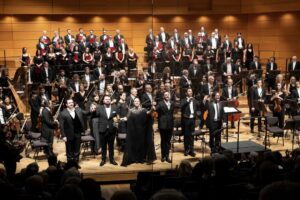
On the podium, Vincenzo Milletarì delivered an intense and forceful reading. His conducting stood out for its personality, rigor, and remarkable theatrical sensitivity. His baton highlighted the harmonic complexity and richness of the writing through a refined palette of colors, alternating dramatic outbursts with more intimate lyrical moments. He consistently maintained cohesion between orchestra and soloists, with particular attention to dynamics. The intimate passages proved especially successful, as did the end of the first section and the final climax, where the conductor balanced tension and delicacy with eloquent phrasing. The Orchestra I Pomeriggi Musicali also offered an excellent performance: precise, well-coordinated, and capable of a wide timbral range; while the Coro del Teatro Petruzzelli sounded compact and solid under the direction of Marco Medved.
The cast featured internationally renowned performers who delivered a superb result, led by Eleonora Buratto in the title role, one of the most sought-after sopranos today (replacing the originally announced Sonya Yoncheva). The singer emerges as a prima donna of extraordinary elegance, nobility, and interpretive intelligence. Her refined and deeply conscious singing combines an excellent timbre and meticulous phrasing with an intense yet measured expressivity, never excessive nor restrained. Her opening intervention in “Ha fin la pugna” stood out for its balance and control, as did the aria “Conobbi appena mia madre.” Throughout the performance she maintained a consistent vocal line, displaying an impressive legato and ringing high notes: powerful and perfectly placed. Gifted with a broad and luminous vocal line, with secure and well-projected top notes, Buratto intelligently deployed the resources of her lyric soprano, capable of both delicate nuance and dramatic thrust, even handling the most impetuous orchestral moments with apparent ease.
Alongside her, Freddie De Tommaso who rightly boasts a “bright and passionate timbre,” brought Giorgio Lascari to life. The tenor has grown noticeably compared to his most recent Milan appearances. He has learned how to master and deploy his large vocal instrument, and this role, interestingly, suits him perfectly. De Tommaso delivered a vocally very solid performance; although it is well known that he can be interpretively uneven and, despite the concert format, his difficulty in conveying expression was evident, vocally he compensates for this and any other shortcoming. His voice is beautiful, large, and expansive, with a voluminous, distinctive, and clean timbre, solid support, and secure high notes thanks to firm technique and stable intonation. His top notes always shine, and a slight vibrato enriches the sound. His aria “Sempre l’istessa vision” was outstanding, particularly in the beautiful closing, when he crowned the phrase “…io satrapperò!” with a tremendously powerful high note that was already impressive, before adding an exquisite filato that drew sighs from the audience. His even vocal connection and smooth transition between registers confirm him as a fine verismo interpreter.
The roles of Lambro and Daniele, entrusted by Giordano to lower voices, embody blind and implacable violence. Baritone Mihai Damian, as the revolutionary soldier Lambro, possesses a good timbre and a deep voice; he handled the role effectively, displaying a powerful, noble tone and convincing stage presence. His aria “In guardia, o Serbia tiranna!” was very well performed. Meanwhile, baritone Nicholas Mogg, the owner of a beautiful voice with undeniable vocal charm, strong control, and resonance in the lower register, also contributes notable stage charisma. Although the role lacks a conventional aria, he has numerous interventions in which he demonstrates a strong, solid, and clearly defined presence.
There were huge and warm ovations for all the performers. A success that confirms the vitality of experiencing new titles which, when well executed -as in this youthful work- continue to speak to today’s audiences despite the temporal distance from their composition.
Categories
Reviews