Opernhaus Zürich 2025-26 Review: Carmen
Elīna Garanča Brings Her Signature Role to a Disappointing Production
By Laura Servidei(Credit: Toni Suter)
Few operas are as iconic or as enduringly popular as Georges Bizet’s “Carmen.” Since its 1875 premiere at the Opéra-Comique in Paris, the work has captivated audiences with its indelible melodies and its unsentimental, ground-level portrayal of passion, obsession, and freedom. Set in 19th-century Spain, “Carmen” charts the collision between a woman’s fierce independence and a man’s consuming jealousy, a confrontation that leads inexorably to tragedy. Its clear-eyed view of human desire ensures its emotional power remains undimmed.
A Meta-Theatrical Misfire
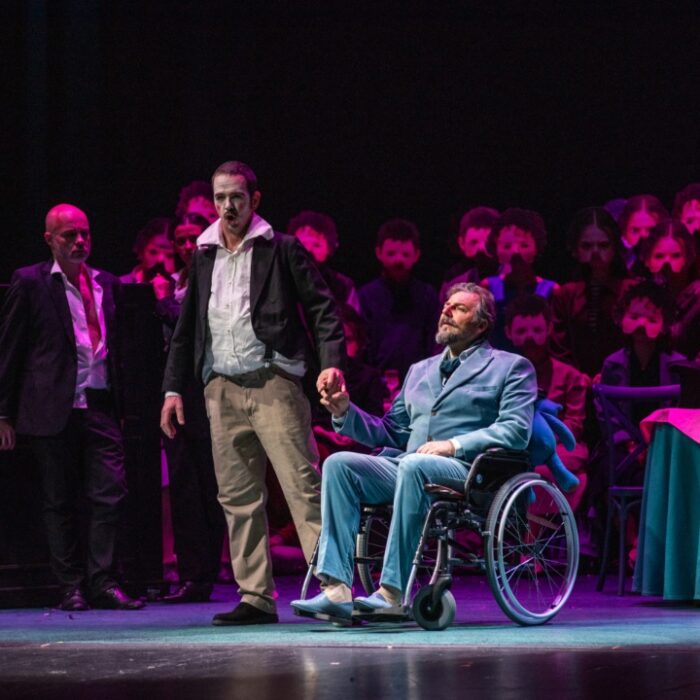
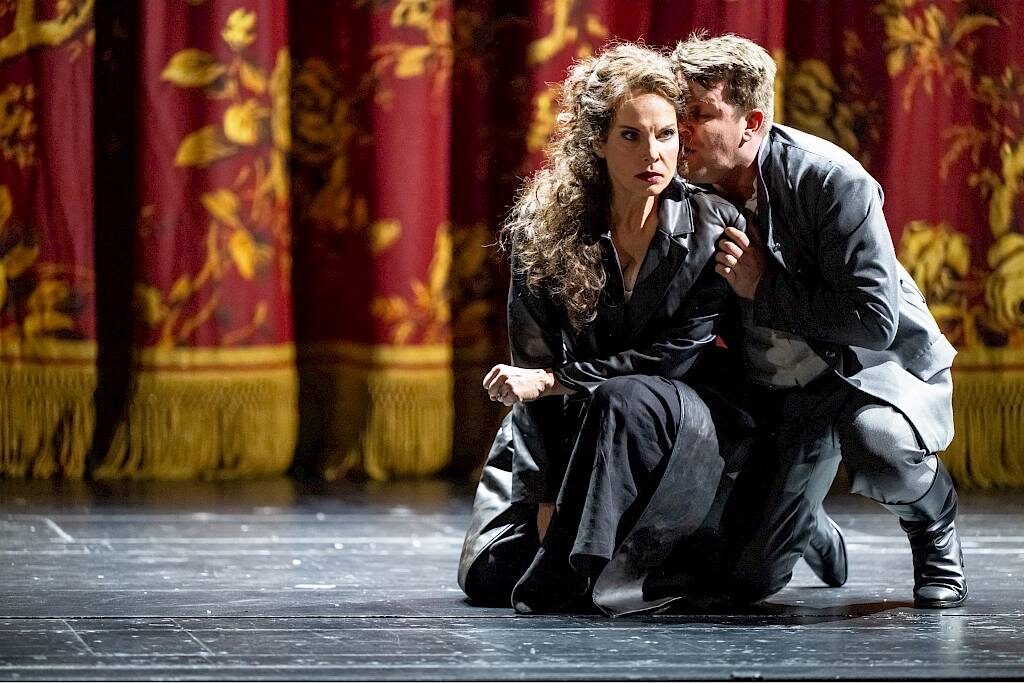
This season, the Zürich Opera House presents a revival of Andreas Homoki’s 2024 production, conceived by the former artistic director as a celebration of the work’s premiere. Set designer Paul Zoller recreated the brick and steel-beam interior of the Salle Favart, placing its curtain squarely in the middle of the Zürich stage. The drama begins as a young man (Stanislas de Barbeyrac) wanders this meta-theatrical space, discovers a score, and becomes engrossed in it, transforming before our eyes into the protagonist, Don José. This conceptual framework extends to the chorus, dressed in elegant 19th-century evening attire (costumes by Gideon Davey), which functions as the original premiere’s audience, both spectators to and participants in the action. In a pointedly clever moment during the very first scene, the theatre’s house lights were turned on. As the libretto calls for soldiers to comment on passersby (“Sur la place chacun passe”), the chorus instead peered into the auditorium, singing and laughing at us, the modern spectators. It was a playful idea, but one that ultimately felt more about Homoki’s concept than about “Carmen” itself. This left the stage a barren no-man’s-land, where the Favart curtain descended or rose arbitrarily, accompanied only by a few modern chairs. The principal singers often seemed isolated in this void, surrounded by onlookers in formal wear, a dynamic that critically hampered emotional engagement. The chorus’s costumes anachronistically shifted periods as the opera progressed: 1920s-30s for the mountain smugglers of Act III, contemporary dress for the final act. The grand bullfighters’ parade, with its picadors and banderilleros, was reduced to a scene watched by the chorus on a small television; it felt like a disappointingly cheap evasion of staging one of opera’s great spectacles. Overall, the production felt aloof and unsatisfying. The original spoken dialogue was used but severely truncated, rendering the narrative less streamlined and flattening the supporting roles.
In the Pit: Hindoyan’s Elegant Hand
Thankfully, things went considerably better in the pit. Conductor Domingo Hindoyan led the Zürich Opera Orchestra with a strong, confident hand, demonstrating perfect command over tempi and judicious, well-calibrated dynamics. His reading was composed and elegant, though one might have wished for a touch more visceral “oomph” in Bizet’s most dramatic moments. That said, the conductor displayed a deep affinity for the score’s architecture, revealing how Bizet’s splendid orchestration narrates every element of the story and amplifies every emotion in the libretto. Hindoyan explored this detail with care, resulting in a musically sophisticated and largely very successful performance.
Credit: Toni Suter
The Performers: Where the Drama Lived
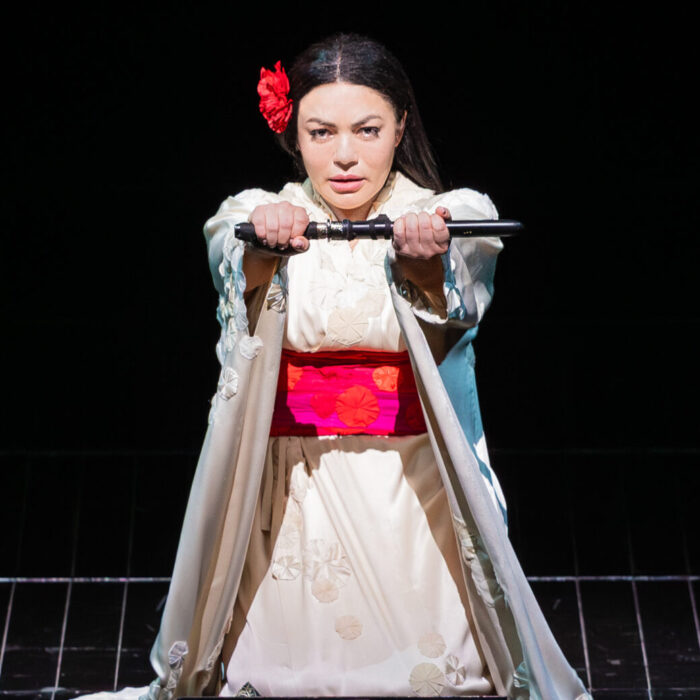
Elīna Garanča returned to her signature role, reaffirming why her Carmen is among the most acclaimed of the past two decades. Her mezzo-soprano possesses a golden-bronze hue, a beautiful timbre deployed to express the heroine’s complex, often contradictory emotions. Her interpretation, now finely tuned to perfection, reveals a vulnerability seldom glimpsed in the character. This Carmen is youthfully rebellious yet conveys a profound, fatalistic embrace of her destiny with arresting depth. The Card Scene was a particular highlight, Garanča’s lower register perfectly embodying Carmen’s resigned, but perfectly self-aware surrender to fate. Technically superb, with brilliant high notes and exquisite phrasing, her voice carries a core of coolness that here served the character’s defiant nature masterfully.
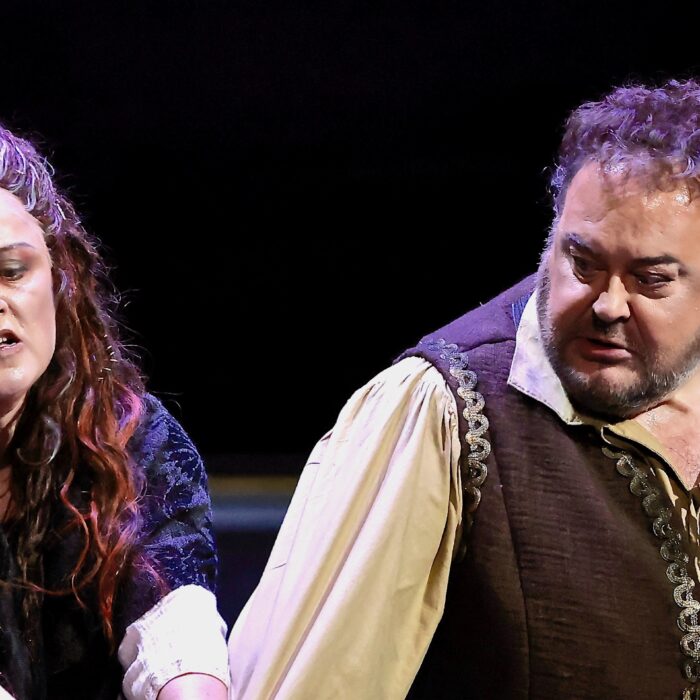
Stanislas de Barbeyrac proved an ideal Don José. His powerful tenor possesses an almost heroic quality, perfectly projected while maintaining a delightful French voix mixte. His high notes were luminous, and his mezza-voce in “La fleur que tu m’avais jetée” was heart-melting. This vocal prowess was matched by intensely committed acting. Despite the production’s shortcomings, Homoki’s Personenregie was careful, and de Barbeyrac meticulously charted his character’s descent. An outburst of violence in Act two—pushing Carmen to the floor—was genuinely shocking, a moment of terrifying foreshadowing executed with raw conviction by both singers. In Act three, his simmering, abusive rage against her shifting affections felt painfully real, met perfectly by Garanča’s portrayal of mingled fear and annoyance.
Olga Peretyatko sang Micaëla, the pure-hearted village girl. Her silvery soprano provided a good contrast to Garanča’s mezzo, even if it lacked the ethereal filati often associated with the role. Her duet with de Barbeyrac in Act one was beautifully tender, and her heartfelt interpretation of her big Act three aria, “Je dis, que rien ne m’épouvante,” was genuinely moving. A directorial oddity saw Homoki repeatedly placing her on the periphery of scenes where she does not belong, a choice that must be disconcerting for any singer, but Peretyatko took it in stride and demonstrated commendable acting skills throughout.
Strength in the Supporting Roles
Ildebrando d’Arcangelo brought requisite panache to the bullfighter Escamillo. His basso cantabile showed some wear but remained handsome, with powerful, well-set high notes and a mellow lower register. His duel scene with Don José was engagingly performed with musical poise. Siena Licht Miller and Yewon Han made confident debuts as the gypsies Mercedes and Frasquita, their contrasting voices—one a metallic mezzo, the other a silvery, brilliant soprano—blending excitingly in ensembles, Han’s high notes soaring over the orchestra’s fortissimo and the chorus in full throttle. Gregory Feldmann and Johan Krogius were excellent as the smugglers Le Dancaire and Le Remendado. Their Act II quintet, taken at a daringly brisk tempo by Hindoyan, was arguably the production’s most successful number, delivered with irresistible confidence and precision.
From the ranks of authority, Guram Margvelashvili sang Moralès with a pleasant baritone, while Stanislav Vorobyov stood out as Captain Zuniga. Vorobyov’s beautiful, deep bass and vivid, even likable characterization suggested a singer worthy of larger roles. His confrontation with de Barbeyrac in Act two was a highlight of dramatic tension.