OperaLombardia 2025 Cremona Review: I Puritani
By Bernardo Gaitan(Photo: Andrea Butti / OperaLombardia)
Although “I Puritani” is an Italian opera through and through, it was conceived in Paris, at the height of the grand opéra tradition. Bellini studied Meyerbeer and Halévy in great detail, noting in his personal papers certain orchestral “effects” he wished to emulate and others he intended to avoid. As a result, the score, especially in the third act, features orchestral passages unusually rich for him, with a climactic structure closer to Parisian tastes of the period than to his Sicilian roots.
The young Vincenzo, only 33, composed the work amid political tensions and a profound personal crisis, just months before his premature death. Although he had already signed the contract for the premiere, he still lacked a complete libretto, and many musical sections were missing. Carlo Pepoli, a Bolognese aristocrat, patriot, and refined poet completely inexperienced in musical theater, wrote the libretto. This was a circumstance that caused several hurdles during the creative process. Bellini quite literally had to “teach” him how to write for opera. So pressing were the deadlines that Bellini began setting entire sections to provisional verses, some of which proved, paradoxically, more “beautiful” than Pepoli’s final versions. For instance, Bellini preferred the provisional version of the famous duet “A te, o cara” which kept an irregular poetic meter unusual in Italian opera.
Anticipating all kinds of scenarios, the Sicilian genius conceived “Puritani” as an extraordinarily adaptable opera: it contains at least four different endings, all approved and supervised by him. Fearing the lack of skill among certain singers, he prepared multiple versions of Arturo’s final cabaletta and the stretta, ranging from simple to virtuosic. At the time, this made the work highly flexible for companies of varying levels: a surprisingly modern strategy. It was his last composition: Bellini died a few months after the Paris triumph and never saw the opera fully established in the repertoire or properly understood in Italy.
(Photo: Andrea Butti / OperaLombardia)
New Production Details
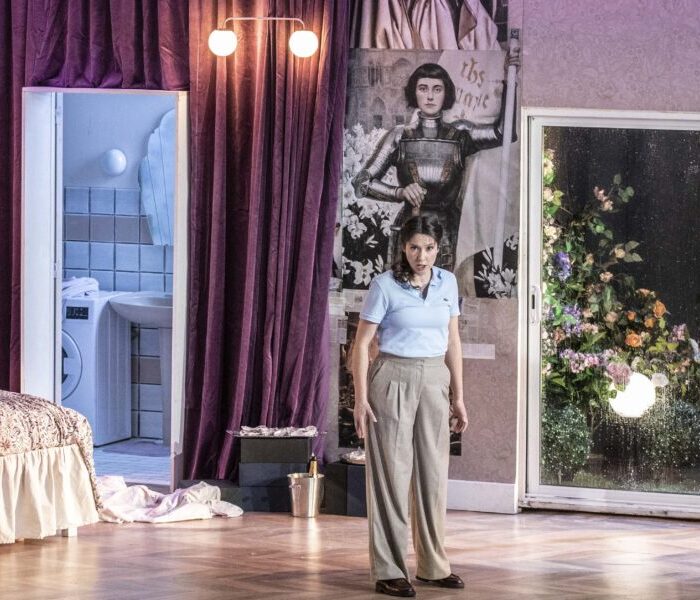
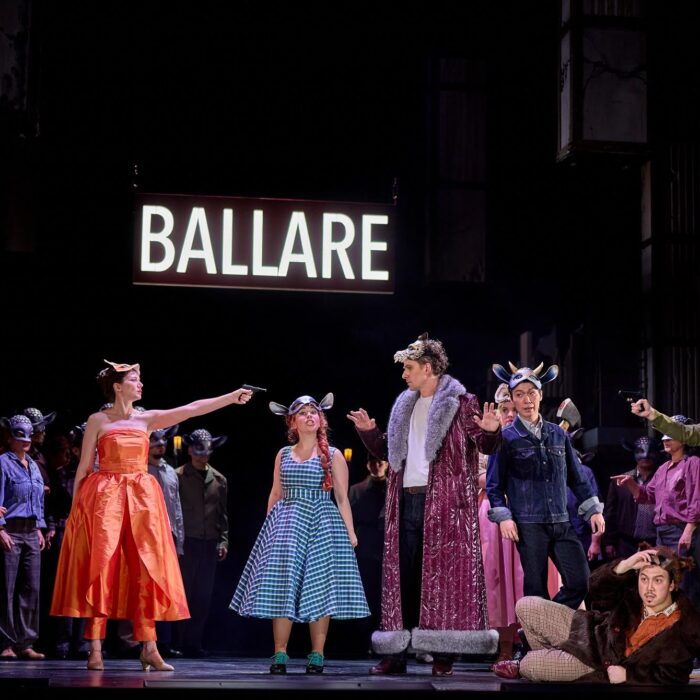
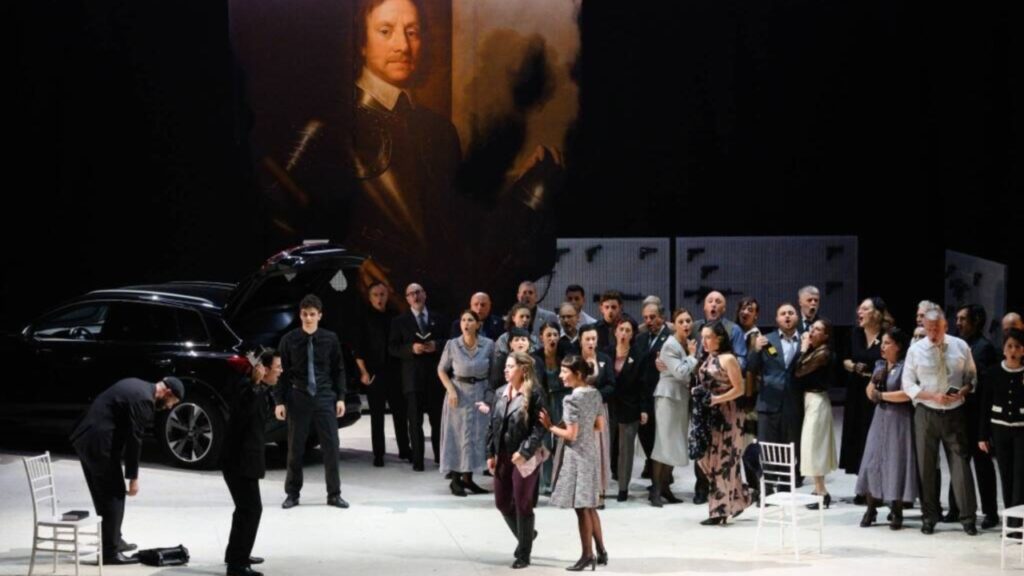
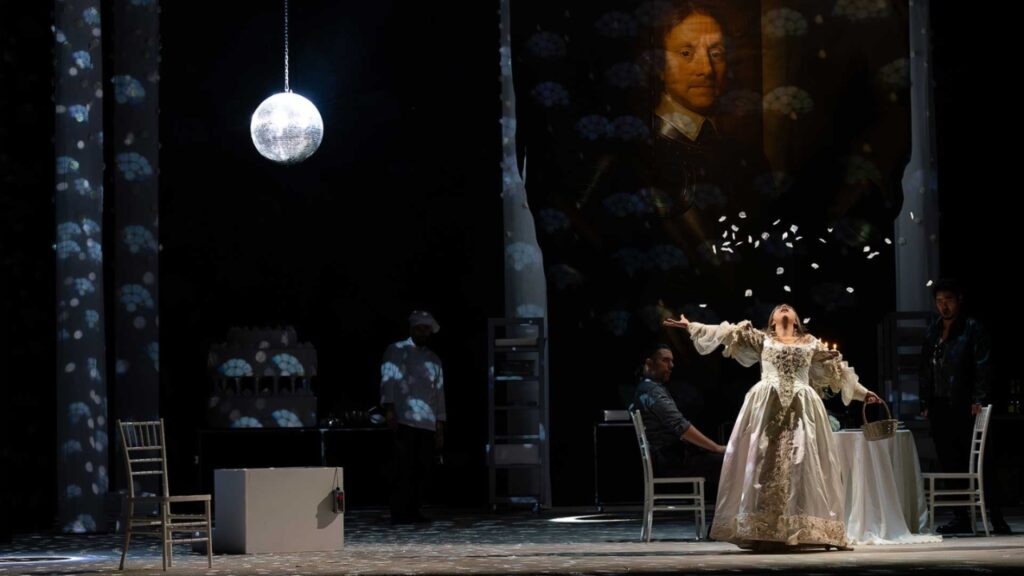
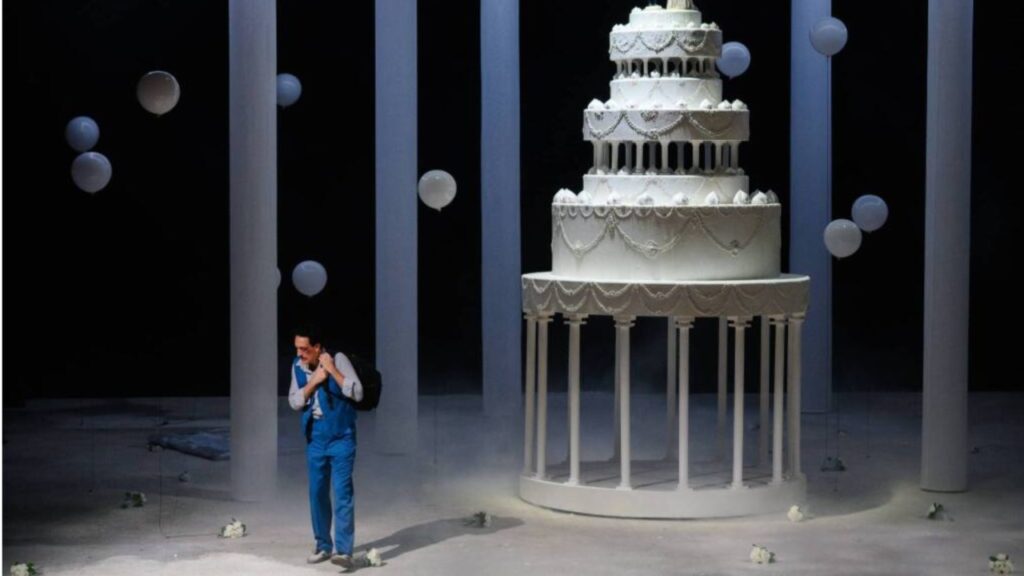
OperaLombardia revived this cornerstone of bel canto with a new production touring five northern Italian cities, including Cremona: the focus of this review. Daniele Menghini’s staging relocates the action to a violent contemporary community steeped in fanatical worship of a “Puritan” past. Davide Signorini’s set design creates a somber space where seventeenth-century relics coexist with modern objects: a real automobile, multiple firearms, helium balloons, a monumental wedding cake, industrial rice sacks, and more. The regista thus shapes a microcosm of violence and identity-based fanaticism, reinforced by Nika Campisi’s costumes, which blend classical elements (Elvira’s wedding dress, men’s suits) with vulgar ones (Enrichetta in sweatpants, Arturo in Converse sneakers on his wedding day). Gianni Bertoli’s meticulous lighting completes the stage concept.
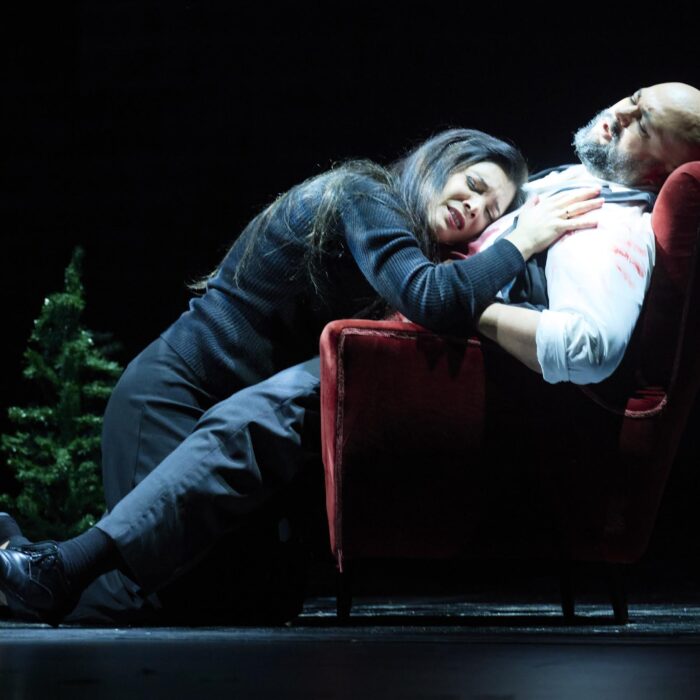
Menghini offers a decidedly contemporary reading. He places the first act in a den of thugs who torture “non-Puritans,” while the second act’s madness unfolds in the banquet hall where the wedding was to take place, illuminated by an ’80s-style strobe ball during “Vien, diletto, è in ciel la luna.” Yet the staging at times diverges from the music: moments of intrinsic beauty and lyricism, such as “Qui la voce soave” or “Suoni la tromba intrepido,” clash with images of torture and executions, disorienting the audience. Equally questionable are elements like the helium balloons or the stuffed toy Arturo gives Elvira in Act three. Even so, the production maintains a coherent conceptual identity, though not always aligned with Bellini’s poetic world. Special mention goes to actors Luca Miele and Gabriele Martini, who carry much of the stage action and performed outstandingly.
(Photo: Andrea Butti / OperaLombardia)
Musical Highlights
Italian-Russian conductor Sieva Borzak led the orchestra I Pomeriggi Musicali. Born in 1997, the conductor delivered a vibrant and finely detailed reading of bel canto style, with generally brisk and concise tempi and incisive articulation that highlighted both lyrical and dramatic passages. His dynamic control was precise, his messa di voce exemplary, and his phrasing with the winds, especially the horns, was notable. This was all while keeping the orchestral volume carefully balanced to avoid covering the voices. The OperaLombardia Chorus, prepared by Massimo Fiocchi Malaspina, offered a secure and refined performance.
The cast, composed largely of young singers, maintained a respectable level, sustaining with dignity a particularly demanding work. The standout of the evening was unquestionably Maria Laura Iacobellis. Her velvety, full-bodied timbre and even emission made her an exceptional Elvira. She excelled in coloratura precision, dynamic control, and radiant high notes. The mad scene, delivered with expressive finesse and complete technical command, confirmed her artistic maturity and her ability to shape a complex character. The aria “Qui la voce sua soave” clearly demonstrated how thoroughly she internalized the role.
Valerio Borgioni as Arturo displayed a beautiful timbre especially in the central register, with notable projection and placement. His high notes were ringing, though somewhat forced. Attempting the dreaded high C-sharp in “A te, o cara” proved unfortunate, as it was shouted and far from Bellini’s elegance. Still, his stage presence was strong. He was an effective actor.
(Photo: Andrea Butti / OperaLombardia)
Roberto Lorenzi as Giorgio proved a solid and convincing bass-baritone. He offered a more relaxed interpretation of the character: not paternalistic but friendly. Though his singing showed occasional difficulties, his performance in “Cinta di fiori e col bel crin disciolto” was effective. The duet “Il rival salvar tu devi,” with Sunu Sun as Riccardo, was well executed; despite onstage distractions, the final high note closing Act two earned them enthusiastic applause. The young South Korean bass sounded dark-voiced, resonant, with stable emission and excellent Italian diction. He was a strong asset. Although the role demands bel canto refinement he has yet to master it fully. His “Ah! per sempre io ti perdei” was solid.
Benedetta Mazzetto as Enrichetta, with her attractive timbre and polished emission, stood out despite the brevity of the role, which was nonetheless important to the drama. Gabriele Valsecchi as Lord Valton and tenor Enrico Bassi as Bruno Roberto fulfilled their tasks correctly; the latter, indisposed, acted onstage while a chorus member sang the vocal part with stylistic reliability and without disrupting the performance’s flow.
The choice of title was unquestionably bold: its extreme vocal demands and the complexity of its melodramatic architecture were rewarded with warm applause from the audience. The production reaffirmed OperaLombardia’s artistic seriousness and merit.