OPERA2DAY & the Netherlands Bach Society 2026 Review: The Opera Circus
Pasticcio and Playfulness: A Radiant Reimagining of Handel’s Dramatic World
By Mengguang Huang(Photo: Bart Grietens)
The production of “The Opera Circus” vividly revives the historical tradition of the Pasticcio, a staple of 18th-century operatic life. By weaving together a curated selection from Handel’s vast sprawling catalog—ranging from the iconic “Alcina” to the lesser-known gems of “Teseo”—the production team mirrors the composer’s own creativity brilliance. This format provides a flexible, 90-minute skeletal framework designed to showcase vocal virtuosity and accommodate the kinetic energy of the circus: prioritizing immediate theatrical impact and melodic delight over complex dramaturgy, allowing Handel’s imaginative scores to act as the ultimate engine for spectacle.
A Scenographic Alchemy: The Arc of Transformation
The narrative of “The Opera Circus” unfolds through a visceral metamorphosis of space and style. The performance ignites within a stark, industrial void, where the warring deities Armata and Armato are trapped in a cycle of unrelenting fire. Dominated by the cold geometry of metal scaffolding and the haunting silhouette of a shipwreck, this world feels bled of vitality—a cosmic gloom that perfectly mirrors the furious weight of Handel’s minor-key arias. Here, the gods appear as monolithic figures of resentment, their costumes draped in obsidian greys and weathered blacks, embodying a desolation that seems absolute.
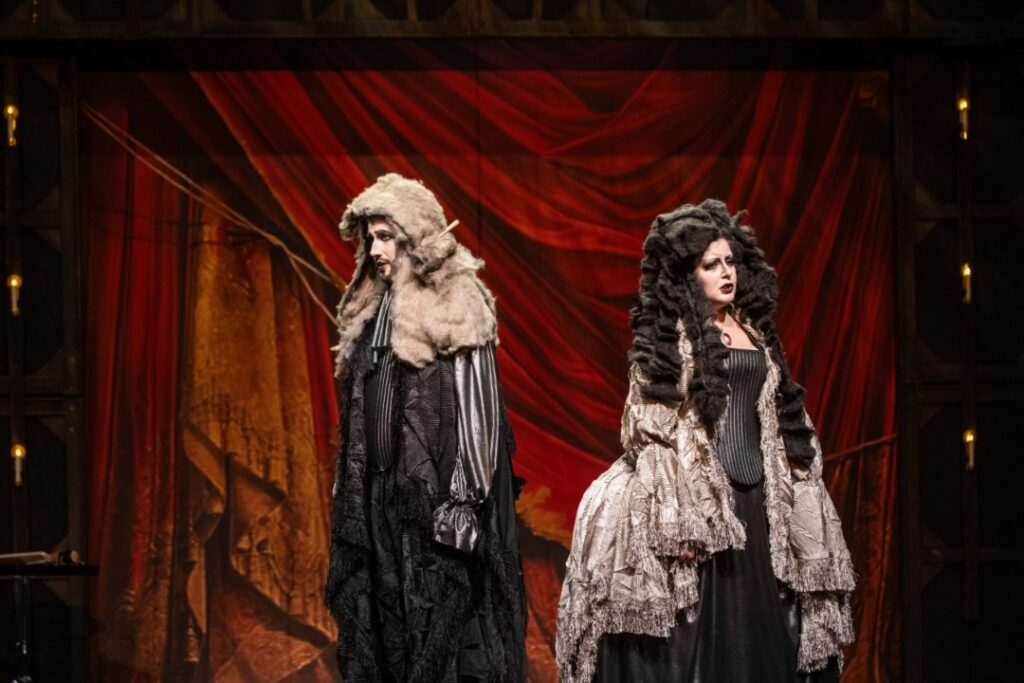
(Photo: Bart Grietens)
This heavy stagnation is suddenly disrupted by the arrival of the circus troupe, heralded by a wonderfully absurd “circus wagon.” This clunky vehicle acts as the initial wedge driven into the gods’ cold reality. Guided by a playful Muppet-impulse, these outsiders—clutching and overflowing with naive energy—stumble upon the rubble and begin to rediscover fragments of an ancient, vibrant aesthetic. As they intervene, the raw machinery of the scaffolding is gradually softened by the charm of a reconstructed 18th-century picture-box theater. Intricately painted flats—evoking lush gardens and fountains—descend from the rafters, literally framing the divine feud within a world of two-dimensional artifice.
As the performance nears its climax, the visual weight shifts entirely from grim textures to shimmering, campy brilliance. The gods’ dark attire is eclipsed by oversized powdered wigs, metallic corsets, and neon-tinged hoop skirts. By reclaiming these old theatrical techniques, the troupe dilutes divine fury with color and humor, successfully steering the apocalyptic wreckage toward a triumphant happy ending of Baroque optimism.
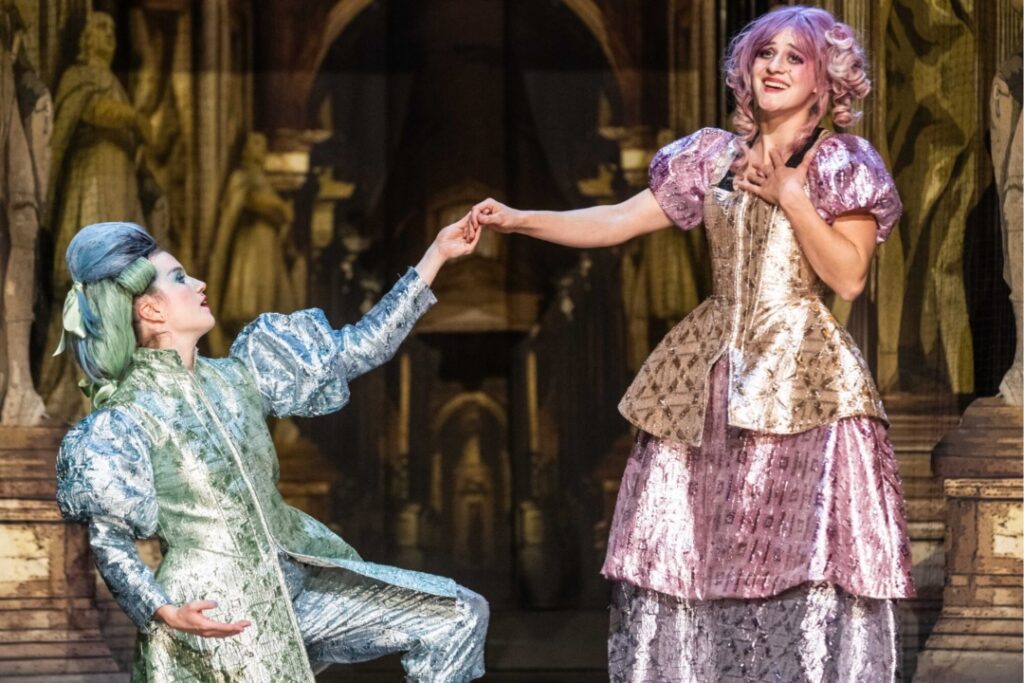
(Photo: Bart Grietens)
The Pulse of the Baroque: The Music Making
The Netherlands Bach Society’s contribution was the production’s heartbeat; the instrumental sections were consistently vibrant, defined by a basso continuo that pulsed with rhythmic vitality. The ensemble’s brilliance shone in the purely instrumental movements, such as those extracts from the Trio Sonata & violin sonata. Here, the strings exhibited an extraordinary transparency and warmth, technical precision and spontaneous joy.
The vocal heavy-lifting was anchored by the two warring deities, whose performances created a magnetic field of dramatic tension. Maria Schellenberg (Armata) commanded the stage with a penetrating voice, cutting through the orchestral texture like a blade. Opposite her, James Hall (Armato) offers a masterful countertenor portrayal. His voice is imbued with a palpable sense of envy and calculation, his sharp delivery in the recitatives captured a god driven by strategic resentment rather than mere rage. The crowning achievement of their partnership was the duet adapted from Giulio Cesare’s iconic “Son nata a lagrimar.” By transforming the famous duet into a moment of shared vulnerability, the production sands down the gods’ furious conflict into a breathtaking, melancholic reconciliation.

(Photo: Bart Grietens)
Providing a luminous contrast to the gods’ gloom was Maud Bessard Morandas, representing the playful spirit of the circus troupe. Her voice was inherently lustrous and radiant. This was most spectacularly showcased in her rendition of role as the Sun. She appeared crowned in a magnificent, spiked golden halo, her shimmering gold brocade gown radiated against the backdrop. Her coloratura flourished and mirrored the agility of the acrobats spinning above her, turning Handel’s demanding vocal lines into a display of pure, sun-drenched optimism.
A Few Notes & Conclusion
As a pasticcio, the actual singing occupies less than half of the performance time, which may leave vocal purists feeling somewhat unsatiated. Furthermore, certain technical transitions—such as the visible stagehands assembling the picture-box theater in plain sight—felt casual to a fault, momentarily breaking the theatrical illusion. Yet, given the production’s lean toward entertainment and meta-theatrical playfulness, these rough edges were easily forgiven as part of the “circus” aesthetic.
Ultimately, the production’s intent is clear: to curate a night of high-spirited revelry by fusing Handel’s melodic splendor with the dazzling humor of the circus. From this perspective, the project is an undeniable success. Crucially, the “theatrical wizardry” on display successfully captured the very essence of Handel’s scores—their profound humanity, radiant warmth, and sharp wit.