Opéra National de Paris 2025-26 Review: Un Ballo in Maschera
Anna Netrebko Creates Moving Portrait in Verdi’s Opera
By Ossama el NaggarThe etymology of the Italian word “maschera” (and its English equivalent “mask”) is rather obscure. It’s derived from the Arabic word “maskara,” meaning buffoonery and/or harsh derision. Indeed, a closer look at “Un ballo in maschera” reveals a higher degree of caustic bite far beyond the final act’s famous masked ball. Amelia seeks help from the soothsayer Ulrica to rid herself of her passion for the King, only to be overheard by the latter, thus confirming the reciprocity of his love. Renato arranges a subterfuge to help Riccardo escape the assassins Samuel and Tom to find out the veiled woman he is to accompany is none other than his own wife. Forced by her husband to draw the card designating the King’s assassin, Amelia ends up picking him, thus implicating herself in the assassination of the man she loves. Riccardo, or Gustav II in the original version, set in Sweden, and historically known for his homosexuality, dies for a passion never consummated.
Verdi’s “Un ballo in maschera (1859)” is one of his finest works, thanks to a plethora of memorable arias, duets and ensembles. Moreover, Antonio Somma’s libretto is well-written and compact; there isn’t one superfluous note in the score. Like several other Verdi operas, starting with “Nabucco (1842)” and “Ernani (1844),” “Un ballo in maschera” follows the Meyerbeerian aesthetic of affording four or five major characters in different vocal registers, rather than the bel canto aesthetic of concentrating on the amorous couple.
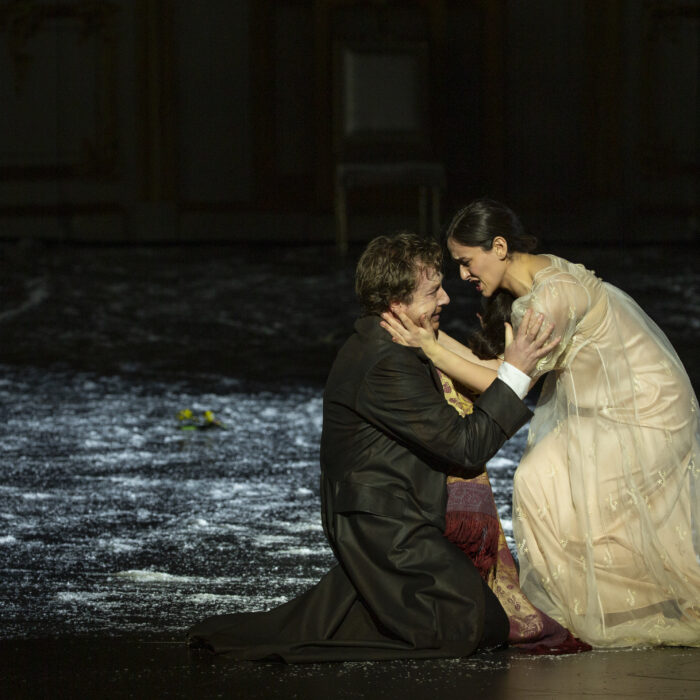
Despite this inherent equilibrium, this production starring Anna Netrebko was very much centred around her. Though the contralto Ulrica, the baritone Renato and even the coloratura soprano Oscar are significant roles, the most remarkable ones in the opera are those of the amorous couple, Amelia and Riccardo. This was a blessing in the case of Netrebko, whose recently made her debut in the role of Amelia in Naples. At this production (seen Jan. 30), her interpretation was marvelous, and the abundant applause was much deserved. She was not only brilliant vocally, but truly inhabited the role. Her emblematic high notes are as brilliant as ever. She continues to float those soaring passages with extreme ease, and signature pianissimi are as impressive as ever. As observed in recent performances, such as the aforementioned “Adriana Lecouvreur” in Paris, and her Leonora in La Scala’s last season opening opera in December 2024, “La forza del destino,” Netrebko’s voice has substantially darkened, at moments almost sounding more mezzo, albeit one easily reaching the stratosphere. Her use of this darker register enhances her dramatic expressivity. Her biggest asset, even more than her beautiful voice, is her charisma, and that quality is as grand as ever. She was simply thrilling in her Act two aria, “Ecco l’orrido campo” and moved me to tears in her Act three aria, “Morrò, ma prima in grazia”.
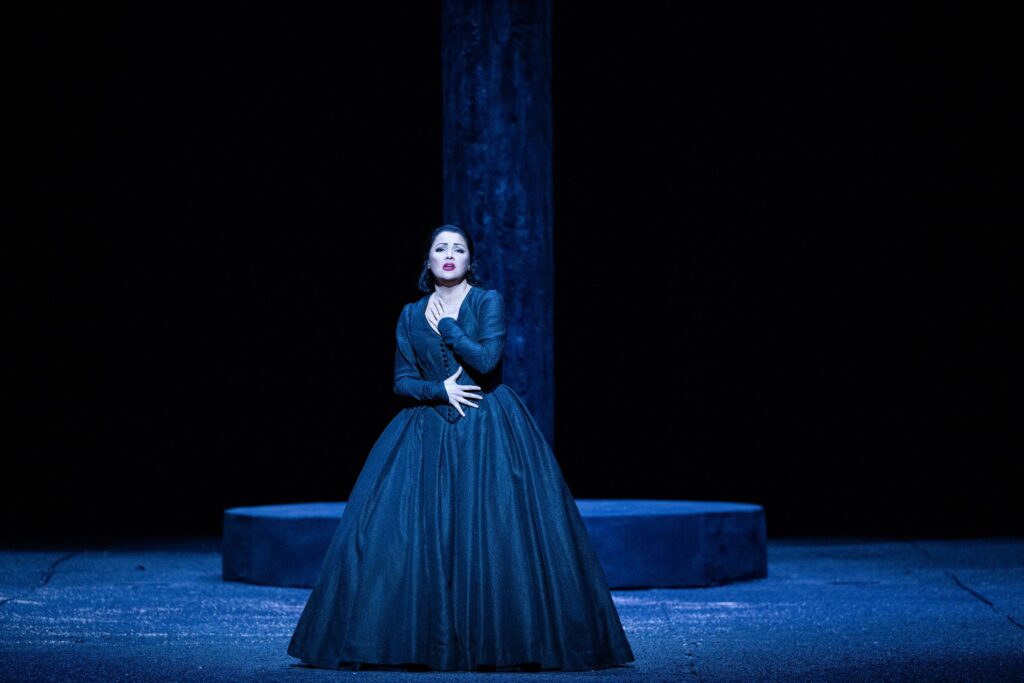
Alas, American tenor Matthew Polenzani was seriously miscast. Given the importance of the role, the overall experience could not be truly pleasurable despite the excellence of the other singers. More than any other Verdi tenor role, Riccardo is possibly his most elegant one, demanding a refined lyric tenor. In his prime, Polenzani was a lovely Mozart singer. Some Mozart voices become bigger with age and maintain their beauty. Alas, this cannot be said of Polenzani. At least as heard in the present performance, his voice was dry and the timbre unappealing. As a skilled technician, he managed the high notes, but they were not a pleasure to hear. More than most of the other singers in the cast, his diction was wonderful; any speaker of Dante’s language needed not to have looked at the surtitles. There was elegance in his singing, but alas, that is not enough. He was at his best in his Act three aria “Ma se m’è forza perderti,” and in his death scene, both requiring more acting and skilled delivery than technical brilliance. However, It was worrying to hear “Teco io sto,” one of Verdi’s most thrilling love duets, sung by such disparate voices. One tried to concentrate on Netrebko alone, but that’s an impossible task. To aggravate matters, the duet was clumsily staged, with each singer addressing the public, rarely looking at each other. Almost certainly, the singers cannot be faulted for this, but it may have also reflected their lack of chemistry.
American mezzo Elizabeth DeShong was admirable as the fortune‑teller Ulrica. She managed the low notes of the role, more typical of a contralto with ease. Her Act one “Re dell’abisso, affrettati,” where she summons the dark forces, was bloodcurdling, thanks to her amazing voice, convincing acting and the well-staged setting that saw six African women swaying to her singing while a crowd of European settlers stood in the background. Director Gilbert Delfo’s imagination revived this usually rote scene: Ulrica summons a zombie from the grave, to the terror and thrill of her audience – as well as the Bastille public!
Canadian baritone Étienne Dupuis was a convincing Renato, Riccardo’s advisor and best friend. His portrayal was dignified: that of a reserved man who keeps his feelings bottled up. This interpretation enhanced the intensity of the character, when he angrily erupted upon discovering his wife was Riccardo’s veiled beauty that he had to accompany home. Dupuis’s warm baritone is powerful and virile and his diction exemplary. His Act four “Eri tu che macchiavi quell’anima” elicited huge applause, and deservedly so.
Spanish soprano Sara Blanch is a rising coloratura who had impressed as Zenobia in Rossini’s rare opera “Aureliano in Palmira” at Pesaro’s Rossini Opera Festival in 2023, thanks to her beautiful timbre and impeccable technique. Sadly, Delfo’s directions remained vague. As the young page in the service of Riccardo, one expects either an admiration on the part of the young lad or the insinuation to some sexual tension given the historic character’s homosexuality (which several directors have already explored). Alas, Blanch’s Oscar was just a diligent and somewhat playful employee. Her Act one “Volta la terrea fronte alle stelle” was somewhat tepid, but she dazzled in the Act three effervescent aria “Saper vorreste.” The smaller roles of the plotters Tom and Samuel were well‑performed.
Italian conductor Speranza Scappucci, admired in Toronto’s production of “Eugene Onegin” last May, is a sensitive conductor who is especially competent in opera. Her conducting was the second best aspect (after Netrebko) of this production. Despite my reservation about Act two’s love duet, she produced a miraculous sound in that thrilling scene, showing her profound understanding of the work and her affinity for Verdi.
The production was strong overall, though chronologically implausible. As it was set in Colonial New England rather than Sweden, the costumes were weird, alternating between proper Colonial and Victorian garb. The opening scene was the most implausible, supposedly a kind of official assembly, with Riccardo discussing personal affairs, including frivolous ones – an impossibility in Puritan America. An eagle, a symbol of the independent United States of America, was present in almost all scenes, though the opera takes place long before its independence.
Most appealing was the ballet in the final act. Dancers dressed as commedia dell’arte characters in black and white costumes performed a brilliantly-choreographed ballet (Micha van Hoecke) that reflected the irony in the music. Together with Ulrica’s den, the masked ball in the final act was truly spectacular; the rest was forgettable. It’s a pity the staging and sets were not more striking, and a real shame the magnificent Netrebko was not better matched romantically.