When they first appeared on European stages a quarter century ago, Calixto Bieito’s stagings were considered revolutionary, typified by their linear contours and geometric shapes. Typically, he deconstructs an opera and then rebuilds it incorporating rarely seen elements. In earlier years, this was refreshing and provocative. However, it’s a sad sight indeed when a once iconoclastic director routinely regurgitates past glories in the absence of fresh new ideas. Two recent stagings by Bieito, Rossini’s rarity “Zelmira” at Pesaro’s ROF (Rossini Opera Festival) this past August, and “Tristan und Isolde” in Vienna in 2023, fell short. What may have passed for stimulating provocation two decades ago is now at best tedious intellectual masturbation.
Uninspired Production
The premise of this production of “Siegfried” is the young man’s obsession with his parentage, especially his mother’s. It’s valid that a boy raised by a creature from another species (Mime, the Nibelung) would wonder where he came from. However, for this to be the driving force of the opera is confounding, to say the least.
More appealing than Bieito’s ideas (or is it just one idea?) were Rebecca Ringst‘s visually fetching sets. Much of Acts one and two took place in a forest scape, with trees growing upside down and sideways in a clin d’oeil to the façade of the now defunct department store Galleries Lafayette, in Berlin. The bizarre condition of the trees reflects the upheaval in the state of the world following events that transpired in the previous chapter, “Die Walküre.”
Throughout Act one, faceless humanoids, a male, two females, one heavily pregnant, resembling James Whale’s “The Invisible Man” (1933), lurk in the forest. These images may be in the subconscious of the inquisitive Siegfried. Unfortunately, Bieito makes Siegfried such a detestable Dummkopf that one wonders if he’d even be capable of being inquisitive. He brings home the door of a vehicle he retrieved in the forest, using it as an exercise machine, jumping on top of it. Mime is a bespectacled bureaucrat rather than a blacksmith. He carries a huge metallic briefcase containing documents and medicine, for he’s also a drug addict. German character tenor Gerhard Siegel magnificently incarnated the scheming Mime. His acting was probably the best in this production. His fear, accompanied by fidgety anxiety made one take pity on him, despite his evil motives, especially given how irritating was Bieito’s child Siegfried. Innocent and amoral are not mean and immoral. This is one rare production where one could not identify with the “hero” Siegfried.
Musically Captivating
Austrian Heldentenor Andreas Schager is currently the king of Wagnerian tenors. In the past year, I had the immense pleasure of experiencing in numerous Wagnerian roles and like the Energizer Bunny, this man never tires. He sounded as fresh in the last minutes of Act three as he did at the opening. Without a doubt, he’s the best thing about this unsatisfactory production.
Australian bass-baritone Derek Welton was an odd choice as the Wanderer. Endowed with a healthy, fresh, heroic voice, further enhanced by his portrayal of the Wanderer as a young thug. Indeed, he looked like the youngest character in this confused production. Sporting a veteran’s dog tag, he looked more like an active combatant, more likely a mercenary than a soldier or an officer, than the older Wotan, rendered wiser by experience. He also sounded and acted like an insolent ruffian, yet another major character in the opera rendered unsympathetic by Bieito.
American baritone Brian Mulligan‘s Alberich was appropriately detestable. Anxious and conniving, he lurked aside Fafner’s cave. His voice was appropriately dry to convey his evil. In this production, there was an innovation by Bieito. One of the lurking humanoids seen in the forest in Act one, the heavily pregnant woman, delivers her baby, with Alberich acting as surgeon. He cruelly removes the baby from her entrails and absconds with it in a thermal bag. One guesses the infant will grow into Hagen in “Götterdämmerung.”
Admired this past summer as Heinrich der Vogler in Bayreuth’s production of Lohengrin, Finnish bass Mika Kares was a vocally splendid Fafner who managed to give a warm quality to the supposedly terrifying dragon. However, this dragon was unusually avuncular and far from terrifying. He was doubly represented by a moderately scary crane truck with its front lights serving as the dragon’s eye and a ridiculous creature that wore a mouse’s head. It was somewhere between Mickey Mouse and The Nutcracker’s Mouse King. If comic relief was the intention, it succeeded. However, it rendered the warm toned Kares one of the least intimidating Fafners that I’ve ever seen. This is a pity, as this Finn is one of today’s best Wagnerian basses.
Canadian contralto Marie‑Nicole Lemieux is a magnificent singer endowed with an impressive voice. She’s also an excellent actress, admired last year as Isabella in “L’Italiana in Algeri” in Paris and “Carmen” in Montréal (both in-concert versions). But Lemieux was miscast here as Erda. Despite her wonderful voice, she does not have the right timbre for the role. Bieito presented the Wanderer’s summoning of Erda as a domestic fight over lunch. Erda arrives at what looked like a bucolic setting to serve lunch, and things soured between the two. After her scene ended, Bieito had her stay to watch the Wanderer’s humiliation by the intrepid Siegfried. Smiling for a few minutes would have sufficed. Unfortunately, she stayed on during the whole scene, first giggling hysterically, then smiling for a long while. Bieito can indeed work miracles; he made the wise Erda look ridiculous.
Spanish conductor Pablo Heras‑Casado is building a reputation as Spain’s Wagner champion. After a hugely successful Ring cycle at Madrid’s Teatro Real, he conducted Parsifal at Bayreuth last summer. Heras‑Casado conducted the Orchestre de l’Opéra national de Paris rather cautiously, especially in Act one. The sword forging scene was almost lethargic. Only in the final act and especially in the love duet did one hear the orchestra in full splendor.
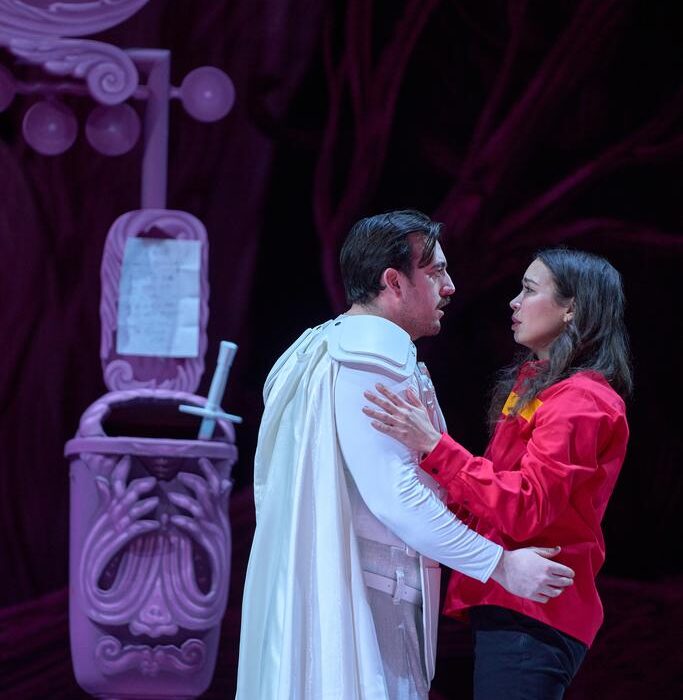
Bieito kept the worst for last. The final scene, Brünnhilde’s awakening, is one of the most beautiful and sensual scenes in the entire tetralogy. Possibly as a homage to Greenland, the hot topic worldwide these days, Brünnhilde’s rock was a block of ice. Siegfried breaks a block with an axe. In a lit screen atop stands the sleeping Brünnhilde, in an image lifted from Spielberg’s “Poltergeist” (1982). Her hands were in the same position as the child trapped behind the television screen in the film.
Instead of laying protected by a sacred fire, Bieito’s Brünnhilde was kept frozen in a block of ice. With the cold late January weather awaiting the Paris audience upon the end of the opera, one felt sorry for this Brünnhilde clad a space age costume. A fur coat would have been more appropriate. No matter how immersed in the drama and the music, the passionate love duet in the Artic cold was distracting. Despite the incandescent Wilson and the stentorian Schager, this was the most forgettable final scene in Siegfried I’ve ever seen. Though vocally terrific, this entire production was the weakest of four “Siegfried “productions