Opéra National de Paris 2025-26 Review: Eugene Onegin
Ralph Fiennes Succeeds in his First Opera Production
By Rick Perdian(Credit: © Guergana Damianova – OnP)
Ralph Fiennes knows a thing or two about Alexander Pushkin’s novel in verse, “Eugene Onegin.” It turns out he has a touch for opera, too, based on his directorial debut at the Paris Opera. His staging of Tchaikovsky’s “Eugene Onegin” at the Palais Garnier is rooted in tradition, but he controlled the action on the stage as tightly as he does on a film set. He was fortunate to have a cast that sang and acted their roles brilliantly, but embodied them physically.
Fiennes first read “Eugene Onegin” as a student at the Royal Academy of Dramatic Art in London. In 1999, Fiennes had the title role in “Onegin,” a film which he also helped produce. It was his sister Martha Fiennes’ directorial debut, and his brother, Magnus Fiennes, composed the score. Ms. Fiennes won the Best Director Award at the Tokyo Film Festival and the Best Newcomer at the London Film Critics’ Circle for the film.
Semyon Bychkov, who is conducting the eleven-performance, sold-out run, picked Fiennes to direct the production and with Fiennes, he found a storyteller with the skills to let the story unfold naturally, without resorting to directorial excess or imposition of a concept.
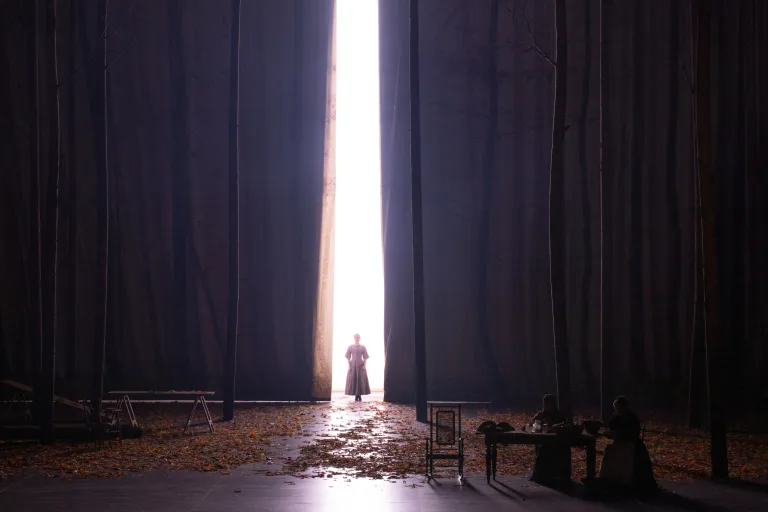
Michael Levine’s sets are equally straightforward. The curtain parts to reveal Madame Larina and the nurse Filippyevna seated at a table outside peeling fruit for preserves. A backdrop of birch trees extends the vista into the distance. Fallen leaves cover the ground, which the peasants kick up as they celebrate the harvest.
Guergana Damianova / OnP
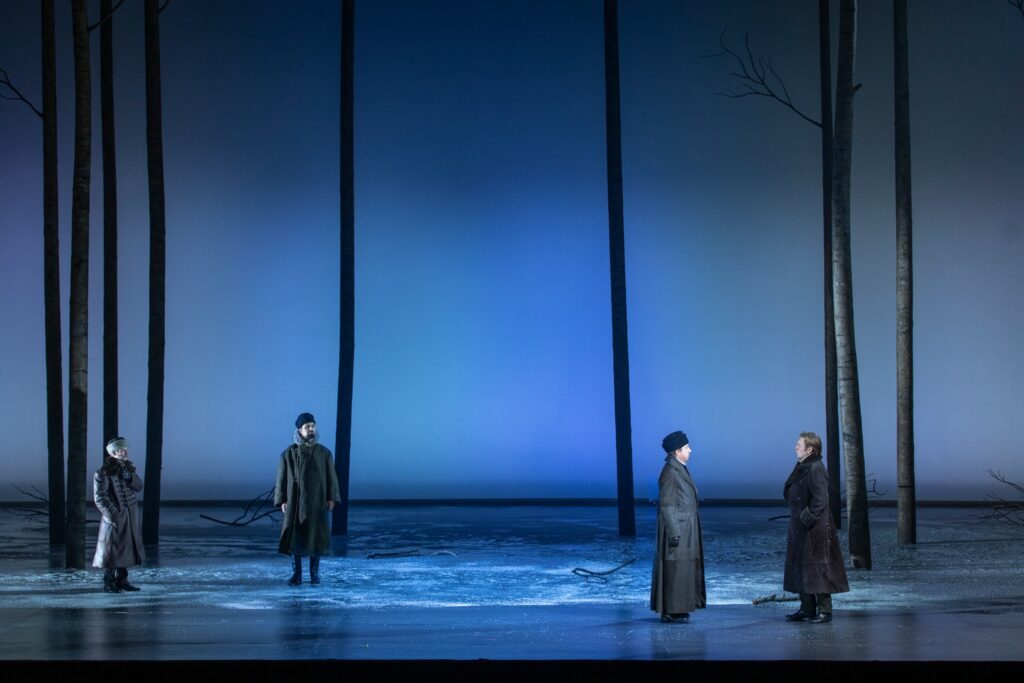
The bedroom where Tatyana writes the fateful letter is plain, as is the furniture. The birch motif carries over into its walls, and also the ballroom of the Larin home. During the Letter Scene, moonlight illuminates Tatiana’s bedroom. As the tension mounts between Lensky and Onegin, the ballroom darkens, and a light snow begins to fall. The duel takes place in a bleak winter landscape awash in pale blues, purples, and grays.
For the final scenes, a grand, mirrored, gilt and white ballroom is created through enormous one-dimensional photographs. Its floor is dusted with snow, and the only three-dimensional objects are chairs. This is the space where Tatyana, while admitting she loves Onegin, tells him that she will not leave her husband. He is left despairing, lying on the floor in a beam of light.
Fiennes’ emphasis on clarity and focus extended to Alessandro Carletti’s subtle, sensitive lighting. He employed bright lighting near the proscenium to keep the focus there, fading it as characters receded to the rear of the stage. There were exceptions, however, as when the rear stage curtains parted, and Tatyana stood frozen in blazing white light. Such grand gestures were few, yet there was no doubt in any scene, especially in the crowded ballrooms, where the audience should focus.
The lighting established mood in addition to focus. The opening scenes were bathed in the faded, ochre warmth of autumn. Ballroom scenes were brilliantly lit until the action forced a change of color. The blue light that brought romance to the bedroom could turn menacing when threats were exchanged and hopes vanquished.
Annemarie Woods’s costumes were rooted in the period. Her best efforts were the richly hued attire of peasants in the opening scene, and the lighter-than-air ballgowns that brightened the ball in Tatiana’s honor. Sophie Laplane was equally adept at capturing emotion through movement, whether through peasants frolicking or more elegant dancing. The spirit and momentum of the former, however, were exceptional, especially when topped by the kiss of two young lovers.
As Onegin, Boris Pinkhasovich was the prototypical anti-hero, arrogant, self-absorbed, and unrelenting. He exuded danger, as did his scintillating baritone, which he wielded like a rapier when rejecting Tatiana’s profession of love or when consumed by rage as his quarrel with Lensky intensified. It was chilling to watch Ruzan Mantashyan trace Tatiana’s evolution from a young girl caught up in romance to a grand lady resigned to her fate. Her Letter Scene was laced with doubt and hope, all captured in a soprano that could blaze brilliantly, float gently, or collapse in desperation.
Bogdan Volkov’s tenor shone as brilliantly as his countenance as Lensky. Volkov sang Lensky’s Aria with all the emotion and beauty of voice that he could muster. It was harrowing to watch his Lensky grasp that he would not survive the duel. As Olga, Marvic Monreal was cheerful and flirtatious, while her mezzo-soprano voice was lovely and vibrant.
Guergana Damianova / OnP
Alexander Tsymbalyuk’s Prince Gremin was a virile, rather than an aged, aristocrat. The power and warmth of his voice as he described Gremin’s love for Tatiana to Onegin was a highlight of the performance. As Madame Larina, Susan Graham’s voice has faded, but its warmth and presence remain. Elena Zaremba’s Filippyevna was richly detailed in character and vivid in voice. Peter Bronder’s Monsieur Triquet was a delight, singing Tatiana’s praises at the ball before the quarrel between Lensky and Onegin spirals out of control.
For a first-time opera director, Fiennes demonstrated a sure hand with the chorus. Individual characters abounded, and their movements evolved organically from the story. They moved with the same polish as they sang.
Bychkov led the Paris Opera Orchestra in creating music as poetic as it was beautiful. The folk dances in Act one sparkled with energy and color, the Act three Polonaise was grand and expansive, and most importantly, he provided space for Tchaikovsky’s melodies to bloom. Bychkov conducted the more delicate, sensitive passages with equal care, underscoring the emotions they conveyed through careful attention to dynamics and tempo.
The conductor’s unerring sense of timing and scale was never more evident than in the devastating final scene, when Tatiana crushed Onegin’s hopes forever. His sensitivity permitted Mantashyan and Pinkhasovich to express the desolation of the present, compared to a love that might have been.