Metropolitan Opera 2025-26 Review: Tristan und Isolde
Lise Davidsen & Michael Spyres are Sublime in Yuval Sharon’s Philosophically Complex Production
By David Salazar(Credit: Karen Almond)
In his book, “A New Philosophy of Opera,” director Yuval Sharon notes that “Tristan und Isolde,” alongside “Pelléas et Mélisande” are not only two of the most difficult operas to stage, but “seem like a losing proposition” for any director to take on. He reflects on how oftentimes, director’s attempt to “find physical form for what the music expresses” results in to more traditional staging approaches. The solution he proposes throughout the book is to approach opera as an open art, essentially an unfinished work completed only by the audience itself. Opera at large is that it is an art form in a constant cycle of birth, death, and rebirth. Given that he views the director as having equal voice as the composer or librettist (or more given that they are alive and the other two in most cases are not), then the director can give new birth to an opera every time they bring it to the stage for the audience. Given the confines of time and space in live theater, it “dies” once the performance is concluded, left to become reborn the next time it takes the stage or is rewritten / directed by a new author / director.
Birth, death, and rebirth are at the core of Sharon’s “Tristan und Isolde,” one of the most hotly anticipated productions in the opera world. The sold-out production’s popularity was so high that the Met added an additional performance, while being unable to offer tickets to some members of the press for the entirety of the run.
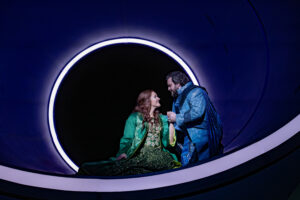
As you enter the Met Opera’s cavernous auditorium you are met by large white ovular design that at times looks like an eye and at others a womb. The audience is signaled to settle in by recorded sounds of the ocean and in the midst of this meditative calm, Wagner’s famed prelude is allowed to commence.
On Knife’s Edge
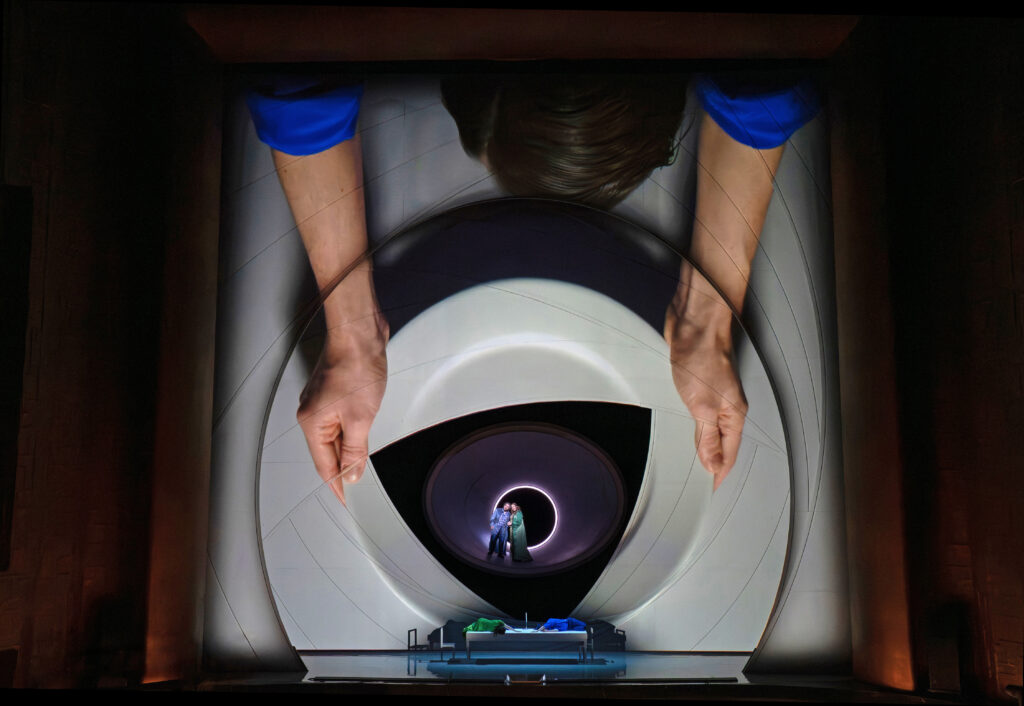
The curtain “rises” and we are met with the titular couple in contemporary clothing, sitting on opposite ends of a table, an hourglass between them. Isolde is clad in green while Tristan sports blue. A live video feed materializes on the curtain itself, zooming in on the hourglass which then dissolves into a projection of sand, which we may interpret as the sands of time. Eventually the camera reorients itself on a pitcher which Isolde fills with water and it is the zoom in on the water that drifts us off to the opening of the opera proper where Isolde finds herself at sea on the way to marry King Marke.
In the midst of this, the two lead singers, Lise Davidsen and Michael Spyres, are replaced by dopplegängers and the singers re-emerge, now in more traditional operatic costume, on a platform within the eye of the stage’s massive design. It’s here where the production’s main motif comes to life.
Schopenhauer’s philosophy is at the core of “Tristan und Isolde,” specifically his “The World as Will and Representation.” In that text the German philosopher posits that the world we perceive around us is an illusion. Behind that illusion is an irrational will that drives human desires and thus its suffering. In a reductive sense, Wagner’s piece is a perfect manifestation of this very conceit – the text and story of the opera is the representation or illusion with the music an embodiment of the will, always yearning, striving, desiring, but never satiated (in musical terms, Wagner doesn’t let the music find any harmonic resolution for nearly four hours of music, waiting until Isolde’s “Liebestod” to finally give us said emotional and harmonic resolution).
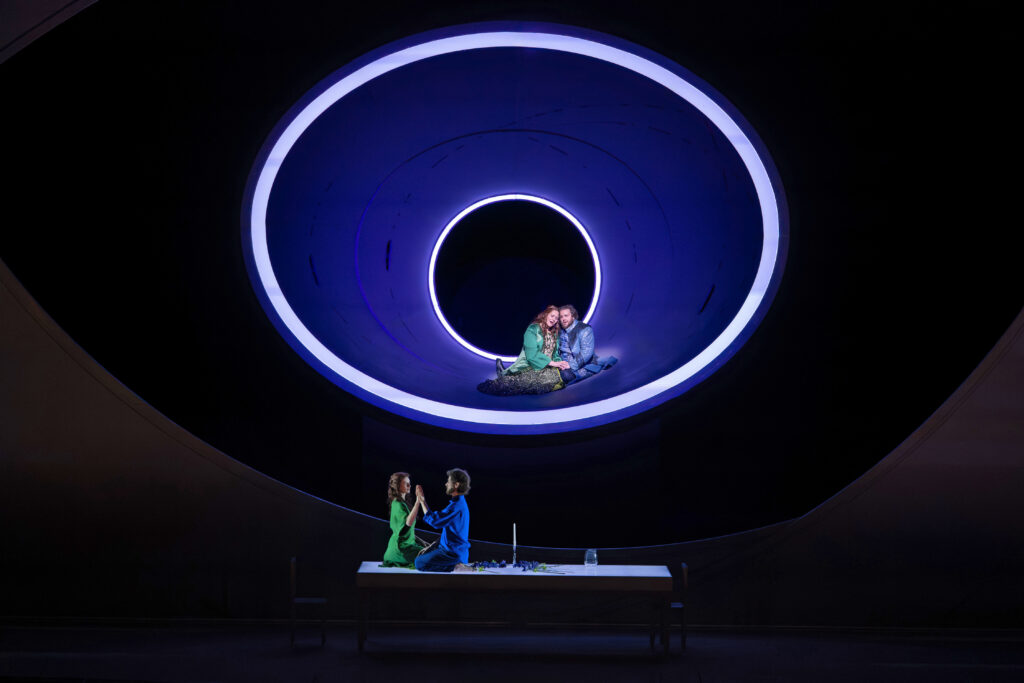
Sharon’s production seems to emphasize this duality via his choice to stage the representation and will in the production. The lower part of the stage features the “representation” or material world and the upper part of the stage, while I will hence forth refer to as the eye, represents the immaterial world or the will, allowing us to see the souls of the characters. It is through this approach that Sharon seems able to make sense of the opera’s narrative while also connecting it to the deeper philosophical underpinnings of the piece.
He adorns this approach utilizing poetic imagery to connect ideas or emphasize certain text and emotions laid out in the opera. In the early instances of the opera we see the dopplegänger Isolde raising a knife to Tristan’s chin, her actions mirrored by Isolde’s own anger toward Tristan and the fate that awaits her once she disembarks the ship. That knife motif (while a bit overly repetitive for my taste) eventually payoffs during their confrontation at the end of this act, the swift movement of the knife upward is projected via the live feed onto the curtain and pauses in its ascent; at this moment, the lighting shifts and the knife itself becomes the set for the doomed lovers. It’s a potent moment, the two on knife’s edge, their lives at stake as Isolde prepares their death via intoxication.
Once they have drunk the potion, a massive, aggressive, blazing light descends into the hall, illuminating the audience. After blinding you for a few seconds, it pulls back up and the “eye” reveals two lovers in traditional operatic garb. But they aren’t the singers or the original dopplegängers. They are another couple all together. It is at this point that the singers replace their dopplegängers upstage, taking their seats at the table. The soul fusing with the material. The two have been transformed, their souls, as emphasized by this third couple, have been reborn. The remainder of the act plays out at this part of the stage emphasizing their awakening into a new reality.
Act one works, but not fully and is, in my view, the messiest in execution. The knife motif certainly aligns with Isolde’s anger and violent nature. But without the power of hindsight, the experience feels static and confusing. The singers, embodying the soul and will fret and move and sing, but they also stand around a lot, feeling too similar to the statuesque actions of the dopplegängers. Lighting might differentiate them, but it isn’t enough in these initial stages to give a sense of these distinct planes of existence. Moreover, because of these devices, it’s easy for the audience to have any sense of direction and feel disoriented. Sharon is asking us to just go with the flow, but he’s also testing our patience given this is a very long opera. I am reminded of Sharon mentioning in his book how his “Magic Flute” production in Berlin was tweaked because he realized that the audience was confused by why there were puppet strings only to reveal at the end that children were the puppet masters. In his revival, he opted for reframing the piece so that the reveal was made at the start of the show, thus creating a stronger effect. In retrospect, his production is about death and rebirth; I think that what’s missing at the top of the show is the initial act of birth.
The other major issue with Act one is the use of devices that never get used again. As Isolde narrates her story to Brangäne, the back of the eye shifts, revealing differing panels in the background. The first one we see is of a hand holding a potion. Then as she narrates about Tristan’s stare, the panel shifts again, revealing… Tristan’s face. It felt like a powerpoint presentation was underway. The fact that it ended here was all the more frustrating because it ultimately doesn’t pay off in any way and clashes with the rest of the production’s aesthetic. There’s no other instance in the entire production where a character says something and Sharon indicates it visually to the audience. It almost felt like he was somehow anxious for something to happen during this narration and stuck in whatever was referenced as a way to pass the time. Later on, the panel will shift one last time to reveal a bucketload of potions. While it is important to establish this prop, this was once again a moment that felt a bit heavy-handed and its excess clashed with the rest of the production’s more minimalist approach.
And one other critique – the quality of the projections by Jason H. Thompson. They often felt like stock images rather than being all that imaginative or poetic. Their use felt rather inconsistent as well with an overabundance in Act one and fewer throughout the remainder of the opera. There were also a few “blink and you’ll miss it” technical hiccups (I didn’t blink obviously) with the projections that immediately sent me spirally into memories of Robert LePage’s unfortunate machine for “Der Ring des Nibelungen” and the handful of technical failures I witnessed firsthand.
Then there were some projections that descended into the realm of cliché.
(Credit: Karen Almond)
Disambiguation of the World
Speaking of which, Act two starts with one such fumble. The table is now expanded and features a single candle that Isolde lights. This light is potent itself as a symbol of the burning passion within her. Then that single light is multiplied by the projections, furthering this notion of the intensity of her emotions. And then.. a moth to a flame. We know this passion will be destructive. We know these two are doomed to suffer. And if we don’t yet, we will most definitely know it at some point in the next two hours of music. This was Sharon’s most egregious moment of indicating, telling the audience what to think about the story, rather than offering them an idea to explore on their own.
Speaking of which, if I may digress for a moment, this is my biggest critique for Sharon and a specific choice he made in the framing of this production. As I opened the program last night, I found something that I despise – a director’s note. While I understand a director providing context to the experience, this one was three pages long. Having read Sharon’s book in preparation for this production I was already used to his voice, his constant quoting of philosophical thought, but also his disambiguation of his own process.
In these three pages he provides context for the macro choices but when he gets into the micro, he does so to his own detriment. One thing is to provide a frame for the experience, another is to try to explain it away. It’s the old adage of “show, don’t tell,” with Sharon somehow emphatically injecting himself into every conversation about his work rather than letting the work do its own heavy-lifting, thus undermining the audience’s ability to explore on their own. My favorite line is, as he references the couple at the start of the opera, “I don’t have a single answer for who these two are, and yet I’d like to think it is also possible to enjoy not knowing.” But instead of leaving things as is, he goes on to suggest answers for this question, all of which the audience likely would have concluded without his help. Why even suggest there’s no answer but then try to give one anyway? It’s these written moments that, while likely provided in the vein of generosity, come off as overzealous need for a director to justify his work, almost as if pre-empting people’s confusion. If a director needs three pages to try to explain his work, then it’s his work that might be the problem. Ironically, this is a case where there was absolutely no need but it felt like Sharon wanted to. And yet, for most of the opera, I didn’t feel I was being guided by my perception of events, but by his words.
For those wondering why a program note matters so much – it is a part of the experience. Whether you engage with it or not is your choice, but that it exists as a possibility emphasizes that the director intended for his work to be read and for his thoughts to be known. In his book, Sharon makes references to Thomas Bauer’s “The Disambiguation of the World” in which Bauer posits that one of the main issues with art over the ages is the trend where “everything must be explained; everything must be understood; and when it’s not, it won’t matter.” Sharon, unfortunately, while styling himself a proponent of Bauer’s thought, falls into this very trap with his overlong program notes. (As an aside, I recognize that in analyzing this production, I am also feeding into that, but alas, I am not operating here in the frame of an artist).
I brought all of this up because this “moth to the flame” cliché was so antithetical to everything else Sharon’s direction exhibited. Like the slideshow presentation in Act one, it was a director not being poetic but kitschy. It was on-the-nose instead of imaginative. Clichés have one intended meaning, leaving no room for ambiguity, which Sharon champions throughout his book.
Fortunately, the remainder of Act two sustained a strong aesthetic identity. Isolde blows out a candle in synchronicity with a woodwind punctuation right before Tristan arrives. As the singers convene in the eye, the camera projects a plate that will then fuse with the eye. The projection will continue to adorn the set with dopplegängers will then set the table with violets as the singers cherish their night together. There’s a beautiful contradiction of the physical world being explored through the flowers which have been stripped from their natural habitat, much like Tristan and Isolde are both emotionally fused emotionally, and metaphysically, but also at odds with the physical world they inhabit. The Act is the most contemplative of all, with the action in the eye minimal. The panels shift to separate the singers at moments, only to later fuse them. All the while, the dopplegängers make love to one another in the darkness of the night.
As the duet heads toward climax, we see background actors entering to set the table. I understood why this had to happen, but upon seeing the remaining action, I felt that it didn’t need to happen more than once because at the end of the day, the audience is only privy to what the camera shows us or what we can see on stage – the camera only shows us the plate and flowers that were already set there. The two candleholders, which become important props, are thus the only other thing that needed to be there and they could been set at the very end of the duet when everyone storms in. I bring this up because unfortunately, it detracted from the most glorious moment in all of opera and the only time I want that moment to be interrupted is when Wagner himself does it.
The remainder of the act plays out in the “physical world,” which, now lit up, emphasizes the day that the lovers disparaged. Here Mark takes centerstage, Sharon’s staging placing him right in the middle, the lovers at opposite ends. Mark crushes the central plate in one of the few moments where the staging itself had visceral impact before launching into his monologue.
Purgatory
Act three has a lot on its mind, but also revealed something about the production at large – the larger work’s own striving for wholeness. Sharon establishes in his book that he doesn’t prescribe to the German approach of directing, “Konsequent.” That is, “start from a point of hypothetical meaning and rationally move through the work to prove my point.” He argues for “inkonsequent” where meaning is allowed to “oscillate between specific meanings” rather than “follow a fixed goal.” He references his own 2014 production of “Doctor Atomic” in which he shifted from a comic book aesthetic in one act to having characters on a curved piece of graph paper to emphasize the more “choreographic language of Act two.”
Sharon’s production illuminated how distinct each act of “Tristan und Isolde” feels. If Act one is hell for Isolde and Act two is heaven for the lovers, Act three in his production is purgatory for Tristan. The first image the live feed camera shows us is Tristan, prostrate on an operating table. The camera pans past him, showcasing all kinds of operating tools. Isolde sits at one end of the table, then exits. Kurwenal sits alongside Tristan speaking to him, waiting for him to awaken, hoping for him to live.
The eye, which now takes on a more ovular form, reveals itself to be a sterile tunnel with a black hole at the end of it. Tristan meanders in this endless tunnel which definitely harkens to a hospital aesthetic, but explores the disassociation between his soul and physical being. While his body fights for its life, his soul is lost, as the massive oceanic projections around the eye indicate, “at sea.” Also of note is the return of the first image we see – the hourglass. It isn’t actively alluded to but it’s right there, under the operating table, a reminder of the limited time available to us in the physical world.
The singer only replaces the dopplegänger when Tristan is told that Isolde is on her way and remains there for some time until hearing the English horn’s mournful tune, at which point another swap occurred as the doomed Tristan fought for his life. This choice was the best use of the dopplegängers in the entire evening and a payoff to an directorial motif that went from torturously underused in Act one to slightly more engaging in Act two.
There’s some sword fighting which felt very out of place with the entire aesthetic, the choreography feeling overly safe and sucking us out of the immersion. I do wonder if this was necessary. In fact, I will go further – why are they fighting with swords? Tristan is on a modern day operating table. I understand that people need to die in this scene, and Tristan was stabbed in Act two by a sword, but this is presumably a different time and place. If you want us to believe in the operating table and hospital aesthetic, then be consistent with all the surrounding action.
Anyway, the big plot twist this production offers. When Isolde does appear, she’s pregnant, presumably with Tristan’s baby (I guess Tristan was in agony for nine months; to my point about why time and space shouldn’t be a deterrent from ignoring the sword play). Two curved lights are brought together to create the shape of a neon vulva to frame Tristan’s death. I understand the decision for the vulva-shaped aesthetic in light of the big plot twist, but it was again, kitschy and not as poetic as Sharon probably wanted it to be. The implication of birth and death is already right there for the audience the moment Isolde walks in pregnant. We don’t need to see Tristan standing in front of a vulva to drive it home.
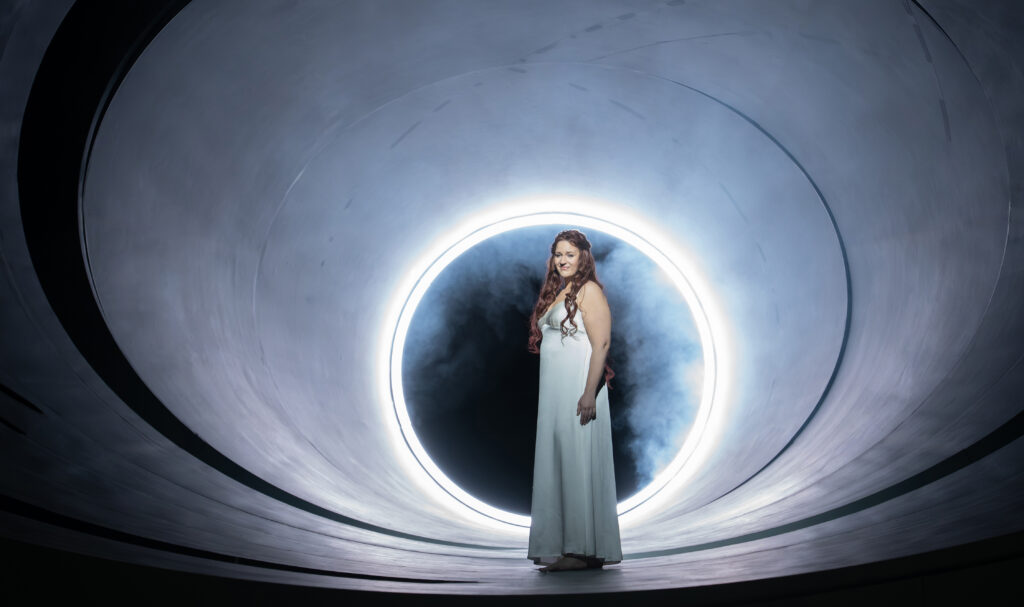
While the vulva aesthetic is questionable, the pregnancy is a deft touch to the storytelling as Isolde now dies in childbirth and her Liebestod, featuring the soprano in pure white instead of the green she’s worn the entire night, is now given new context. Her commenting on the beautiful sounds she hears and the eternal breath are now referencing the new life born into the world and the notion that she and Tristan are now fused not just into the will, but into a new life. As the opera’s final notes ring out, Brangäne hands the child over to the childless Marke who kisses the baby in synchronicity to the final chord. In my experience, the choices made in the third act managed to pay off the entire production.
(Credit: Karen Almond)
Leaving You Breathless
One final comment on the production, and it is perhaps my most positive – it supported the singers. Some of the press leading up to the production noted that the eye funnels the sound in a such a way as to offer natural amplification for the singers. And these artists reaped the greatest rewards from this concoction.
Michael Spyres didn’t seem like the most obvious choice for Tristan. The self-styled BariTenor has performed Siegmund in “Die Walküre” and Walter in “Die Meistersinger von Nürnberg,” but his schedule also features “L’Elisir d’Amore” and “Les Contes d’Hoffmann.” Tristan is, of course, another animal altogether, a role treacherous for its vocal and stamina demands. Tristan’s night gets started halfway through Act one and even then you could argue that he’s limited here. It’s in Act two where he’s immediately tasked with singing over the orchestra alongside the soprano for three quarters of an hour. Throw in the fact that in this particular case, Spyres was tasked with singing alongside one of the most titanic voices on the planet and his task couldn’t be more daunting. And yet, he managed to pull it off.
As expected, it took him time to warm up into it, the voice sounding a bit overpowered in its upper range during the first act, particularly as Tristan and Isolde launch into emotional tirades at the very apex of this Act. You could wonder how he’d ever manage the extremely long Act three.
But before that, he delivered some epic singing in Act two. Him and co-star Lise Davidsen performed with a vocal chemistry that isn’t always obvious or easy in this opera. During the entrance “Isolde! Geliebte!” the duo erupted over the orchestra, finding a strong balance. While Davidsen voluminous soprano could override the tenor’s at climactic moments like “bin ich die Welt,” it was notable how they found ways to blend and meld in other softer ones. I don’t think I’ve heard Davidsen sing with such delicate colors in any other performance I’ve witnessed and in scaling back her sound to mesh with her partner, the two were allowed the breadth to meld the most glorious of legato lines, especially throughout “O sink hernieder, Nacht der Liebe” and later passages such as “Liebe-heiligstes Leben.”
In Spyres’ case, the tenor’s suave legato was the kind of luxury seldom afforded to tenors that take on this role. Whereas most have robust instruments intended for the thickest textures the orchestra throws at them, their softer singing is often just blunted force disguised as softer singing. Spyres has no such setback and in such passages as “Von deinem Zauber sanft umsponnen,” his elegant phrasing became the embodiment of the bel canto singing that Wagner desired but rarely gets.
As the duet shifted toward its climax, the two were as in synch as ever and while Spyres’ sound could get pulled into the vortex of Davidsen massive instrument, there musical connection was appropriately exhilarating. I would call it one of the high musical moments of the night, but it seemed like every moment was.
At the close of Act two, Tristan responds to Marke’s admonishment by “Wohin nun Tristan scheidet, willst du, Isold’, ihm folgen?” Spyres was at his most polished, the lines delicate and beautifully connected. He luxuriated in his piano singing, expressing a sense of acceptance about Tristan’s fate.
Act three is a gauntlet for the tenor. Wagner deprives us of the female voice for an hour with most of that time occupied by Tristan lamenting his fate and fighting to live long enough to see his beloved. Wagner throws all kinds of treacherous musical moments at the tenor for that hour often with a gargantuan orchestral sound as partner. Throw in that the fatigue might set in before the act starts and will undeniably grow as the act progresses and a lot of tenors barely make it through. Spyres managed the lengthy “Dünkt dich das?” quite well. He managed the softer lines with beauty of tone, his voice fresh and he maintained this in the buildup to the explosive “Verfluchter Tag.” Here his highs might not have had the squillo of more heroic voices, but they also sounded even and measured. A few moments later, he exploded with similarly potent sound on “Isolde kommt,” his body language crazed; whereas “Dünkt dich das” was sung inside the eye, this part was sung downstage by the operating table; Tristan is now awake to the knowledge that Isolde is on the way. The orchestra is at its most effusive but Spyres was again composed vocally throughout, his singing projecting well and smoothly.
This passage ends and we get “Muss ich dich so verstehn,” as Tristan understands that she’s still not here. Back inside the production’s eye, this scene played out like a duet inside purgatory between Tristan’s soul and an English horn player. Spyres’ singing was at its most gentle here, emphasizing the sense of loss palpable. But of course, this nearly 10-minute passage of singing will eventually build into another volcanic display forcing the tenor to be at his most potent and desperate. There were some moments where the tenor’s voice had a coarseness and you could sense that he was testing the limits of what he could do against this increasingly aggressive orchestration. But he held serve, his climaxing in an arresting, angered, and painful “Verflucht, wer dich gebraut!”
His “Und drauf Isolde” was sublime, his singing at its most tender, the lines building slowly and delicately to spell-binding crescendoes on “Ach, Isolde, Isolde!” He capped his performance with an exuberant display as he anticipates Isolde’s ship arrive, throwing everything he had he had left into “O diese Sonne!” What was most fascinating about this performance was that at no moment, save for the aforementioned moments in “Muss ich dich so verstehn” did it sound like he would run out energy to finish, his voice sounding poised and confident to the very end of the show. It was a truly heroic performance from someone most wouldn’t think of as a Heldentenor.
Sublime
For years we’ve heard about Lise Davidsen as the second coming. Antonio Pappano started the hype train by calling her “a voice in a million.” Peter Gelb fed that engine by proclaiming her the Met’s reigning diva and doing everything in his power to sell that image. For years, I didn’t get it. I admired her instrument and found her Lisa in “Queen of Spades” a special show. But subsequent performances left me disappointed. The nadir of this was her “Tosca” last season, a role for which her artistic strengths never felt suited. For a vocal magician like Davidsen, the vocal precision and calculation seems to come at the cost of emotional rawness, explosiveness, and the excitement of unpredictability. Meanwhile, her Leonore in “Fidelio” was a stronger showing, but due to some questionable dramatic choices, it wasn’t the earth-shattering experience, in my view, of what many proclaimed to be legendary.
Well, after this Isolde, I am fully seated aboard the hype train. I don’t think artistic perfection exists, but this is about as close to it as I’ve witnessed on the operatic stage in my lifetime. She was arresting throughout Act one, her voice on knife’s edge with how aggressive it was. It pierced with a raw intensity that I never heard from her. She oscillated from soft shame on “Ich ja war’s, die heimlich selbst” to bitterly suppressed anger throughout “O blinde Augen!” the voice exploding with hair-raising intensity on “mit ihr bag er es preis!” From there she shifted into a sardonic bite on “Das wär ein Schaltz” her posture even cavalier in imitating Tristan. As the music shifts, her voice took on more aggressive quality, the anger released and the soprano unleashing glorious highs and concluding with a blood-curdling “Tods un beiden.”
Her first scene with Spyres was notable for her restraint here. While Davidsen maintained an aggressive demeanor, her singing had a snake-like fluidity as she goaded Tristan into accepting a death pact with her. Following the consummation of the potion, the soprano matched her vocal partner with impassioned cries of desire.
As noted, her work with Sypres throughout the duet was otherworldly, but so was everything she did before. She wove one glorious legato line after another throughout “Dein Werk?” She created a potent energy around her that made it feel like she was driving the music forward toward the inexorably climactic “dass hell sie dorten leuchte,” Davidsen’s soprano thundering over the orchestra in a moment of pure ecstasy.
In Act three, her entrance featured some truly breathtaking singing, the soprano lamenting her fate of never seeing her beloved alive again. In the context of her pregnancy, that moment hit harder when Davidsen grabbed the dead Tristan’s hand and put it against her bump.
And then came the “Liebestod.” Davidsen took an almost excruciatingly slow tempo, but it was a calculated risk that allowed herself ample breadth to build the piece. It was a musical embodiment of the will, depriving the audience of the much-desired catharsis, but also ensuring that its effect would be all the more potent. What’s more, she combined the extremely slow tempo with similarly extreme dynamics, commencing that iconic “Mild und leise” with the most hushed of tones. I don’t think there was softer or gentler singing the entire night. She sustained this ppppppp singing throughout the opening lines of the piece, crescendoing slightly only to return to the same softness on “hold er öffnet.” The build throughout was full of similar peaks and values until slowly but surely the effect became cumulative. The expansive lines created truly mesmerizing tension throughout “Hör ich nur diese Weise,” but they also allowed you to immerse yourself in the vocal beauty that Davidsen radiated in that moment. Stillness abounded but you were transfixed by the singing. Everyone was holding their collective breath. And then on “Heller schallend mich unwallend,” Davidsen’s singing reached another gear of potency and flew above the tidal waves of orchestral sound. She built, her voice growing and growing toward the inevitable G we’ve been waiting for, with only another hushed “Soll ich schlürfen” interrupting that initial climb. Again she shifted toward an extreme hushed sound allowing her to build up with greatest intensity and power to deliver that sublime catharsis. Her final lines were as glorious as everything that came before, the soprano diminuendoing gradually until dying away with an expansive and soft F on the final “Lust!” This was both the most intellectually rewarding interpretation of this aria I’ve personally witnessed, but also the most emotionally resonant, putting a stamp on what was a performance that will undoubtedly be remembered as historic. Everyone that has tickets for the ensuing sold-out performances is in for a truly special moment.
(Credit: Karen Almond)
Titans
Ryan Speedo Green’s bass has a grainy quality that might not be my cup of tea for most Italian roles, but served as perfect contrast to Spyres and Davidsen’s doomed lovers. Throughout his monologue “Tatest du’s wirklich?” his shifted from bitterness to mournfulness to hints of fury as he lambasted Tristan for his betrayal. The bass’ slouched posture emphasized his emotional wound, which coalesced nicely with the dish he had destroyed and that was projected throughout this passage. His final moments, wherein he’s too late to save the lovers, saw him unleash his sound with similar desperation, allowing for his final redemption with the baby in his arms to hit harder.
As Brangäne, Ekaterina Gubanova delivered a beautiful rendition of Isolde’s lady-in-waiting. The role gets a few standout moments, the first one being “Hör mich! Komme!” wherein Brangäne tries to reason with Isolde. Brangäne sang with ample sound and a sweeping legato. Her high notes, while noticeable in their wide vibrato, were full of desperation. The second big moment, in addition to her scene with Isolde, comes during two sections in Act two in the midst of the love scene. Off-stage, Gubanova’s delivered “Einsam wachend” with ample breadth, each line building on the previous one. When she gets an abbreviated version of this same motif, she sang that one with increased intensity.
Tomasz Koniecsky is the best Kurwenal I’ve had the opportunity to witness. Whether it be his sardonic and aggressive tones in Act one or the impassioned pleas in the final Act as he did his utmost to revive Tristan, his voice sparkled in the theater with tremendous clarity. As he lay dying, he hushed his voice to the softest of sounds, the effect a glorious contrast to his more vocally effusive display prior.
Ben Reisinger got the all-important task of being the very first voice we hear as the Sailor and he made the most of that moment, his tenor resounding beautifully in the hall, every line magical. Thomas Glass’s tenor was notable in his brief appearance as Melot, its darkness providing a strong contrast to Spyres’ sound. Ben Brady and Jonas Hacker also sounded solid as the Steersman and Shepherd, respectively.
The dopplegängers, including Tim Bendernagel, Simon Catillon, Cecily Campbell, and Caitlin Scranton, did strong work. A special mention to the ones who endured Act one where they would spend countless minutes in absolute stillness.
And a shout out to Pedro R. Díaz who delivered the English Horn solo. Where most soloists are off-stage during this section, he was up on the stage performing those solos from memory, surrounded by an environment alien to the one he usually performs in.
Maestro
This was one of Yannick Nézet-Séguin’s strongest showings in the pit. But it was far from a perfect night for the maestro. The prélude, while lush and full of musical detail, tended to feel more and more expansive as it developed and its climactic moments never really felt like they got a sufficient build-up. Energy seemed to pick up the moment Davidsen opened her mouth and for much of Act one, there was a strong sense of propulsion and great balance between pit and stage. The brass section did have more than a few hiccups where it became a pattern throughout this act.
Act two was the weakest for the conductor. His tempi were dirge-like and there never seemed to be any semblance of forward movement. I understand wanting to bask in the glory of the love duet, but he dragged things on for so long that it threatened to destroy the pacing of the entire Act. As Tristan and Isolde shift toward consummating their love and losing themselves in each other, the music itself shifts toward climax. In Nézet-Séguin’s hands, there seemingly was no rush or desire to get there and it made the entire duet feel monotone in its pacing. Marke’s monologue is already slow enough and you want to give the singer the space to explore, but in order for that moment to sing, it can’t come in a sequence of slow pacing or it threatens to feel too long. Perhaps he felt he had time to indulge because the traditional cut was employed during the duet but the fact it all felt rather long is telling of how poor his pacing was.
Fortunately, tempi for Act three were far stronger and there was a sense of drive that made it the tightest and most emotionally potent. Balance was also generally strong with Spyres never needing to fight over the orchestra and the orchestra never needing to soften its own bite at the most ferocious passages.
And I doubt the Davidsen’s “Liebestod” manages its sublime catharsis with the conductor’s similarly sensitive tone painting alongside her. Her softest of tones was met with similarly clear whispers from the orchestra and both ensemble and soloist seemed to build together.
If you’ve made it this far, I appreciate that. It’s a long summation of my experience, but given the epic quality of the work at hand, the greatness of its interpreters, and the fact that I am among those nobodies who care about opera, it merited a lengthy exploration.
Next up for Sharon at the Met will be the Ring Cycle. Last time the Met gave Wagner’s tetralogy to someone, it resulted in a $15 million machine that had more technical hiccups than artistic merits, showcased Peter Gelb’s defensive tendencies as he censored a publication for having the slightest of ill thoughts toward his precious machine, and ultimately failed to leave much of a cultural impact beyond its excess. In his book, Sharon notes that there’s a kind of elitism that exists in the “seeming to burn resources on extravagant productions, all while our natural climate is literally on fire. It’s a ‘kind of let them eat cake’ attitude that constructs an entire universe for a mere five performances, before it all ends up on the junk heap.” Given Gelb’s propensity for ventilating everything to a select few publications who then write headlines like “The Met Opera’s Desperate Hunt for Money” and include quotes calling for his head, we all know that the Met can’t spend $15 million on Sharon’s “Ring.” But we do know they could spend nearly $4 million on “Tristan” and its 42 containers despite repeatedly dipping into the endowment. Whether Sharon’s “Ring” will be part of that kind of elitism of opera is to be seen. But for the moment, we have his “Tristan und Isolde,” which as he writes in his book, “might appear to be single-handedly responsible for deforestation” but also engages “new ideas, new sounds, new visions” that “create conditions for people to think differently.”