Metropolitan Opera 2025-26 Review: Madama Butterfly (Cast A)
Ailyn Pérez Triumphs in Puccini’s Tragic Work
By Francisco Salazar(Credit: Evan Zimmerman)
The Metropolitan Opera is in the midst of a revival of Puccini’s “Madama Butterfly” in the acclaimed production by Anthony Minghella.
The opera has one of the most complex soprano roles in the repertory, a role that requires stamina as well as vocal agility to shift from lyrical lines to intense dramatic passages.
Luckily for this revival the company has brought in one of the leading Puccini sopranos in the world, Ailyn Pérez. Her performance was beyond impeccable in its musical and dramatic qualities.
A Tour de Force Performance
Pérez has been making waves for her Cio-Cio-San since first singing it at the Teatro San Carlo di Napoli. And now at the Met, a venue where she has an impressive resume of diverse and complex characterizations, Pérez scored arguably her greatest triumph to date.
In her entrance, Pérez’s Cio-Cio-San was delicate and timid, her voice took on a girlish timbre and she sang with finesse, especially on “Ancora un passo or via.” This lightness persisted throughout entire passage, emphasizing that innocence of the character. As she ended on her high note, Pérez floated her first of many pianissimi, holding the note as long as she could with the voice blending slowly into the orchestra.
In her subsequent interactions with Pinkerton, there was a flirtatious quality as she showed him her belongings. The voice continued to produce a sweet timbre and hovered around a piano sound. However, in her duet with Pinkerton, the soprano gave into her lush timbre expressing Cio-Cio-San’s desires. Her voice slowly became more lyric with a weightier tone and as she approached the lines “Adesso voi,” her tone blossomed with Pérez delivering gorgeous legato lines, each one melting into the next and expressing the happiness in Cio-Cio-San. Her “Vogliatemi bene” saw the soprano float one immaculate piano into the next until she crescendoed the line into a forte, releasing the full intensity of her voice. It was a truly cathartic moment because you could feel the musical interpretation building for it. She made us wait for his moment of vocal power, but when it came, it truly delivered.
And she was just getting started. While Hyona Kim’s Suzuki was convinced that Pinkerton would not return, Pérez’s interpretation of Cio-Cio-San was filled with hope in the opening of Act two. Pérez, her voice now richer than in the first act while still retaining hints of that “lighter side,” sang with impeccable diction. Her phrases in “la sua sposa, la sua sposa che son io: Butterfly” were filled with beauty while her “Un Bel di Vedremo” burned with brightness and tenderness. In some ways this was the most joyful experience I have had hearing this aria. As she sang the piece, Pérez had a smile on her face and shaped each line with delicacy. There was a purity to the approach that didn’t tip the hand of Puccini’s iconic climax. When that moment did come, again, Pérez’s intensity added that much more emotion. She capped it by delivering a beautiful pianissimo on “l’aspetto.” One couldn’t help but be overcome with that same emotion knowing where the story was going.
Upon seeing Sharpless, Pérez’s voice once again attained that youthful timbre from the opening act. There were some playful moments especially as she imitated Goro and Yamadori and even emoted in her lower voice, implementing a nasal sound to express her sardonic response.
In the letter scene, the soprano’s voice delivered a weeping quality that was combined with the a brighter tone. Pérez’s eyes were completely locked into Sharpless’ letter excited to hear the next word. But all that came to a halt in her “Due cose potri far,” as she turned to her darker lower range, singing with dramatic force. Here, Pérez’s voice evoked cries and desperation. And then during “Ah! m’ha scordata?” and “E questo? E questo?” as she embraced her son, the soprano’s voice rang with power and intensity, which continued into her “Che tua madre dovra prenderti.” Here the soprano really dug deep into the text and into her lower voice expanding each line to express her desperation. It was true commitment in every way and incredibly heartbreaking.
But upon hearing the canon from Pinkerton’s ship, the soprano sang “Bianca, bianca…Vedi lo scimunito tuo dubbio?,” with passion and the same hopeful bright timbre as the line climaxed in “ei torna e m’ama!” The flower duet was sung with gorgeous legato lines as she climbed into her higher range with delicate pianissimi. The joy was intoxicating, making it impossible to look away from Pérez.
In Act three, as Pérez’s Cio-Cio-San learned of Pinkerton’s betrayal, she slowly unraveled. That weeping sound came to full force in what was a powerful and heartrending “Con onor muore chi non puo serbar…piccolo Iddio! Amore, amore mio.” The soprano gave everything of her voice in what was one of the most committed musical moments I have seen in a while.
At the end of the evening Pérez received a well-deserved standing ovation filled with cheers. She herself looked overcome with emotion as she took her bow.
In all, it was a marvel to see Ailyn Pérez bring her Cio-Cio-San to life, showcasing what is one of the best Butterfly’s in many years.
Evan Zimmerman
The Supporting Cast
As Pinkerton, Seokjong Baek struggled at the beginning of the opera. In his first aria “Dovunque al mondo,” his voice was coarse and produced a pushed sound. He could barely manage a legato line and the aria sounded choppy with the top notes also harsh. It didn’t help that his acting throughout the evening was a bit stiff. But at the start of “Bimba dagli occhi pieni di malia,” Baek delivered delicate piano singing and slowly started to show a bit more flexibility in his vocalism. As the duet developed, his timbre obtained an ardent sound that displayed some beauty. But it wasn’t until Act three that Baek was able to finally show the extent of his vocal powers. His “Addio fiorito asil” was heartbreaking as he caressed each phrase and slowly built the line to a vibrant high note that brought Pinkerton’s pain to life.
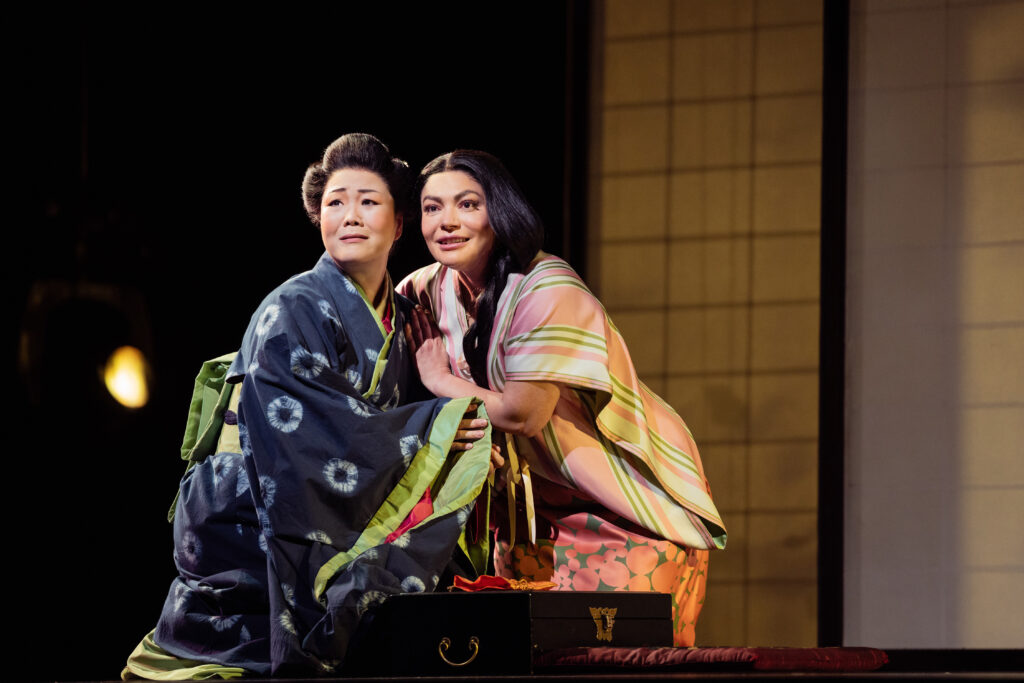
In the role of Suzuki, Met debutante Hyona Kim brought a devastating portrait, bringing a lush vocal quality that varied between lyrical and dramatic. During the Flower duet, her voice blended beautifully with Pérez’s and in the trio “Io so che alle sue pene,” Kim dug into her lower voice as her middle range rang with power. One could see how she was suffering for Cio-Cio-San. In the final scene between Pérez and Kim, you could sense Kim’s fear as Pérez embraced her. It was truly a star making performance for Kim and a mezzo audiences should look out for.
As Sharpless, Andrzej Filończyk returned to the Met after a successful turn in “The Amazing Adventures of Kavalier and Clay.” In his debut season, Filończyk is poised for a big Met career. However, on this evening the Polish baritone had a rough start with his voice sounding grainy and pushed. In the accompanying lines of “Dovunque al mondo,” Filończyk pushed his voice to the limit and sounded forced. In Act two, he sounded more comfortable and was better able to shape his letter scene, “Amico, cercherete quel bel fior di fanciulla…” Here he was able to deliver a lighter tone and more legato phrases. Throughout the scene, his character became more compassionate toward Pérez’s Cio-Cio-San with his voice obtaining a more leathery timbre and a clear middle range. In Act three, as he accompanied Baek’s Pinkerton in “Addio fiorito asil,” the voice produced a clear and gorgeous tone.
Rodell Rosel displayed a hefty tenor as Goro, while Jeongcheol Cha had a booming bass-baritone as Yamadori. Hannah Jones brought a lush sound to Kate Pinkerton.
In the Pit, Marco Armiliato showcased a powerful rendition of Puccini’s score. He was able to bring the full power of the ensemble in the most dramatic moments such as the “Con onor muore chi non può serbar vita con onore” and the heartwrenching “Che tua madre dovrà prenderti.” Then he was able to scale it back and bring ethereal colors to the score, especially during the Act three prelude. There was also delicacy in the “Una nave da guerra,” in which gradually crescendoed with the singers. His humming chorus felt mystical as the orchestra played with tenderness and slowly died down at the end, accompanying the chorus to perfection.
Anthony Minghella’s production continues to be outstanding and on this occasion the bunraku puppet was even more affecting as Pérez’s interactions with it were filled with tremendous care and affection. The moment that the puppet walked on stage, Pérez never took her eyes off of it. You could tell the puppeteers were following the soprano’s every movement and reacting with the puppet in that way. It made the relationship all the more heartbreaking at the end.
Pérez has one more performance in January and then returns in March for four more performances. Make sure to be there.