Metropolitan Opera 2025-26 Review: La Traviata
Lisette Oropesa & Luca Salsi are Stunning in Verdi’s Masterpiece
By Francisco Salazar(Credit: Ken Howard / Met Opera)
On March 31, the Metropolitan Opera presented the fourth performance of its current revival of Verdi’s “La Traviata.”
At the core of this revival’s first cast was Lisette Oropesa, who returned to the Met after a successful “I Puritani” earlier in January. While that role showed the soprano’s precision and elegance in the bel canto repertoire, “La Traviata” brought out Oropesa’s full lyric voice in what was one of the best interpretations of the role today.
A Masterful Interpretation
Act one saw the soprano take advantage of her shimmering bright tones, especially during “Libiamo” and “Un dì felice eterea.” Her entrance in the duet “Ah, se ciò è ver, fuggitemi” featured virtuosic staccato and playful phrases that showed off her vibrant high notes. That was followed by an introspective “È strano! è strano! in core” and “Ah! fors e lui che l’anima” during which Oropesa employed delicate pianissimo and smooth legato bel canto phrases. One could sense a woman in conflict with her sense of falling in love. That was heightened in the subsequent “Sempre Libera,” with Oropesa’s Violetta battling the emotions of first love and freedom. Vocally the cabaletta had gutsy crescendoes and coloratura roulades even though it was slightly imprecise and often times strained on the high note following “Gioire.” Her final E flat also lacked ring. I bring this up because Oropesa’s performances are almost always marked by a technical precision and refinement that no other working singer has.
In Act two, the soprano’s vocal quality was warmer. During the extended duet with Germont, Oropesa’s Violetta evolved from a charming woman to one filled with defiance, fear, remorse, and sadness. Her “Non sapete quale affetto” was desperate as the soprano crescendoed to a full forced fortissimo on the lines “Che morir preferirò.” The moment was so intense that she received some applause from the audience. As Luca Salsi sang his ensuing passages, Oropesa’s face was filled with horror, leading to her “Così alla misera – ch’è un dì caduta,” which showcased a melancholic timbre and a resonant middle tone. Her “Ah! dite alle giovine ” was also extraordinary with Oropesa spinning a gorgeous piano sound and extending each lie with as much care. She took her time with each line, especially as she reached her high register. “Morro la mia memoria” foreshadowed’s Violetta’s destiny in Oropesa’s interpretation, her physical movements gaining frailty and her voice singing with pure power and some audible breaths to emphasize Violetta’s hopelessness. During “Siate felice Addio,” Oropesa gave the lines a weeping sound. She capped the first half of the second act with a passionate “Amami Alfredo” that was affecting in every way.
In Act three, Oropesa was all about conveying the raw emotion of Violetta and the weakness of the character as she slowly became more frail in the act. In her letter reading, “Teneste la promessa,” Oropesa dug into her chest voice slowly emoting with more force until she reached “È tardi!” which she accented almost shouting the lines out of desperation. That led to her “Addio del Passato” during which Oropesa sang the first part with gorgeous floating lines that slowly crescendoed into desperate yearning lines in “Ah, della traviata sorridi al desio” and “Or tutto finì!” During the second repeat, Oropesa lay on the ground and sang her opening “Le gioie, i dolori tra poco avran fine” with hushed pianos slowly growing her sound but never getting to the same forte from the first part. Her final lines “Or tutto finì!” were held with a thin floating line that emphasized that weakened state in her Violetta. In “Parigi o caro,” Oropesa’s voice rang with a gleaming middle voice and lush legato lines, each connecting with beauty and expressing the joy of her Violetta in that moment. But in the following lines “Ah! non piu a un tempio,” Oropesa expressed the darkness of her impending death with deep chest tones but also with frazzled trills leading up to an impressive and emotional “Ah! gran Dio morir si giovine.” During the opening of this passage, the soprano started with a pianissimo sound, eventually crescendoing to a fortissimo before once more quieting down in the subsequent lines and later on letting out the full power of her voice. The entire passage expressed Violetta’s desperate will to live, the emotional roller coast laid out for us in a truly visceral manner. In Oropesa’s final ensemble “Prendi quest e l’imagine,” the soprano sang each moment with the utmost delicacy and sweetness in her voice, all while lying her bed. At the end in “È strano! Gli spasmi del dolore,” Oropesa emphasized each line of text, emoting it with a lightness and the vibrant voice from Act one while slowly standing up with a revived energy. The final “Oh gioia!” was delivered with renewed power. In all the soprano conveyed the devastation of Verdi’s heroine and once again showed the Met audience why she is one of the best sopranos today.
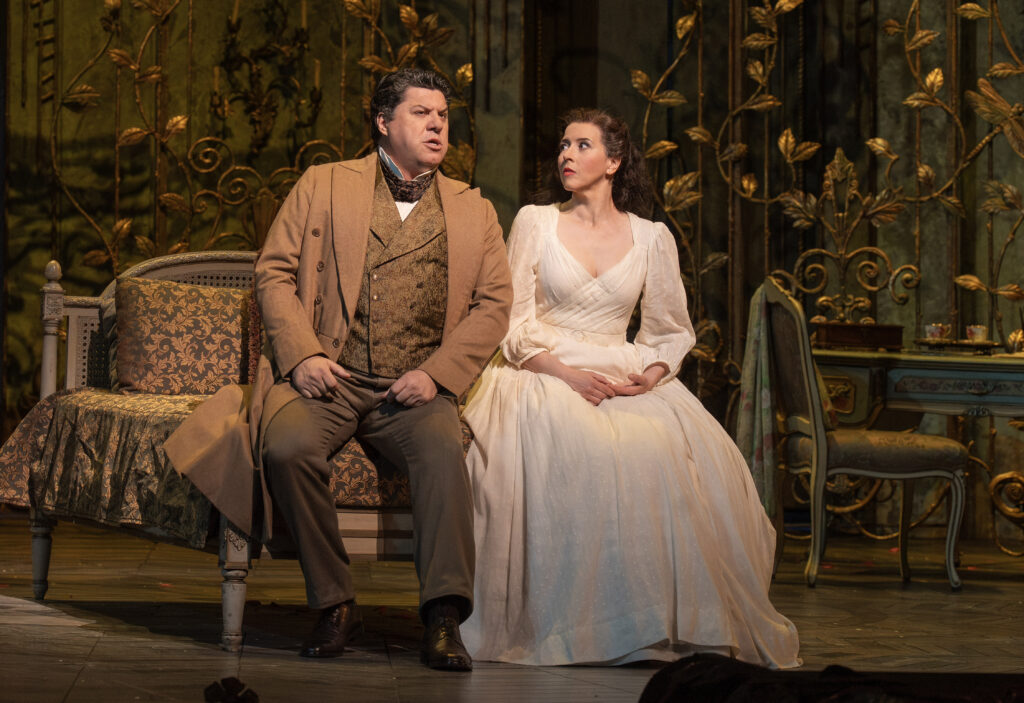
Credit: Ken Howard / Met Opera
Verdi’s Baritone
As Germont, Luca Salsi brought his iconic turn back to the Met with depth and complexity. Together with Oropesa, Salsi made Act two, part one a scene full with tension. Salsi entered the stage with a booming imposing presence coupled with a chilling baritone that emphasized the sternness of his character. Then as he began his “Pura siccome un Angelo,” his voice turned to smooth piano singing with legato lines and tenderness before erupting with a biting and staccato “E grave il sacrifizio” as he sat next to Oropesa, looming over her every look. As the soprano sang her opening lines of “Ah! Dite alla giovane,” Salsi’s demeanor changed and you could sense a conflict in him causing him to attempt to exit. But he eventually returned for his “Sì, piangi, o misera – supremo, il veggo.” That warmth and tenderness returned and the voice was full of rich tones that supported Oropesa’s singing beautifully. There was sincerity toward the end of the duet as Salsi reached out to comfort Oropesa.
In his subsequent aria “Di provenza il mar il suol,” Salsi sang with a wide range of dynamics especially a mezzo piano with smooth legato that emphasized Verdi’s long flowing lines. It was a moving rendition, further emphasized by his choice to caress Piotr Buszewski’s Alfredo. Salsi ended the first part of Act two with a soothing and virtuosic “No non udrai rimproveri” in which the baritone delivered depurated runs and a smooth legato line. The second part of the act gave Salsi another moment to bring out that booming sound in “Di sprezzo degno se stesso rende” emphasizing the disappointment in his son. And Act three, Salsi had a full circle moment as he sang “Troppo rimorso l’alma mi divora” with tremendous remorse for his actions.
A Rising Star
As Alfredo, Piotr Buszewski got off to a slow start with his voice falling short and his acting a bit stiff. His opening duet with Oropesa showed some promise especially in his mezza voce singing but as he crescendoed into his full voice, there was a disconnect between registers. That was even more evident in “De’ miei bollenti spiriti,” where Buszewski opened the aria with a mezzo piano singing and a smooth legato line. However as he moved into the his higher range, there was a lack of cohesive phrasing and the high notes did not gleam cleanly. He recovered in his Cabaletta “O mio rimorso!” and sang with great resonance in his highs, topping the entire section with an impeccable High C.
Act two Scene two was also a high point for the tenor, especially in his “Ogni suo aver tal femmina,” where Buszewski sang with desperation and anger. The voice slowly crescendoed to its climax in the lines “Che qui pagata io l’ho.” The tenor’s stage presence gradually became more and more erratic acting in his desperation of feeling betrayed.
In Act three, Buszewski sang with a gorgeous pianissimo in “Parigi o caro,” at times finding himself disconnected from his full voice. Nonetheless he was able to blend with Oropesa’s ringing sound to create a moment of pure passion. The second section of the duet “Ah! gran Dio morir si giovine,” the tenor sang his lines “Oh mio sospiro, oh palpito” with great intensity. In the final ensemble, the tenor’s “No, non morrai, non dirmelo” was performed with great affect, emphasizing the lament in Alfredo’s music.
Dwayne Croft made a cameo as Baron Douphol. A renown Germont himself, Croft showcased a nobility in Baron, his voice resonant and elegant. Edyta Kulczak was an animated Flora, while Tessa McQueen showcased a promising lyric soprano as Annina. As Grenville, Richard Bernstein was great support in the final ensemble.
Time for Change
Unfortunately the evening was all but perfect.
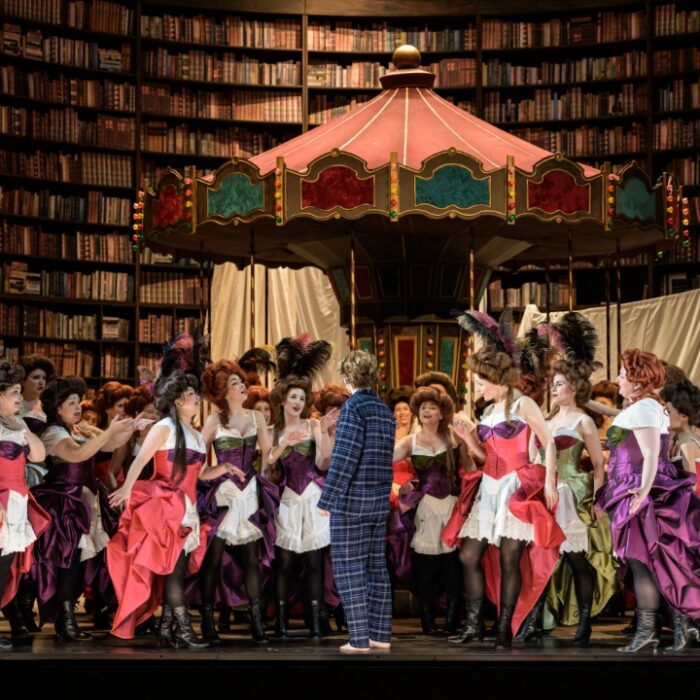
A few months ago it was announced that the Metropolitan Opera would revert to an older production of “Carmen” due to the lack of success of the new one by Carrie Cracknell. The current “Traviata” by Michael Mayer deserves the same fate as it becomes harder to watch each season. The ovular shaped set is flat in every way, lacking depth of field. Its gold ornamentation reminds one of the tasteless trump tower. The costumes by Susan Hilferty are gaudy and out of place, while the choreography by Lorin Lattaro is noisy and it is clear the dancers struggle to move in the restrictive spaced forced on them by the bed and a set that makes the Met stage look extremely small. The direction for the chorus is unfortunate with the ensemble made to stand around while bunched up the entire evening without any motivation. It should be a pre-requisite for anyone who wants to direct an opera to know how to direct a chorus. The chorus’ poor direction is the first sign that the director is not ready to take on the task of an opera and given that the Met Opera is the premiere opera company in the world, it should only be reserved for those truly ready for prime time. This production’s direction never was. Finally, the inclusion of Alfredo’s sister is always a distraction and an example of a director trying to add where the opera simply never needed it.
Then there was the conducting by Antonello Manacorda, which was erratic the entire evening. The preludes to Act one and three were extremely slow and tinny with the violins sounding small and lacking color. The “oomph pa pa” rhythms were extremely exaggerated especially in the Brindisi. Then there were the numerous choral sections, especially in the second part of Act two, where the conductor was behind or ahead of the vocal ensemble, creating imbalance. There were also constant bombardment of sounds every time the score went to fortissimo. It seemed like Manacorda wanted to release as much sound from the orchestra as possible for dramatic effect, but it was an example of overdoing it.
In all, this was Oropesa and Salsi’s evening and one more win for the 2025-26 Metropolitan Opera season.