Metropolitan Opera 2025-26 Review: I Puritani
Sandro Sequi’s Production is Replaced by Incoherent New Production; Lisette Oropesa & Lawrence Brownlee Give Bel Canto Masterclass
By Francisco Salazar(Photo: Ken Howard / Met Opera)
Less is more!
That was what Sandro Sequi did well in his traditional 1976 production of “I Puritani” at the Metropolitan Opera. Originally staged for Joan Sutherland, the production was a vehicle for the great divas of the Bel Canto repertoire. And while it was admittedly a product of its time, the last three times it was revived, each of the divas assigned to the production transformed the old-fashioned production into something modern, fresh and unpredictable.
But in the Met’s latest rendition by Charles Edwards, the attention wasn’t so much on the characters and the story but on wondering what new gimmick Edwards would throw on stage at any given moment. And by executing a sloppy production, “I Puritani” joins “Lucia di Lammermoor” and “La Sonnambula” in completing a new production hat trick in the bel canto repertoire at the Met. For the third time in the Yannick Nezet-Seguin-Peter Gelb era of Bel Canto, the director manages to make a mess of trying to justify and make sense of a story he clearly lacks confidence in.
For Lucia we got a rotating set in a modern day impoverished community with lots of blood, a zombie, and a fidgety camera, while “Sonnambula” was set in a Swiss alps staging with no dimension, random dances, and a spirit that appeared out of the blue. In “I Puritani” we got random apparitions in the most crucial moments to go with a static set that was disguised as traditional. Needless to say, the Met’s latest trend has made Bel canto a chore to watch and, sadly, hard to want to return to.
Distraction Galore
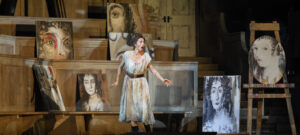
For Charles Edwards’ production, the opera is set in a Puritan meeting house, which serves as a public gathering place, church, courtroom, and makeshift fortress. The set evolves throughout the entire evening with it gradually descending into scenic chaos. It’s spacious and uses the entirety of the Met stage but it quickly becomes static to look at as Edwards’ blocks everything poorly with the singers relegated to the front of the stage and the chorus moving about in a messy way.
There are some interesting lighting ideas like the opening of Act two, which shows a dilapidated set created by the use of bright lights. The thunder that opens Act three is also visually stimulating and the use of green lighting for the apparitions is eerie.
However, the rest of the evening is “One Distraction after Another.” Edwards gives a back story to the opera which takes place during a conflict between the Royalists and the Puritans and shows us how Elvira and Arturo meet. He gives audiences subtitles for each of its Acts to explain what is happening. Edwards even changes the plot to give us a break between the first scene and the second scene and make an eight-year jump. It doesn’t really clarify much in the grand scheme.
Then there are the directorial choices where Edwards clearly doesn’t trust the music and needs to give us something every time there is a new number. First we see a young Elvira fall in love with a young Arturo as she paints him during the prelude. Then during Riccardo’s aria we see him signing random papers or drinking as he sings florid lines while in Elvira and Giorgio’s duet, we see her break paint brushes, dance with Enrichetta, and later paint Enrichetta. In “Son vergin vezzosa,” the chorus randomly comes in to sing two lines and then leaves all while we are trying to focus on Elvira’s joyous song. During the confrontation between Riccardo and Arturo, Riccardo has to be drunk and attempts to rape Enrichetta, all while Arturo is attempting to confront Riccardo with an axe that he can’t hold. That moment elicited laughs. In the final scene of Act one, “Ah! Vieni al tempio,” Elvira attempts to hang herself and then sees an apparition of Arturo which she interacts with. At the end of the scene, she takes that aforementioned axe and then attempts to have sex with a drunk Riccardo.
Act two is no better. During Elvira’s mad scene, we have to be subjected to chorus members leaving the stage one by one during the entire 15-minute aria; it’s a meta moment in which the on-stage audience’s action almost seems to be commenting that all of this (by this, I mean the opera’s most iconic and essential moment) is such utter nonsense that they should just leave. He might as well have been commenting about his own work. Then during her cabaletta “Vien, diletto,” the apparitions of Enrichetta and Arturo return. At first, they just stand around and do nothing. Then Elvira, during the repeat of the cabaletta, starts to paint Arturo. During “Suoni la tromba,” both Giorgio and Riccardo get drunk and start painting themselves in a rally call to battle. Random actors appear, moving in laughable motions, and transforming what is usually a heroic moment into a joke.
Act three is filled with less distractions but the duet “Fini mi lassa” is marred with Elvira turning paintings around and then throwing them about. In the final scene she breaks one of the paintings and sits center stage with one around her neck. The finale is also baffling as Arturo returns to his father and leaves Elvira, prompting the Met to cut “Ah! Sento, o mio bell’angelo,” making it the first time in 50 years that this aria is not heard at the house.
Costumes by Gabrielle Dalton don’t make matters any better as the Elvira’s wardrobe blends into the grayish-beige set while Arturo’s pastel blue gets lost in the mix of blacks and beige. Only Enrichetta’s yellow costume stands out and you understand she is not part of this society.
As the opera came to an end, I couldn’t help but wonder about Edwards’ choices and why everything he did seemed to undermine the opera itself. The painting motifs adds up to nothing as it is unclear why Elvira is so obsessed with painting and whether it has anything to do with her ability to express herself (and if it does, then what is she, in fact, expressing during the course of the staging). Riccardo is a drunk throughout but at the end of the opera he suddenly isn’t. Giorgio sits and watches on with really no tangible perspective on the proceedings and Arturo’s shift from a love interest to abandoning Elvira doesn’t really make much sense. If there was a statement to be made about patriarchy and its laughable nature, then it came across as overly on the nose with the potential complexities thrown aside in favor of overzealous rewriting. This might as well have been a completely different opera.
Reliable
In the pit, Marco Armiliato gave a fantastic reading of the score with the orchestra sounding rich and dynamic.
Never did you feel the music drag and he never got in the way of the singers. The orchestra also sounded precise and polished under him. His prelude was wonderful to listen to while his choral numbers were well-balanced. Some of the passages were performed with forward movement especially Giorgio and Riccardo’s duet and even Elvira’s mad scene, which had propulsion from the first “O rendetemi la speme.”
But what was missing was a point of view on the music. With these new productions, one hopes that like the story, the music is also being rediscovered. On this occasion, the score was performed in a more complete form with many of the usual cuts opened and therefore audiences were allowed a fuller perspective of the complete score. But then there were random codas cut and repeats suddenly missing. It seemed like they wanted to do a critical edition but stopped short of it and as a result, there was no sense of the overall musical vision. The only cut that made much sense was the aforementioned “Ah! Sento, o mio bell’angelo,” and that seemed to happen only to accommodate the production’s needs.
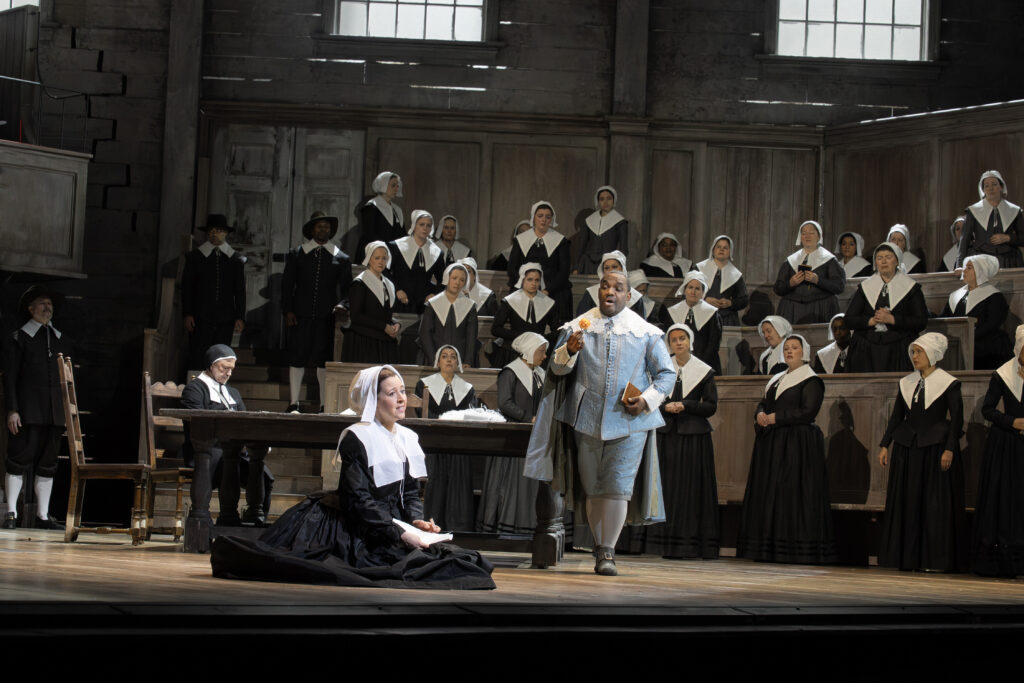
Photo: Ken Howard / Met Opera
Bel Canto Singing for the Ages
In the role of Elvira, Lisette Oropesa finally arrived at the Met in a Bel canto role. The soprano has been making waves in this repertoire for years throughout Europe, but sadly the Met had seemingly overlooked her during all that time. With so much hype for her arrival, it’s safe to say that Oropesa delivered on her promise. From her entrance in her duet, “Sai com’arde in petto mio,” Oropesa delivered one impressive roulade after another with precision, all the while inserting a couple of variations. There was a nostalgic quality to her vocal powers in her subsequent lines but then the voice obtained a brightness in the “Odi..qual suon si desta” and her lines “Ah! padre mio,” which she started out piano and slowly crescendoed to forte. That was followed by a joyful “A quel nome, al mio contento,” which Oropesa delivered with delight, all while dancing alongside her colleague Eve Gigliotti.
More impressive was her held out lines in “A te o cara,” where her voice gleamed with ethereal colors, displaying delicacy and tenderness. Then in the famed “Son vergin vezzosa,” Oropesa showcased fantastic interpolations and pristine high notes. It didn’t hurt that the soprano repeated each phrase and each time added one more virtuosic coloratura passage. Something to take note of were the accurate trills that Oropesa displayed, adding to her Elvira’s gleefulness and innocence.
As Elvira descended into madness, Oropesa’s voice gained a weightier quality, emphasizing the extremes from the lower chest voice to the high notes. Her “Ah! Vieni al Tempio” was filled with pathos as each line gained a more lyrical and rounder sound. As the passages developed and the melodies repeated Oropesa continuously took musical risks. At the climactic moment of the concertato, Oropesa interpolated a passage on “Ah! vieni, ah! vieni a me” as traditionally done. Her voice rode over the orchestra line to its highest extremes, displaying Elvira’s madness. It was one of the best moments of Oropesa’s performance. The cadenza that ended the line was showstopping as Oropesa sang with delicacy and beautifully timed roulades. Oropesa’s voice gained more power in the subsequent stretta as she dispatched the final lines and the voice filled the house with powerful high notes.
In her famed mad scene, Oropesa had to compete with the aforementioned chorus members’ exits and a huge set of distractions. But the soprano was up to the task. From her first, off-stage “O rendetemi la speme,” you could sense her longing for Arturo singing with her long legato lines. Then as she went on stage for “Qui la voce sua soave,” the soprano began her first verse with tender and smooth lines. The “Ah! tu sorridi e asciughi il pianto!,” interlude maintained a delicacy that soon turned to darker tones, especially in her lower notes. In the repeat of the A melody, Oropesa sang with slight accents, particularly on each repeat of “O lasciate, lasciatemi morir,” giving the line a little more aggressiveness. She pushed the melody forward, helping express the character’s ever-growing desperation. In the subsequent, “Vien diletto e in ciel la luna,” Oropesa once again displayed prowess in her coloratura each time rising to exquisite high notes and impeccable fioritura. Her E-Flat that capped off the mad scene resonated with striking power.
Oropesa’s Act three was capped off with a mix of brilliant phrasing in her duet with Lawrence Brownlee that expressed nostalgia, suffering and joy as the duet developed. Both voices blended gorgeously as they accompanied each other in the “Vieni fra queste braccia,” with the High Ds ringing gorgeously. While Elvira does not have as much as Arturo in Act three, Oropesa did hold out gorgeous lines in the accompanying melody of “Credeasi misera.”
Oropesa is a one of the finest singers in the world and it’s great to see the Met finally rolling out the red carpet for her in a new production. Hopefully she gets a better one next time.
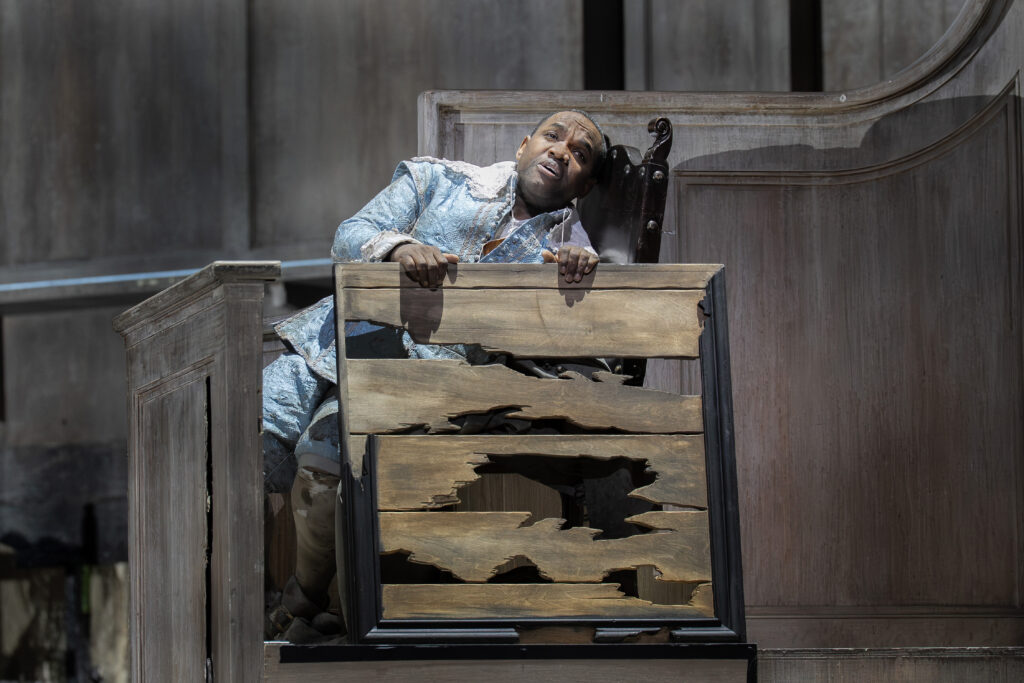
Photo: Ken Howard / Met Opera
High Fs, Ds and Es
In the role of Arturo, Lawrence Brownlee reprised his signature take after more than a decade. While the blocking often detracted from his interpretation, his voice continues to beautifully handle the demandingly high tessitura, especially on the High F in “Credeasi misera,” which he sang with utmost power.
His opening “A te o cara” was full of ardent sound and one could feel the youthful qualities of his Arturo. In his “Al brillar di sì bell’ora” Brownlee interpolated powerful high notes that emphasized his joy at being with Elvira. But that Arturo soon turned to anguish, especially in “Non parlar di lei che adoro” where he pushed the tempo forward and sang with forcefulness and bright high notes. You could sense that his Arturo was distraught by the decision to leave his beloved. And that only grew in his duet with Riccardo, where Brownlee dispatched coloratura runs with fierceness as the voice continued to rise above the orchestra. The lines turned a bit more assertive as he continued the “Sprezzo, audace, il tuo furore.”
Act three was all about Brownlee and while he did began his first aria, “A una fonte afflitto e solo,” a little fatigued, he slowly regained that legato line that flowed and melted into the next. It was intoxicating to hear and you could sense the tenderness of Arturo’s emotions. As noted in his duet with Oropesa, the two complimented each other incredibly but it was interesting to see them so far apart throughout the entire thing.
His final aria, “Credeasi misera” was filled with bravura, but what was more interesting was the agony that you could sense from his Arturo. Brownlee’s sound obtained a desperate feel especially on “Crudeli, crudeli!” and in the accents on “Ella è tremante, Ella è spirante.” The high notes that capped the aria were filled with torment. It was truly one of the high points of his evening.

Photo: Ken Howard / Met Opera
Bel Canto Complete
As Giorgio, Christian Van Horn started a little rough sounding in his opening duet with Oropesa, though he quickly warmed up in his “Piangi, o figlia, sul mio seno,” where he showed a warm and luxurious legato that flowed with ease. He did struggle a bit in the “A quel nome, al mio contento” portion, as he seemed to lose breath due to the swift tempo and could not keep up with Oropesa’s coloratura. However, where he impressed the most was in his Act two aria, “Cinta di fiori e col bel crin disciolto.” Here Van Horn showed warmth with his dynamics never moving from a mezzo-forte and even at times bringing his hefty sound to a piano. His lower notes were also imposing especially as he ended the final note diminuendoing to a pianissimo. In “Suoni la Tromba,” Van Horn was a force to reckon with, singing with mighty power.
In the role of Riccardo, Artur Ruciński demonstrated some fine legato phrases especially during his aria “Ah! per sempre io ti perdei” where he shaped each line with flexibility and immaculate coloratura. In his cadenza that begins the repeat of the main melody, the baritone held a phrase in one breath into the line “Io sfidai sciagura e affanni.” It was impressive and virtuosic. Then during the cabaletta “Bel sogno beato,” Ruciński sang with great force and accurate coloratura during the coda, “La dolce memoria.” His final G that ended the section was held out until the final bar of music which was simply amazing to hear as it resonated throughout the auditorium. The baritone received the loudest ovation of the evening following his aria. In his duet, “Se tra il buio un fantasma vedrai,” Ruciński emphasized the staccato phrasing that blended well with Van Horn’s authoritative bass. While Ruciński’s baritone did sound a bit worn out at one moment, he conserved his energy for “Suoni la Tromba,” where both Van Horn and Ruciński sang with rich and heroic tones that reverberated throughout.
In role of Enrichetta, Eve Gigliotti showed off a round mezzo-soprano in her short but crucial role, especially during her duet with Brownlee’s Arturo and during the “Son vergin vezzosa,” where she emphasized the rhythmic notes that support Elvira’s melodic line. Meanwhile, David Pittsinger, as Gualtiero, displayed a booming bass-baritone in his recitative lines.
The chorus was also in good form especially at the opening of Act one and two. The finale of Act one, “Ah! Ah Vieni al Tempio,” also saw the chorus support Oropesa to perfection while the finale of the opera was jubilant, even if the staging was not.
In all, musically this was everything one would want of Bel Canto singing. The staging and production was everything but that.