La Monnaie 2025-26 Review: Falstaff
Laurent Pelly’s Inventive Production Oscillates Between Buffoonish Realism & Fairy-Tale Fantasy
By Andréas ReyFrom September 21 to October 9, the Brussels opera house “La Monnaie” revived Laurent Pelly’s 2018 production of “Falstaff” at the Ópera Real in Madrid.
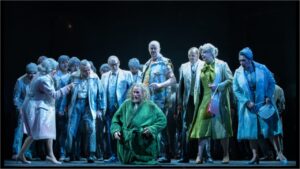
Setting the drama in the present day, the French director successfully blends realism, comedy, and fantasy with constant inventiveness. There are dozens of inventive touches in the staging, and they never grow tiresome. From the clones of Ford representing high society to the mirror representing the forest fog, and the symmetrical construction of the two staircases at Mrs. Ford’s house, the audience is constantly entertained. The best of these inventions, however, is the way the dimensions of the stage reflect Falstaff’s importance. The opera begins in the cramped confines of the Garter Bar, then opens when Falstaff describes his plan to his henchmen, expands further when Miss Quickly comes to him, and has no walls at all in the forest of the last act. This set design perfectly captures the atmosphere of this comedy, which oscillates between buffoonish realism and fairy-tale fantasy.
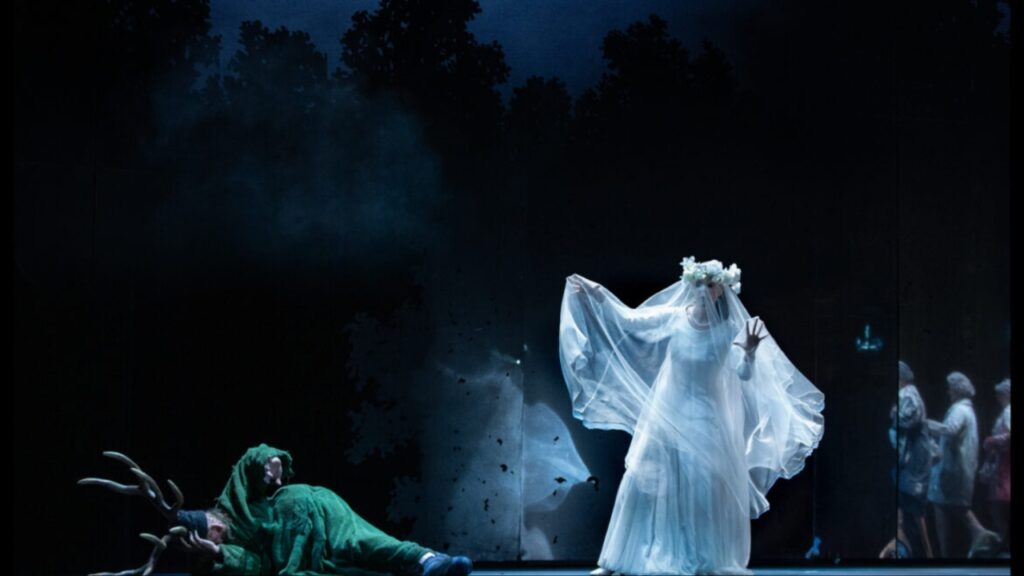
(Photo: © Clarchen Baus / La Monnaie Bruxelles)
It would have been preferable for the costumes and makeup to complement the staging rather than weigh it down. Falstaff is portrayed as a sort of tramp with a ruddy face and second-hand clothes. He is ridiculed. Bardolfo is a sort of punk, and Pistola wears combat boots, a military vest, and a ponytail. While the pair of sidekicks certainly has a comical aspect, with Pistola being three heads taller than Bardolfo, the earthiness is still lacking. Similarly, while the symmetry between Mrs. Ford and Mrs. Page is emphasized on the women’s side, both by the architecture of the staircases in the middle of the stage and by the similarity of their suits, the ridicule here is brought about by very cliché postures and stage acting. Here too, they are caricatures. Miss Quickly does not escape this general caricature either.

(Photo: © Clarchen Baus / La Monnaie Bruxelles)
The difference between caricature and earthiness is that the second retains tenderness in the grotesque. The first judges, assassinates and therefore lapses into cliché. Unfortunately, there is no compassion, no nuance and no affection in their stage acting.
Fortunately, despite some exaggerated stage acting, Nanetta and Fenton’s pairing provides relief and refreshment from these heavy-handed incarnations, thanks to their spontaneous rapport. Their duets, during Mrs. Ford’s plot and before Falstaff is thrown into the Thames, move the audience just as much as those of Lauretta and Rinuccio in Puccini’s “Gianni Schicchi.” Discerning ears may regret that Benedetta Torre as Nanetta sings slightly louder than Bogdan Volkov‘s Fenton, but the tenor’s velvety voice nevertheless blends well with the soprano’s mellifluous tones.
Otherwise, the singing lacks sparkle and color. It’s not that the singers sing badly, but they never completely delight. Sir Simon Keenlyside as Falstaff lacks roundness in the “L’Onore! Ladri! Voi state ligi all’onor vostro, voi!!” of the first act, and in his “Io, dunque, avrò vissuto tanti anni, audace e destro. Cavaliere, per essere portato in un canestro” of the third act. Lionel Lhote as Ford sounds dry, especially when he is Fontana, in his “E’ sogno o realtà?… Due rami enormi.” And both Sally Matthews as Miss Ford and Daniela Barcellona as Miss Quickly sound cliché in their arias because of their lack of embodiment. I regret not having Marie-Nicole Lemieux as Miss Quickly.
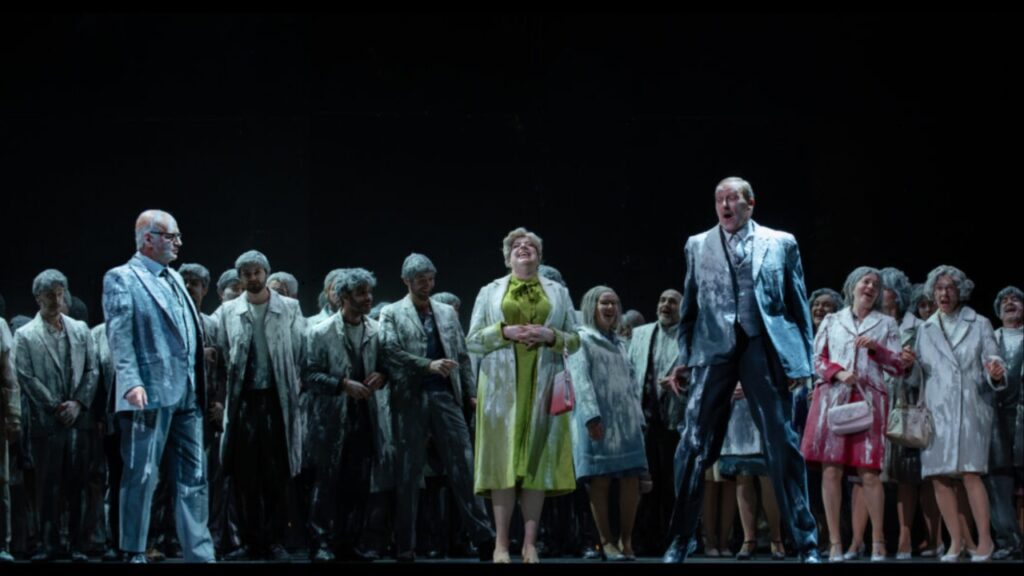
(Photo: © Clarchen Baus / La Monnaie Bruxelles)
The orchestra lead by Alain Altinoglu, for its part, is hampered by lengthy set changes that interrupt its musical flow. As a result, the musical inventions Verdi used to give realism to the score seem to become merely anecdotal. The orchestra becomes conventional instead of magical.
Without being excellent, like last year’s Paris or New York productions, this “Falstaff” is an honest version, saved by the comical inventions of the staging. This one is more for the eyes than the ears.