Irish National Opera 2025-26 Review: The Bartered Bride
By Alan Neilson(Photo: Pato Cassinoni)
Irish National Opera‘s (INO) recent tour of Smetana’s “The Bartered Bride” took in a number of small venues across Ireland that rarely, if ever, get featured in its normal schedule. Included were towns such as Birr, Monaghan and Manorhamilton, situated in the rural hinterlands, far distant from the Dublin metropolis and the smaller urban areas of Galway, Cork and Limerick. Presenting a fully staged opera that requires a large performance space, one able to accommodate a sizable cast, an orchestra of 40-plus musicians, and a chorus, is therefore going to be problematic, if not impossible. The opera was therefore substantially downsized. The orchestra was reduced to a small ensemble comprised of five members, the single set was small and very basic, and the chorus was performed by the soloists.
This may sound somewhat disappointing. After all, it was hardly going to be the sparkling spectacle that one expects, full of peasant dances and energetic choral numbers with a rich orchestral palette offering variegated textures and a range of colors and dynamic possibilities.
However, what actually transpired was surprisingly good. It turned into a more intimate presentation, in which the relationships between the characters and the underlying dynamics that fed the dramatic momentum were clearly brought to the fore, rather than lost within the spectacle itself, which can happen on occasions. Moreover, the natural, small-scale musical forces actually reinforced the dramatic context of village life and provided closer support for the personal utterances of the characters. Thus, what was presented was not an inferior but a different representation of Smetana’s most performed opera.
The score was rearranged by Richard Pierson, who also directed the small ensemble comprising a piano, violin, cello, clarinet and horn. For the performance, it was positioned at the rear of the stage on a wooden, rustic platform decorated with lightbulbs found in a dancehall in the not too-distant-past, which fitted perfectly with director Louisa Muller’s presentation.
A Reading Inspired by 1970s Rural Ireland
The simple narrative is a light-hearted depiction of 19th-century village life in rural Bohemia that makes use of widely accepted stereotypes to reflect the concerns, values and behavior of the people, particularly their close-knit relationships, the gossip and the role of marriage in securing the fortunes of the family and, of course, their communal celebrations. Jump forward to 1970s rural Ireland, and one finds a not too dissimilar situation. Much of the country was economically underdeveloped, in which people’s lives were closely entwined and centered on the village community. Land was a major source of status and wealth, and the suitability of marriage partners was widely discussed, while visiting dance bands at the local dancehall was a major social event. Muller thus decided to create an Irish version of “The Bartered Bride,” which had the advantage in that it chimed with INO’s chosen venues: small towns in which the echoes of mid-20th century Ireland still resonate with a clarity that has largely disappeared from the rest of the country, which following the economic miracle of the last 30 years fundamentally transformed the nature of its society.
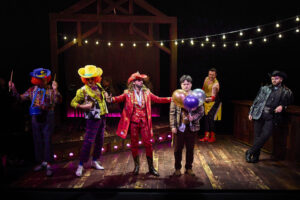
Working with the set and lighting designer, Ciaran Bagnall, and costume designer, Joan O’Clery, Muller created a convincing staging that captured the ambience of the time, in which the set transformed easily between a pub and a dancehall, with the ever-present ensemble playing on the rustic stage, as if they had been hired for the evening, which they celebrated by wearing cowboy hats. Occasionally, characters would step onto the stage and sing an aria from an open microphone, as if they were participating in a pub sing-along. Discussions with the parents about the marriage with Kecal, the marriage broker, took place, like most discussions, over a few pints of Guinness in the pub. Differences in the status of the characters were clearly displayed in the costumes, so, for example, Vašek’s parents were attired with higher quality clothing than Mařenka’s parents, successfully highlighting the gap in wealth that separated them. The evening dance took on an American country music theme, for which the characters were costumed in an appropriate dress, and choreographer, Rebecca Howell, created splendid dance routines that filled the small stage without appearing overcrowded. The circus scene was also imaginatively handled; there was plenty of fun and laughter as the performers hammed up their roles brilliantly, while their costumes were suitably over-the-top and garishly colorful, adding successfully to the lively atmosphere and general sense of excitement.
This reading worked very well on all levels, and not just visually. Smetana’s characters were brought convincingly to life while fitting seamlessly into 1970s Ireland. Each scene was imaginatively and sensitively developed so that its updated staging sat easily with the original setting of 1860s Bohemia. Nothing jarred, and nothing appeared forced. It was just a fun production from which the narrative grew naturally, and successfully captured the spirit of the opera.
A Lively Cast Serves Up a Well-Sung Performance
Soprano Amy Ní Fhearraigh has impressed in a number of productions over the past couple of years, in which she delivered well-judged performances that have uncovered the emotional depth and dramatic significance of the characters she portrayed. Not only is she a fine actress that is able to bring out the nuances of her character, but she also displays skill in using the voice to flesh out her characterization. As the bride, Mařenka, she proved to be loving and loyal, although she could also be feisty and defiant when necessary. There was also a fun side to her character, which she played up convincingly. Her singing was confidently crafted, employing her colorful palette, well-placed accents, flexibility and ability to alter the emotional quality of the sound in order to strengthen the impact–indeed, there was much to admire about her performance! However, her desire to capture the full vocal depth and nuance of her role often meant compromising its beauty. Although possessing a beautifully weighted middle register, the underlying lyricism of her singing did not always appeal. Her transitioning between registers was awkward and occasionally grated on the ear, and her vocal leaps were not always successful. With more dramatically intense characters, this may not have been so obvious, but her Mařenka would have benefited from a shift of focus away from expressive honesty in favor of lyrical beauty.
Tenor Egor Zhuravskii created a sympathetic portrait of Mařenka’s preferred husband, Jeník. Working behind the bar at the local pub, he cut the image of an easy-going, cool dude; he was outgoing and charming with an independent spirit that made him an obvious match for Ní Fhearraigh’s Mařenka. He possesses a voice with a pleasing tone and a lyrically alluring quality that he used well, not only in promoting his ardent feelings for Mařenka, but also for masking his true intentions in his dealings with Kecal.
Together, Zhuravskii and Ní Fhearraigh made a convincing couple that displayed a believable connection that was reinforced through their singing, which was sensitively molded to reflect their relationship.
Tenor William Pearson has a notably sweet and lyrically pleasing voice, which he used expertly to characterize Vašek as a pleasant, timid and naive potential husband, one very unlikely to attract the amorous attentions of many women. In fact, Vašek became a far more interesting character when he decided to get drunk, which Pearson carried off very convincingly, which also allowed him to display the expressive flexibility of his voice.
Bass John Molloy is an excellent singing actor who knows exactly how to bring a character to life, both physically and vocally. As the marriage broker, Kecal, he produced a strong, lively, and animated performance that was peppered with humorous additions; his attempt at persuading Jeníck to accept an alternative to Mařenka was particularly amusing.
The parents of Mařenka and the parents of Vašek were given sharply defined characters, which revealed not only their status within the community and within their own marriages but also their attitudes towards the proposed marriage of their offspring. Although they were essentially stereotypical portraits, they nevertheless functioned effectively in carrying the narrative forward.
The parents of the bride, Ludmilla and Krušina, were performed by mezzo-soprano Carolyn Holt and bass-baritone David Howes. They convincingly portrayed them as less well-off and socially less confident than Vašek’s parents. Howes’ Krušina was excited about the marriage of his daughter into such a wealthy family and was anxious about everything going well, while Holt’s portrayal of Ludmilla was more sympathetic; she worried about her daughter’s happiness, although, of course she was careful never to challenge her husband’s opinions too robustly. Both produced expressively compelling performances.
Vašek’s parents, Háta and Míka, were confident and assertive, and acted as if they knew they came from better stock. Mezzo-soprano Rebecca Afonwy-Jones created an amusing portrait of Hata, which brought out her proud and forceful nature, while showing off the beauty of her voice to good effect. On the other hand, Míka, performed by bass Julian Close, came across as somewhat boorish, authoritarian, and even bullying, and was very impressed by his own money.
The characters that made up the circus scene were wonderfully energetic and colorful and took every possible opportunity to infuse their performances with fun and hijinks, which included the introduction of a bear.
Soprano Megan O’Neill showed off her vocal talent with a confident, bright and fresh-sounding performance as the circus performer, Esmeralda. She supported her role with lively and animated acting.
Tenor Ben Escorcio as the Master of Ceremonies created a strongly defined, suitably larger-than-life portrait. He sang with a pleasing and confident ease that allowed him to dominate the troupe.
Bass-baritone Matthew Mannion, dressed as the gun-toting cowboy, made a strong visual impression as the Outlaw and sang well.
Overall, this was a well-designed production. It was entertaining, full of color and energy, and successfully brought the narrative to life. The cast, which genuinely appeared to enjoy the experience, sang with brio and a sense of freedom that captured the flavor of the work perfectly. Even the small-scale musical ensemble did not undermine the presentation; in fact, its incorporation into the drama added to the atmosphere! Muller’s resetting of the work in 1970s Ireland was an inspired idea in that it drew on the work’s communal memories of the towns in which it was performed.