Florida Grand Opera 2025 Review: Silent Night
By Maayan Voss de Bettancourt
Florida Grand Opera (FGO) opened its 85th season with a heartfelt reminder that opera can be community-driven, emotional, musically accessible, and relevant to the present moment. The atrium was pleasantly crowded before the opening performance of “Silent Night” by Kevin Puts and Mark Campbell; a wide spectrum of glamorous attendees sipped drinks from the bar and watched singers from FGO’s CANTO training program as they serenaded everyone with operatic hits. Ambassadors from the British, French and German embassies were in attendance, as well as artistic leadership from Atlanta Opera and Opera Carolina, who came to see the first iteration of this co-production between the three companies.
One of the immediately striking features of FGO is the way it embraces its community and bilingual fanbase—fully half of the audience were speaking Spanish as they mingled beforehand and during intermission. Supertitles are projected in both English and Spanish for every performance, and Artistic Director Maria Todaro gave her pre-show talk in both languages as she took the proscenium in a custom black leather gown to welcome everyone. Very fitting for an opera that is in five languages (English, French, German, Italian and Latin). She spoke of community, acknowledging the huge team that brought the opera to life (including the newly-established and dedicated FGO Orchestra), nodding to her numerous opera admin colleagues who traveled from as far away as Spain, as well as donors and sponsors, and earnestly thanking the audience for being there and supporting the company. She also announced the official launch of FGO’s Voices of Wellness, a new initiative that aims to bring opera to first responders, veterans, military personnel, and medical professionals. Again, very fitting to tie that launch in with this particular opera.
Production Details
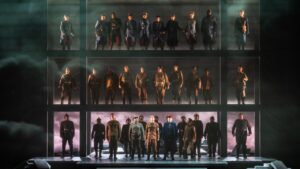
“Silent Night” is a dramatization of the real-life Christmas Truces of WWI, when opposing units (in this case French, Scottish, and German) decided to observe a temporary ceasefire and spent Christmas together in 1914. The production leans heavily into the morbid absurdity and tragic cost of war. Projected names of WWI casualties slowly scrolled across the proscenium scrim before and after the opera, and during intermission. The opera began and ended with a backdrop of a giant tombstone, and the trenches of the set looked like they were made of marble, designed by Erhard Rom to look like a mausoleum. Built in Cardiff at the same facility the Met Opera commissions from, it has three levels, with no-man’s land downstage center on the apron. Projections on the scrim provide additional texture and detail to various scenes and transitions. The shape of the set enhanced the acoustics, and I hope companies beyond the three involved in creating this production rent the set in the future.
After the initial scenes that established the main cast, the opera launched into a battle. The fight choreography, by Rick Sordelet and Christian Kelly-Sordelet were executed by stunt performers from Miami Action Design. They were fantastic. It had a sense of chaos, energy, and escalation without ever being messy. It was easy to focus on the story being told through the combat.
Director Tomer Zvulun, himself a combat veteran, created some striking tableaus throughout the opera that legitimately took my breath away. His staging was very natural, and though there were some static moments, they intentionally made space for the music and acting. It never felt stiff or boring. He drew authentic, emotional performances from the cast. Overall it had a very believable feel, even among such a stylized setup.
This was an incredibly cohesive production; one really got the sense that the team was unified by Zvulun’s vision and in constant discussion from the start. It doesn’t hurt that the bulk of the team has been involved in various iterations of this opera before, so they really have the luxury of a deep understanding of and familiarity with the material. Robert M. Wierzel’s lighting elevated and reinforced the structure of the set, playing over the various zones and highlighting each focal point in a way that kept one’s eyes riveted to the action. He also really used the temperature of the lighting to full advantage to heighten the emotional language of each scene. Vita Tzykun’s costumes were authentic and detailed to a cinematic degree. Every detail, including the tailoring, the accurate military insignia, the fabrics used, the little individualizing touches to even the chorus members’ costumes, made this production feel real and truly grounded in 1914, which was crucial since costumes are often one of the few aspects in a stage production where this level of historical verisimilitude is possible.
Notably, the entire backstage crew came onstage for the bows — a reminder and wonderful acknowledgment of the huge effort and teamwork required when bringing opera to life.
Performance Highlights
With an ensemble cast this large, it’s difficult to pick out individuals to highlight. Especially when everyone is as talented as this cast. The baseline was excellence; literally every performer sang and acted well, with no weak links to pull you out of the story.
That said, the disappear-into-the-role, gorgeous-voice standouts were the three lieutenants, Alex DeSocio as Lt. Audebert, Kyle Albertson as Lt. Horstmayer and Andrew Garland as Lt. Gordon. They completely embodied their characters, with seamless acting and beautiful, intentional singing. DeSocio brought a warm lyricism to his role, playing into the romantic and empathetic nature of his character. Albertson was a forceful presence as befits a German commander. He got the biggest laugh of the night with his delivery of “it is the only Christmas in my life…I’m Jewish.” His character’s growth throughout the opera felt natural, and his unwavering commitment to duty and Vaterland at the end in the face of its direct conflict with his reality and newfound friendships was heartbreaking. Garland brought an understated believability to his role. He wasn’t flashy, delivering lovely, solid singing, then quietly grew on you throughout the opera. His Scottish accent was top notch, and he had fantastic diction. I never needed to look at the supertitles while he was singing.
In such a male-centric opera, the women really stood out and held their own. Sarah Joy Miller as Anna Sørensen deftly handled her insane high notes and brought a really elegant energy mixed with quiet steeliness throughout. I believed she could enchant and soothe three different military units, then exude enough don’t-mess-with-me energy to defect and walk across a battlefield unscathed. Catherin Meza as Madeline Audebert had the shortest role in the opera, but her literal two minutes on stage made me want to hear much more of her.
Kameron Lopreore as Nikolaus Sprink, as the protagonist of one of the main plotlines alongside Miller, carried the weight of that well. His singing was expressive and he really embodied the complex inner world of the character, bringing you along on his tumultuous personal journey. Elliot Madore as Ponchel brought an appealing buffo lightness to the stage with his clowning early on in the opera, and really dropped into a naturalistic and moving delivery in his (spoilers!) death scene. Great contrast. Elijah Brown as Jonathan Dale also displayed excellent dramatic range, starting off with a loveable boyish earnestness and quickly shifting to a brooding detachment that was a deliciously sour counterpoint to the warm camaraderie of the rest of the characters’ arcs.
Joseph O’Shea as William Dale, Mark Diamond as Father Palmer, Craig Irvin as French General, William Dopp as British Major, and James Mancuso as Kronprinz all proved there are no small roles, giving you the sense that each minor character had a full life you just weren’t privy to.
Any issues I had were minor, and more structural than anything; the biggest thing was I wished we got more time with the character of William Dale, to better motivate Jonathan Dale’s arc. It also took me a second to realize the two characters were literal brothers, since O’Shea as William was singing in British RP rather than the Scottish brogue almost everyone else in the unit used.
The chorus was cohesive, sang well, and brought the right balance of support and individualism to the production. They were always engaged even when in the background, and rose to the occasion whenever they were the focus.
Conductor Christopher Allen confidently and sensitively led the ensemble and singers. The orchestra played beautifully, with a full and dynamic sound. They naturally integrated with the singers, never overpowering them, but brought an excellent bombastic sound in the battle scene and a lovely delicacy to the more emotional scenes. They ended the opera with a heartbreakingly tenuous pianissimo that had the audience holding its collective breath.
FGO has executed a world-class production, with a timely story and deft artistry. You only have two more chances to see it in Fort Lauderdale on December 4th and 6th, until it gets remounted at Atlanta Opera and Opera Carolina next year.