Elbphilharmonie Hamburg 2026 Review: I Capuleti e i Montecchi
Bellini’s Opera on Love, Duty and Cantilena
By Mengguang Huang(Photo: Jann Wilken)
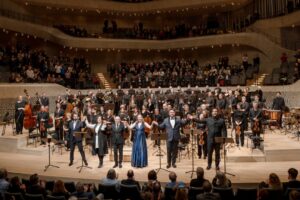
Hamburg’s Elbphilharmonie is not an opera house, yet it regularly presents high-calibre concert performances of opera and oratorio—projects that inevitably place artistic and operational pressure on the city’s Hamburg State Opera. This Bellini evening continued that pattern. With Ensemble Resonanz returning after their previous notable “Norma,” the hall again became a theatre of the imagination. In its enveloping acoustic, Vincenzo Bellini’s “I Capuleti e i Montecchi” unfolded with such fullness and clarity that the sonic richness conjured its own visual drama.
Musical Highlights
From the outset, Riccardo Minasi’s aesthetic was unmistakable: tempi alert yet unhurried, attentive to Bellini’s energetic flexibility. Ensemble Resonanz brought a distinctly modern edge, their lean sonority and sharply profiled articulation giving the texture a refined, almost incisive clarity—strings transparent, winds vividly characterized. The Capulets’ opening chorus unfolded with taut restraint, its rhythm suggesting political tension. The WDR Rundfunkchor expressed this with disciplined diction and controlled dynamics, projecting menace without weightiness.
Elsa Dreisig delivered a performance of striking commitment, placing Giulietta firmly at the emotional center of the evening. In her first scene, culminating in “Oh! quante volte,” she shaped Bellini’s recycled melody with an inward, almost suspended lyricism. Her soprano, silvery and focused, floated effortlessly above the delicate orchestral texture, particularly in the phrases conveying Giulietta’s longing. She maintained a marble-like purity of line, allowing sadness to emerge organically from the seamless legato. The result was a Giulietta whose melancholy felt classical in outline yet deeply human in affect. Her partnership with Romeo developed with palpable immediacy, reaching its peak in the long-breathed unison melody that closes Act one, “Se ogni speme,” where, against the agitated ensemble of their antagonists, both sustained an extraordinary melodic arch with hypnotic control.
Appearing as ruolo en travesti, Kate Aldrich offered a largely compelling Romeo. While in the early scene as the Montecchi envoy proposing peace her characterization showed a momentary hesitation, she quickly settled into assured expressivity. Bellini’s choice of a mezzo-soprano for the hero is central to the opera, and Aldrich embraced this ambiguity with intelligence and authority. Her dark, burnished yet flexible timbre lent Romeo a nobility tinged with vulnerability, while her dynamic nuance—phrases blooming and receding—mirrored the character’s tension between political defiance and private tenderness.
The final scene confirmed the depth of their partnership. In Bellini’s continuous interplay of chorus, recitative, arioso and ensemble, Aldrich’s Romeo darkened as despair took hold, while Dreisig’s awakening Giulietta answered with luminous fragility. Under Minasi’s exemplary guidance, the orchestral texture remained transparent, allowing harmonic suspensions to register with devastating clarity. Aldrich chose restrained, almost spoken intensity in her final phrases, while Dreisig’s legato, briefly fractured by shock, traced Giulietta’s dawning horror. If, at the very climax, one sensed that the absence of theatrical framing slightly softened the immediate dramatic impact, the singers’ exceptional performances more than compensated: the lovers’ last duet thus subsided in an inexorable ebb toward silence, sealed by the chorus’s grave, judgment-like close.
Illuminating Cast
Among the supporting roles, Amitai Pati as Tebaldo stood out for their convincing power and dramatic presence. Too often treated as a secondary antagonist, Tebaldo is the only character besides the lovers to receive a full aria, and Pati seized the opportunity to shape it with clarity and intent. His tenor was bright, cleanly focused, and agile, conveying aristocratic resolve rather than mere bluster, projecting a sense of disciplined pride. In his confrontations with Romeo, the contrast between Pati’s incisive, almost pointed attack and Aldrich’s broader, more legato phrasing heightened the ideological tension at the heart of the drama.
Nicolò Donini offered a warmly humane Lorenzo, grounding the drama with a voice that combined richness of tone with remarkable clarity of diction. As the family’s spiritual and moral mediator, he guided the young lovers through perilous choices, balancing authority with compassion. Donini’s phrasing conveyed both gentle persuasion and quiet resolve, suggesting a man whose wisdom and foresight are tempered by deep empathy. Antonio Di Matteo as Capellio, stern and unyielding, provided a dark vocal anchor to the ensemble. His deliberately square, emphatic phrasing underscored the character’s inflexibility and uncompromising authority, while his imposing stage presence communicated patriarchal dominance that made Giulietta’s obedience tragically believable,driving the narrative toward its inexorable conclusion.
Ensemble Resonanz under Riccardo Minasi’s assured direction, absorbed the early-Romantic, historically informed elements of Bellini’s score with convincing fluidity, entirely without dogma. The WDR Rundfunkchor Köln and orchestra highlighted Bellini’s long-breathed cantilena and the intimate, chamber-like dialogue between voices and instruments, revealing “I Capuleti e i Montecchi” not as a precursor to Verdi or Wagner but as a self-sufficient tragedy—elegiac, intimate, and devastatingly sincere.