Donizetti Opera Festival 2025 Review: Il campanello & Deux Hommes et una femme
By Bernardo Gaitan(Photo: Studio UV – Fondazione Teatro Donizetti)
Presenting two comic titles by Gaetano Donizetti in the same program serves to underline that his genius was not confined to serious melodrama or grand opera. The production, conceived to showcase the students of the Bottega Donizettina, theDonizetti Opera Festival’s opera studio, offers a double bill featuring “Il campanello” (The Night Bell) and “Deux hommes et une femme” (Two Men and a Woman), the French version of “Rita.” At first glance, these pieces may seem “minor” when compared to lyrical titans such as “Lucia di Lammermoor” or “Anna Bolena,” the kind of masterpieces expected at a major festival. But they are genuine chamber gems of the buffo repertory: brief, concentrated, and irresistibly charming. They belong to the tradition of the “domestic farce,” with plots revolving around marital misunderstandings, romantic entanglements, jealousy, mistaken identities, and small acts of comic revenge.
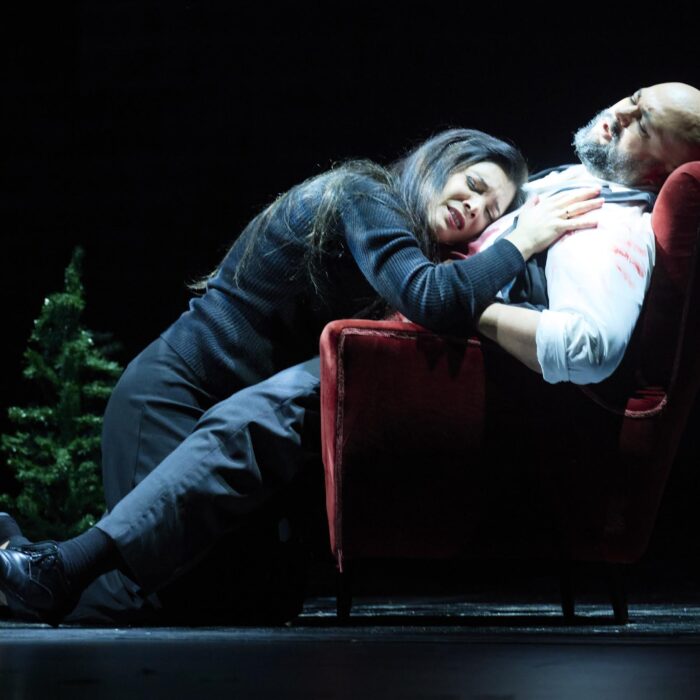
Even more revealing is that, even today, these works continue to unsettle certain audiences unable to grasp Donizetti’s irony and the final message conveyed in the staging of “Deux hommes et une femme.” Days before the premiere, the production sparked an animated debate in Bergamo: the comic treatment of domestic violence led several feminist organizations to voice concerns about addressing such a delicate subject through comedy. In a letter to artistic director Riccardo Frizza, they did not request the cancellation of the show, but a proper contextualization, suggesting a pre-performance statement reaffirming the theatre’s commitment to a culture of respect and non-violence. Frizza replied that they had “misunderstood,” clarifying that the inclusion of the opera was not meant to trivialize gender violence but to offer a reflection on patriarchal dynamics still present today.
Although the works belong to different creative phases–the Neapolitan farce and the Parisian opéra-comique–their orchestration and language speak for themselves: both display Donizetti’s theatrical precision and his ability to observe human relationships with refined irony. Programming them together at the Donizetti Opera Festival is fully aligned with the institution’s mission: to recover, study, and revive the donizettian repertoire in all its facets, including works conceived for popular taste and smaller venues.
(Photo: Studio UV – Fondazione Teatro Donizetti)
Production Details
Stefania Bonfadelli’s immaculate stage direction reveals a meticulous understanding of farcical mechanics and a remarkable ability to integrate two works of distinct natures into a single theatrical framework. Her background as a singer, particularly in Donizetti, undoubtedly helped her anchor the concept with clarity. Her ingenious regia stands out for its dramaturgical coherence, precise handling of comic timing, and admirable control of the balance between action, rhythm, and physical detail. Bonfadelli opts for refined comedy built on gags, physical humor, and gesture calibrated to musical prosody.
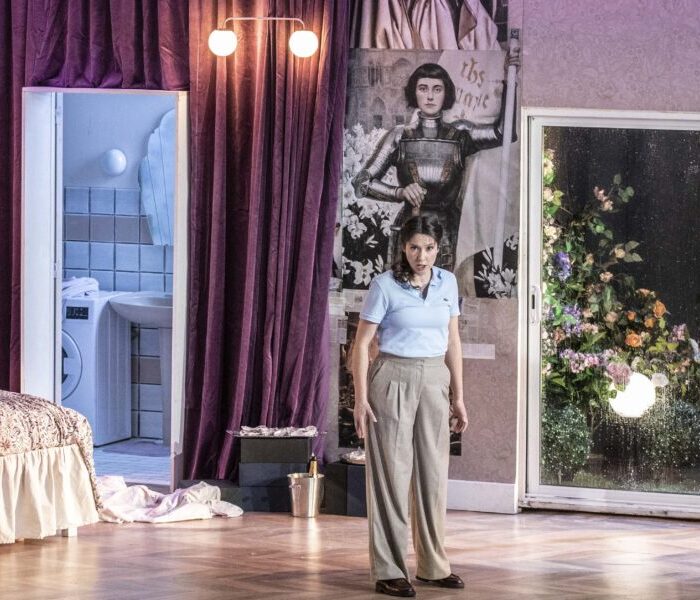
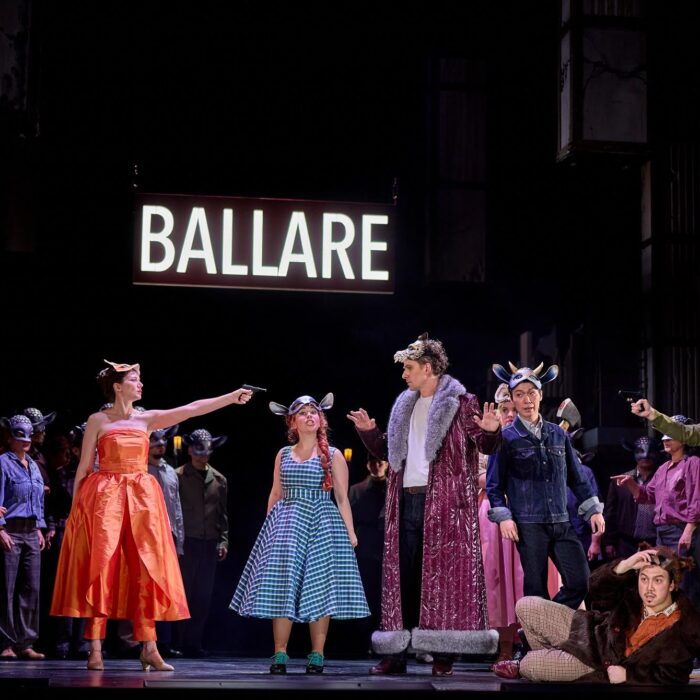
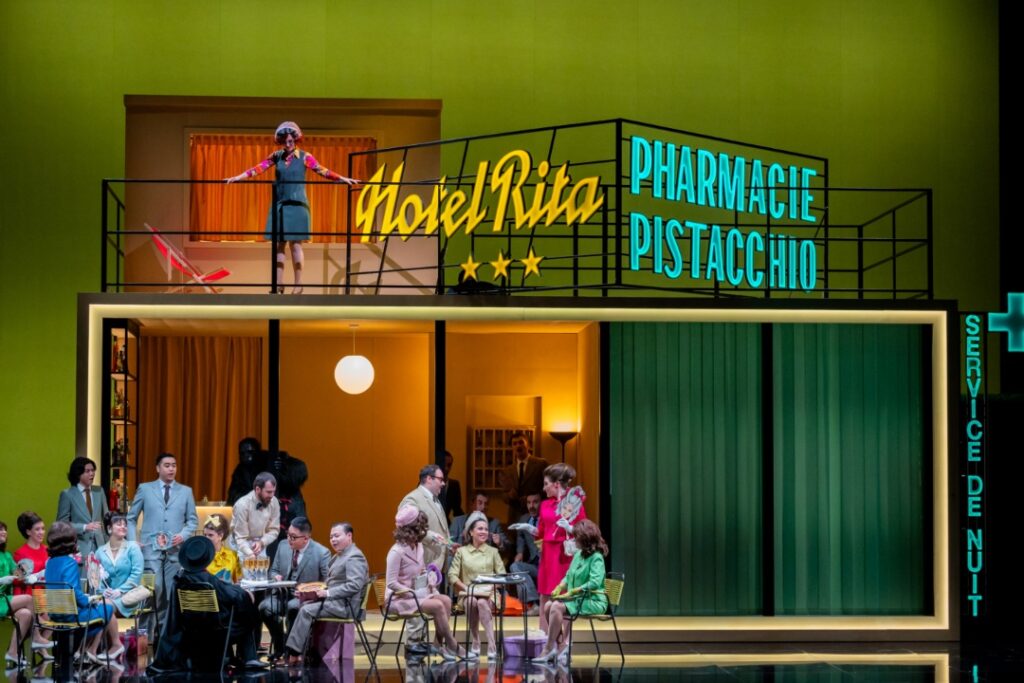
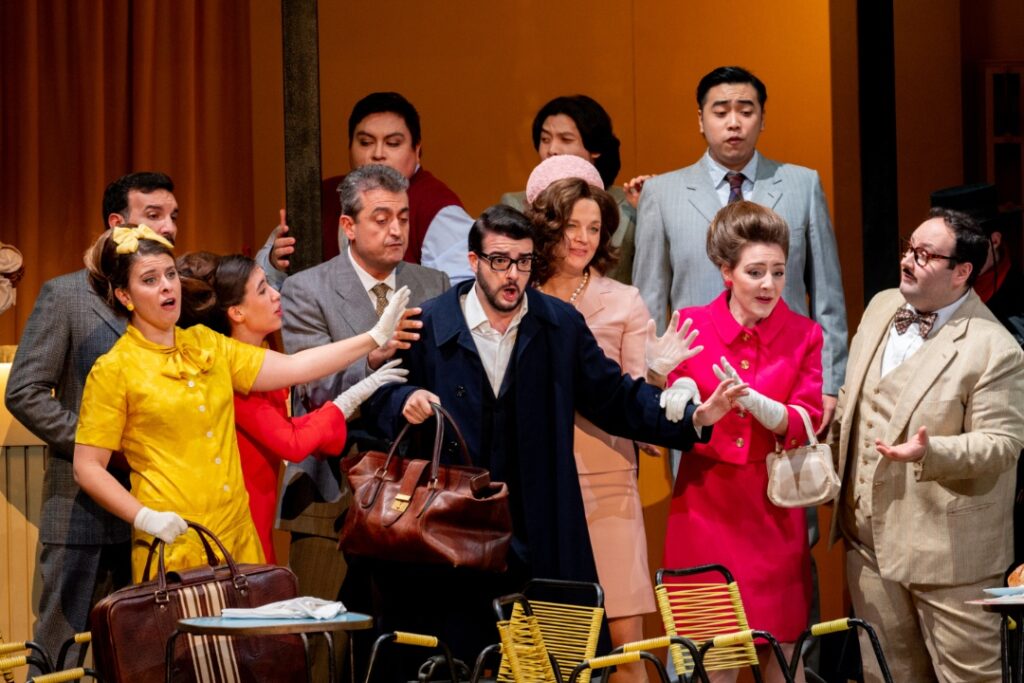
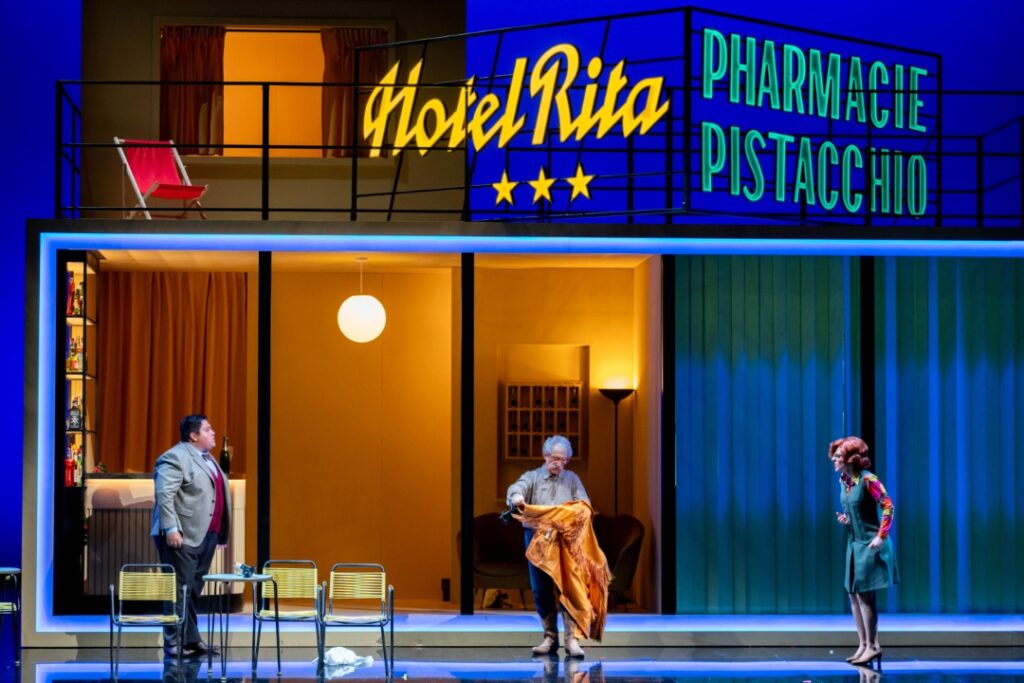
Serena Rocco’s set design unfolds a visual universe that merges the spaces of both operas into a single 1960s environment with exemplary theatrical functionality. The coexistence of the Pharmacie Pistacchio and the Hotel Rita within the same “scenic box” proves especially effective: not a simple spatial overlap but a true narrative osmosis, where situations, characters, and tensions in one work influence the other, creating internal continuity. Since Don Annibale’s wedding celebration takes place on Rita’s premises, the characters of both operas share the stage, interact, and inhabit the same world: an idea genuinely out of the ordinary. At the end of “Deux hommes,” the characters from “Il campanello” return to close the shared narrative cycle. Fiammetta Baldiserri’s lighting, rich in chromatic sensitivity, and Valeria Donata Bettella’s vibrant costumes reinforce the comic reading of each character.
Enrico Pagano’s conducting, at the head of the period ensemble Gli Originali, confirms his position as one of the most reliable young conductors for historically informed donizettian performance. The use of period instruments added another layer of authenticity. In “Il campanello,” he emphasized a chromatic palette of sounds, highlighting the prominence of gut strings and shaping a refined phrasing. The light textures, clear articulation, and controlled volume consistently sustained the timing essential to comedy.
(Photo: Studio UV – Fondazione Teatro Donizetti)
Illuminating Cast
On the vocal side, the festival entrusted the cast to the young students of the Bottega Donizetti, under the pedagogical direction of vocal coach and pianist Giulio Zappa. Pierpaolo Martella as Don Annibale stood out for his clarity of articulation, meticulous diction, and impeccable rhythmic control in both sung passages and recitatives, supported by a solid fiato. His homogeneous, well-projected instrument met the role’s demands with ease, and his vis comica was particularly effective in “Bella cosa amici cari:” a buffo singer of great promise.
Baritone Francesco Bossi as Enrico confirmed his standing as a brilliant and versatile baritone, with impressive comic instinct, notable vocal flexibility, and agile stage presence. His multiple appearances in disguise, challenging due to rapid timbral shifts and sudden changes of register, were executed with accuracy and naturalness, provoking hearty laughter from the audience, largely composed of foreign visitors. He displayed a beautiful legato in the duet “Non fuggir, t’arresta.”
Soprano Lucrezia Tacchi as Serafina, offered a limpid, luminous timbre and a musical line that remained flexible and elegant, even in the most lively passages. Mezzo-soprano Eleonora De Prez as Madama Rosa contributed a rounded, full-bodied vocality, while Giovanni Dragano as Spiridione completed the cast with sparkling presence and effective gesture work, essential to the production’s physical comedy.
In Deux hommes et une femme, Pagano revealed a more mature sound orchestration, fitting for opéra–comique, shaping the woodwind phrasing with elegance and achieving a fluid integration between music and spoken dialogue.
As the title character, Cristina De Carolis delivered an energetically balanced performance of Rita, with firm vocal line and a stage portrayal that blends authority with innocence, always with vocal elegance. Playing the role of Pepé, tenor Cristóbal Campos Marín displayed a clear, agreeable timbre, firm central register, and brilliant top notes; despite some imperfections in his French pronunciation, he crafted a tender, self-ironic, and persuasive character.
The artistic anchor of the production, and its central reference point, was legendary baritone Alessandro Corbelli. As Gasparo, he offered a masterclass in bel canto style: absolute command of the spoken word in immaculate French, flawless vocal line, and an innate ability to shape humor without slipping into exaggeration. Despite being well into his seventies, the acclaimed singer possesses astonishing vitality: kneeling, jumping, even rolling on the floor during his scenes, he remains undeniably a fuori serie. His interaction with the young cast generated a rare equilibrium onstage.
This youthful and charming diptych confirms that the Donizetti Opera Festival remains capable of revitalizing two short works of remarkable theatrical effectiveness, qualities that have defined the festival for over a decade. Warm applause for the young performers and ovations for Corbelli, the great revelation of the evening.
(Photo: Studio UV – Fondazione Teatro Donizetti)