Deutsche Oper am Rhein 2025-26 Review: Le nozze di Figaro
By Bernardo Gaitan(Photo: Jochen Quast)
Deutsche Oper am Rhein prides itself on having the largest permanent ensemble of soloists in the world. This is no exaggeration: the German opera house is renowned for maintaining one of the most substantial fixed ensembles internationally, with approximately 47 singers under permanent contract –excluding the chorus and its collaborations with two orchestras – thus covering the artistic needs of two different cities, Düsseldorf and Duisburg, and sustaining more than 280 performances annually across both venues.
This model is particularly noteworthy when one considers the significant financial burden of maintaining such a large permanent payroll without intelligent management of the ensemble. Economic sustainability is achieved through a rich and varied programming that ranges from Italian and German opera to Baroque and contemporary repertoire, and by reusing the same singers across multiple productions, thereby avoiding the systematic engagement of guest artists. The true “magic” lies in the superintendence, the programming office, and the casting management, whose task is to ensure that every contracted singer is extremely versatile: capable of singing Wagner on a Monday, Rossini on a Friday, and Massenet on Sunday, always with stylistic awareness and technical assurance. This performance was a clear example of the ensemble’s high artistic standard, as the overall vocal result was, generally speaking, spectacular.
(Photo: Jochen Quast)
Production Details
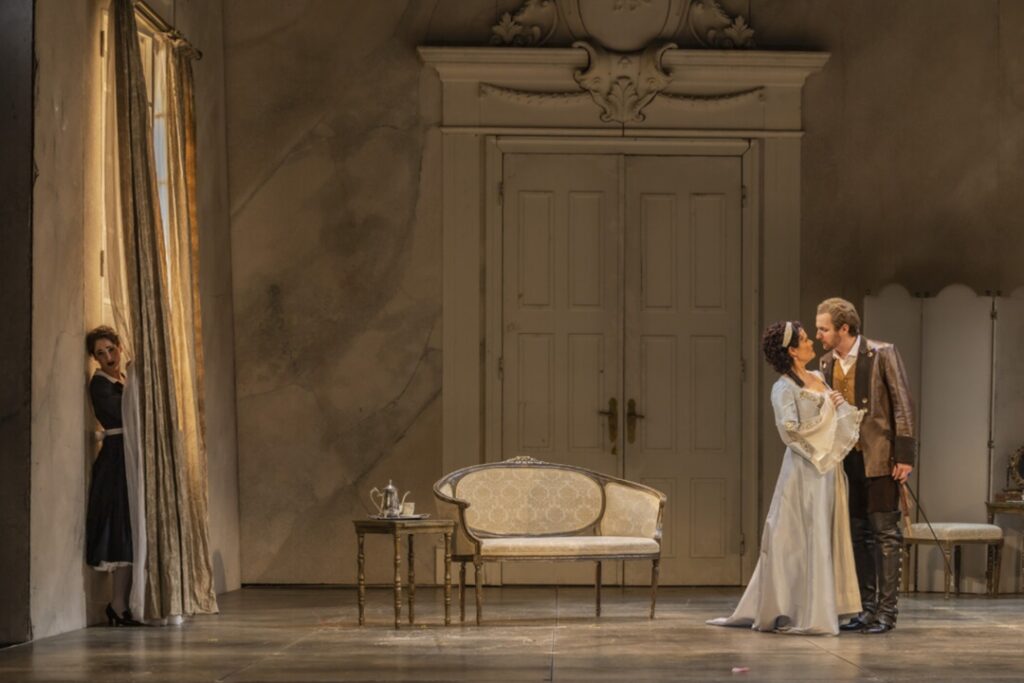
The revival of Mozart’s masterpiece at the Duisburg Theatre corresponds to Michael Hampe’s staging, originally created in 2012 for this same venue and performed entirely with resident artists; the final result was notably successful. This revival also carries added value as a tribute to Hampe’s memory (he passed away in 2022) leaving behind a solid production that, nearly fifteen years later, continues to demonstrate how a well-conceived “traditional” staging can feel more alive and theatrical than many forced modern reinterpretations. The work of the late stage director and former intendant maintains impeccable timing, is filled with refined comic touches, and displays a strong directorial hand, proving that the classical repertoire – when done well – can be preserved and continue to thrive over time without resorting to special effects, video projections, or conceptual excesses alien to the work itself.
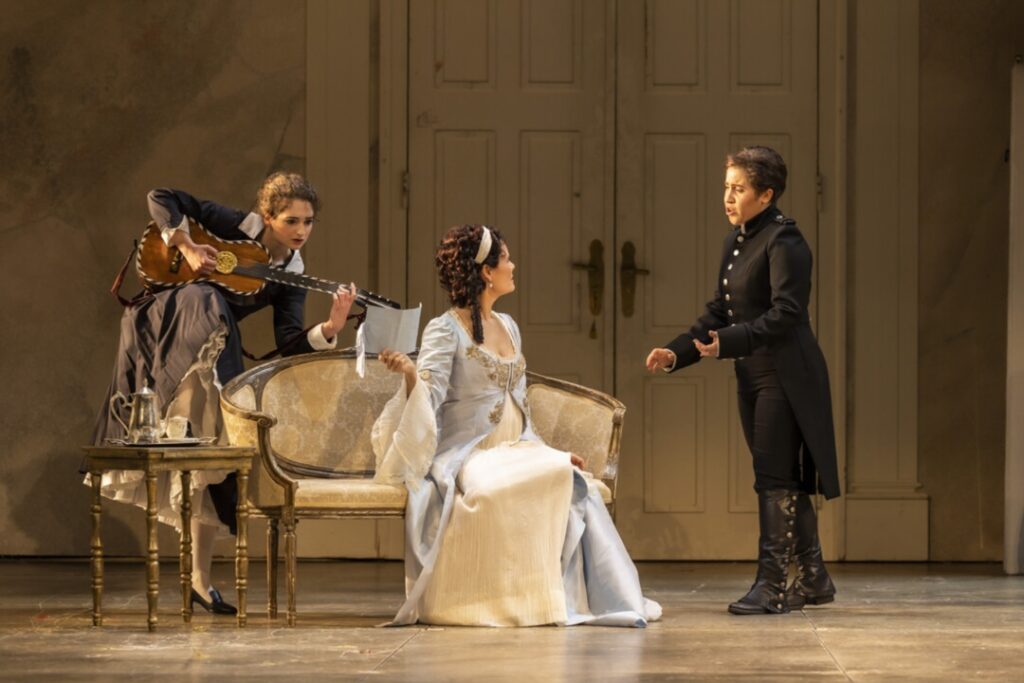
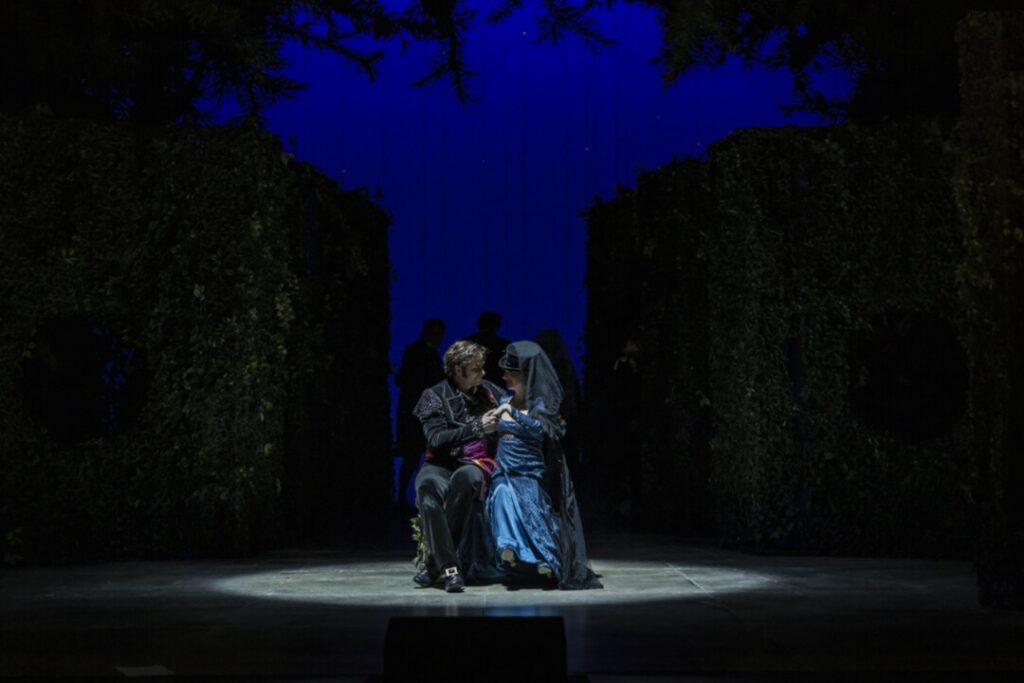
Germán Droghetti’s set design immediately evokes the famous 1976 production by Jean-Pierre Ponnelle and, even more clearly, Giorgio Strehler’s 1981 staging, though here with greater luminosity. The neoclassical, minimalist aesthetic of the sets, combined with a highly focused stage direction, lends the performance remarkable fluidity. The setting changes in each of the four acts, all conceived with the same architectural intelligence, further enhanced by Manfred Voss’s outstanding lighting, which evolves according to the time of day in which the action unfolds (one must remember that the entire plot takes place within a single day, from dawn to dusk). Hampe also incorporates an intelligent use of Spanish-flavored elements, reminding us that the action is set in Seville, a detail many stage directors tend to overlook, if not outright forget. The most evident example can be found in the costumes, also designed by Droghetti, who dresses Figaro in an elegant traditional Sevillian outfit and replaces Susanna’s usual wedding dress with the quintessential flamenco bridal attire. The limited choreographic movements by Michal Matys are equally well resolved, adding vitality and lightness to the overall staging.
The cornerstone of the production lies in the musical dimension. The performance found a solid anchor in Katharina Müllner’s conducting. The young Austrian conductor demonstrated a clear affinity with Mozartian style and unquestionable command of the score. Leading the performance musically, while also accompanying the recitatives at the harpsichord, she offered a solid, academic, and functional interpretation. With particular care for orchestral balance, always avoiding covering the voices, and with rhythmic, consistent tempi, she led the Duisburger Philharmoniker with a firm hand, instilling from the overture a sense of contained energy and contagious enthusiasm. The orchestra responded with brilliance and cohesion, in contrast to some soloists who did not always follow her clear and precise tempi; nevertheless, Müllner proved adept at rescuing the singers from their own missteps with remarkable skill. Such is her mastery of the score that during a scene between the Count and the Countess – when the Count forgot the text of a recitative and improvised a solution to jump directly to the musical section – Müllner resolved the situation with her baton so effectively that the audience scarcely noticed the cut and the performance continued seamlessly. The management of the relationship between pit and stage was excellent throughout. Equally effective was the contribution of the Deutsche Oper am Rhein Chorus, well prepared by Albert Horne and fully functional in its few but meaningful interventions.
(Photo: Jochen Quast)
Illuminating Cast
Anke Krabbe’s Countess stands out as one of the production’s high points. The soprano displayed a natural projection toward a fuller lyricism without losing the brightness of a lighter vocal placement. Her timbre remained noble and powerful, her phrasing broad and carefully shaped, and her expression consistently controlled. In her arias and ensembles she achieved moments of genuine emotion, shaping an intense, vulnerable, and profoundly human Countess. Her “Dove sono i bei momenti” was exemplary, showcasing both her expressive sensitivity and dreamlike phrasing. As further proof of the versatility mentioned earlier, the soprano performed the role of Liù in “Turandot” in Düsseldorf just two days prior.
Equally convincing and assured was the Count Almaviva, who found in Bogdan Baciua vocally solid and scenically credible interpreter. His voice, attractively coloured and well focused, allowed for agile yet authoritative singing. The baritone crafted a virile and elegant character, with a well-judged dramatic conception that subtly revealed the fragilities hidden beneath the nobleman’s arrogance. His aria “Hai già vinta la causa” was among the highlights of the evening; a perfectly placed high F crowned the feared phrase “e giubilar mi fa,” confirming him as an excellent interpreter of the role.
A very pleasant surprise was Mara Guseynova’s Susanna. The soprano mastered the role with naturalness, musical intelligence, and a magnetic stage presence. Her timbre was very attractive –though not always especially voluminous, yet consistently audible – light and effervescent; her careful diction and a sensuality that is never ostentatious make the character the true axis of the drama. Her “Deh vieni, non tardar” was memorable, sung with impeccable control and refined intimacy. In the scene “Esci ormai, garzon malnato” her performance was particularly comical, largely thanks to her interaction with Luke Stoker’s Figaro. The bass combined vocal experience with strong theatrical charisma. His voice was flexible, well projected, clearly emitted, and well articulated. The arias were delivered with confidence, with “Non più andrai” standing out for its virtuosity, while “Aprite un po’ quegli occhi” was especially comic. Stoker approached the role with energy and dramatic commitment, offering a Figaro who is lively, ironic, and never caricatured.
Unfortunately, Annabel Kennedy’s Cherubino did not meet the same standard. The mezzo-soprano appeared stiff, rigid, and lacking the energy and youthful vitality the role demands. Her timbre was uneven and short on nuance, rendering the character’s most emblematic arias monotonous. Equally unfortunate was Rita Kapfhammer’s Marcellina: while her acting was adequate, her voice showed evident problems of intonation and placement, particularly in the upper register. In contrast, Elizabeth Freyhoff offered a restrained and delicate Barbarina; the young soprano, a member of the Opera Studio, delivered a balanced and lively performance.
(Photo: Jochen Quast)
The level of the secondary cast was also very high, led by Thorsten Grümbel with a richly nuanced and delightfully malicious Don Bartolo, very well acted; Florian Simson as an emphatic and reliable Basilio; and a precise, well-characterized Don Curzio by Sander de Jong. Rolf A. Scheider’s Antonio was well acted, though plagued by intonation issues and rendered completely unintelligible in the Italian language.
A strong production that requires neither dusting off nor modernization, but simply the enjoyment of a solid and talented cast. A warm success, with a relatively full house at the Sunday matinée performance, and convincing applause for all the protagonists.