CD Review: Sondra Radvanovsky’s ‘Puccini Heroines’
By Bob Dieschburg“Puccini Heroines,” “Puccini’s Heroines,” “Heroines”—or “Eroine”—of Puccini.
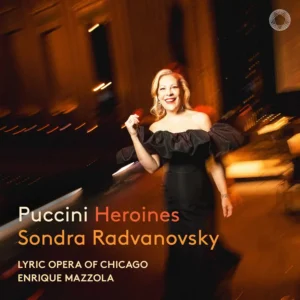
This myriad of near-identical album titles reflects the indiscriminately amorous fascination the composer’s female protagonists have exerted upon a century of operatic singers and spectators alike (after all, 2026 marks the centennial of “Turandot”). Therefore, another “Puccini Heroines”—this time from Pentatone—comes as little surprise. It features Sondra Radvanovsky, whose career has followed the trajectory of the maestro’s creations almost exemplarily: from her first full-length performance as Mimi at age twenty-one to the 2023 recording of Puccini’s swan song (with Kaufmann, on Warner Classics). She has progressed, so to speak, from a lyrical apprenticeship to the heavyweights; in over three decades Puccini has been a constant throughout Radvanovsky’s time on stage.
Fittingly, the program is all-encompassing. Recorded live at the Lyric Opera of Chicago, it comprises arias from each of Puccini’s ten operas (“Il Trittico” counted as one), interspersed—for a breather—by orchestral interludes under the baton of Enrique Mazzola.
There is precedent for such a project: one might think of Carlo Bergonzi’s “31 Tenor Arias” (on Philips), in which he paints a chronological frieze of Verdi’s tenor roles—though, to my knowledge, he never performed that exact program outside of the studio. Radvanovsky, by contrast, takes the greater risk. Her recital was captured during a run of three evening performances in February 2025.
To be plain: the result leaves mixed feelings, though it stands as a wonderful homage to Puccini. In particular, the American soprano’s marathon program takes her back to soubrette parts like Mimi and Musetta, which she has vocally outgrown. Her timbre now boasts a steely firmness no longer compatible with the suavity of the Parisian seamstress or Lauretta from “Gianni Schicchi.” In “O mio babbino caro,” for instance, she replaces sentiment with vocal prowess by floating the climactic A-flat rather nonchalantly; yet the dolcissimo markings do not quite bear fruit. Similarly, one notices a widened vibrato which, in the neuralgic passages of Mimi’s self-description (“Sì, mi chiamano Mimi”), precludes the gentle discreetness of a true lirico.
“La Fanciulla del West,” however, is a different story. The tessitura lies higher—congenial to Radvanovsky’s almost columnar sound—and the style is declamatory rather than grounded in cantabile arcs. “Laggiù nel Soledad” fully works in her favor: her volume expands alongside the orchestral thickness to the effect of a delightfully luminous blend. In line with Puccini’s notation, she eschews the interpolated High C.
In “Vissi d’arte,” one admires the craftily sustained “Ah” connecting Tosca’s outburst in B-flat (“Signore”) with the inwardness of “perché mi rimuneri così.”
The part of Cio-Cio-San again sits at odds with the soprano’s vocal profile. She falls just short of projecting the intimacy of the young geisha; notably, her lower register remains largely blended, with little audible chest color. Compared to the soliloquy-like character of “Un bel dì vedremo,” the present rendition feels like a grand tableau instead of a private vignette.
This may surprise, especially as she navigates “Senza mamma” with considerable interpretive sympathy. Her portrayal of Angelica is speckled with dynamic variation and rhythmic flexibility. It is–in my opinion–the album’s highlight. Here, the ebb and flow of the melodic line is embraced more than anywhere else on the release.
And what about the crown jewel, Turandot’s “In questa reggia?” Measured against her own 2023 studio take, the Chicago performance appears less firmly shaped. Under Pappano–in the studio–the outburst of “quel grido e quella morte” functioned as the outward projection of the princess’s repressed trauma. It progressed naturally toward a climax, whereas in the present release, the rendition is steeped in an almost continuous forte, which unfortunately affects the pitch focus, notably in the first “gli enigmi sono tre.”
That is not to disregard the enthralling tops and the forward-thrust of Radvanovsky’s phrases. But when pressed, one would hardly want to trade the Chicago palace aria for the earlier studio version. “Puccini Heroines” is a marathon—though it occasionally feels like a sprint. I believe slower tempi would have aided the interpretation.
The album, in short, has its share of flaws. Yet for all its shortcomings, it represents a daunting act of bravura–incomparable, and for the sheer scope of the undertaking Radvanovsky is deserving of every accolade. These “Heroines,” then, are best understood as a homage rather than an anthology.