Carnegie Hall 2025-26 Review: Emily – No Prisoner Be
Kevin Puts, Joyce DiDonato, & Time for Three Set Emily Dickinson Free
By Chris Ruel(Photo: Chris Lee)
A hush fell over the hall before a single note was sung.
“Shh…” a pre-show hush repeated at intervals as the audience chattered, “Shh…”
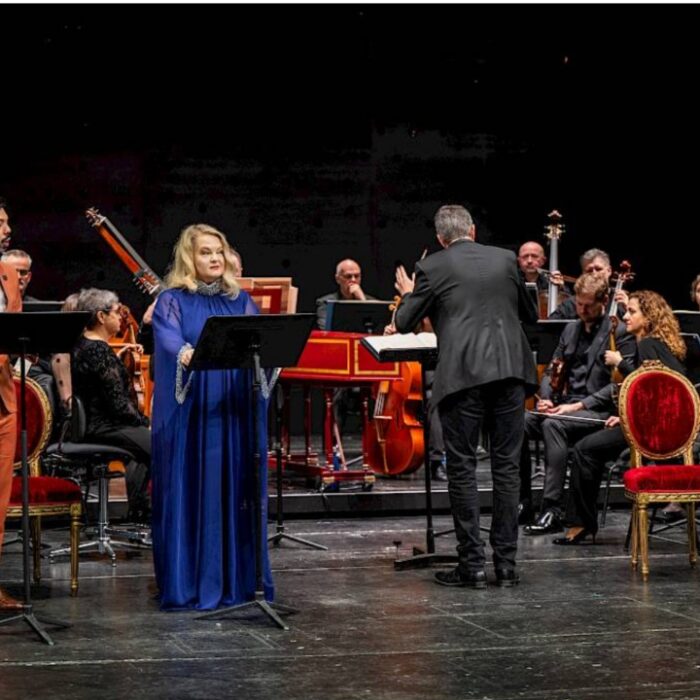
The sound was barely there—more suggestion than speech—but it was enough to draw the audience into a sense of peacefulness, suspended between listening and disbelief. Is it real? Is someone whispering “Shh…” or is it just in their mind? As the lights dimmed, Joyce DiDonato stepped onto the stage from the back, all in white. She sat at a simple writing desk beneath sheer drapes as a gentle haze filled the space. What followed wasn’t a traditional song cycle or quite a concert, but something more like an immersive theatrical ritual.
Thus begins “Emily–No Prisoner Be,” a genre-bending musical experience by Pulitzer Prize and Grammy-winning composer Kevin Puts, created for DiDonato and the string trio Time for Three, featuring Nicolas “Nick” Kendall (violin, vocals), Charles Yang (violin, vocals), and Ranaan Meyer (double bass, vocals).
Reframing Emily Dickinson
Emily Dickinson has often been seen as reclusive, restricted, even imprisoned by circumstances. “No Prisoner Be” challenges that view. Instead of depicting Dickinson as locked away, the work shows a mind constantly in motion—restless, playful, defiant, and fiercely free.
From the opening moments, Puts places the audience inside Dickinson’s inner world. DiDonato, often with her back turned, scribbled furiously, crumpled pages in frustration, and started again. The gesture is simple but powerful: we are not watching a poet frozen in time, but one actively wrestling with language, thought, and self-identity.
The result is a portrait of inwardness without confinement—of solitude as agency rather than isolation.
A Proven Creative Partnership
Puts and DiDonato have a rich creative history with “No Prisoner Be.” Most recently, they worked together on Puts’ opera “The Hours,” commissioned and staged by the Metropolitan Opera in 2022, where DiDonato played Virginia Woolf alongside Renée Fleming and Kelli O’Hara. That project created a shared artistic language rooted in psychological nuance.
At the same time, Puts was composing “The Hours” and writing Contact, a triple concerto for Time for Three. In his program notes for “No Prisoner Be,” Puts recalls that he and the trio realized they were “having too much fun” to stop collaborating. When the idea of a song cycle emerged, DiDonato was, as he put it, “just the singer” he had in mind to join Time for Three to create the work.
Sound World: Classical Meets Concert Hall Energy
Time for Three is central to the work’s identity. Dressed in black and moving freely around the stage, the trio performed with explosive physicality. Their playing shifted between ferocious, high-energy passages—more like thrash metal than chamber music—and moments of quiet lyricism. Puts showcased their stylistic fluency, asking them not only to bow but also to pick, strum, and even sing.
The trio also acted as a kind of chorus, providing backing vocals that blurred the line between instrumentalist and singer. While this versatility is common in pop and rock, it remains unusual in classical performance—and here, it felt both surprising and completely natural.
The effect is intentional: “No Prisoner Be” appears and sounds less like a traditional recital and more like a contemporary concert. Lighting effects, minimalist staging, and a subtle use of a smoke machine replace the formal stillness of the song cycle tradition.
Setting Dickinson—Again, and Anew
With over 3,000 musical settings of Dickinson’s poetry already created, the choice to make another one naturally invites doubt. Puts addressed this directly by rejecting a strict concept. He has said he composed the piece quickly and intuitively, letting it develop naturally through close collaboration with DiDonato and Time for Three.
The ninety-minute performance is built around selections of Dickinson’s poetry, punctuated by three short “bee scherzos”—lively instrumental interludes inspired by the poet’s interest in bees. These moments offer contrast and relief, giving the trio space for virtuosic display and DiDonato brief moments of physical rest.
Musically, the score swings between sharp, atonal passages and moments of bright lyricism. The contrasts feel true to Dickinson herself, whose poems explore darkness, wit, nature, liberty, and longing in an ongoing, unresolved conversation.
Beyond Performance: A Communal Experience
What ultimately sets “No Prisoner Be” apart is not just its musical innovation but also its emotional resonance. Beneath the technical skill of Puts, DiDonato, and Time for Three, there is a clear purpose: to create space for reflection, release, and connection.
From the pre-concert “shh” to the minimalist visual palette of desk, drapes, and light, the production gently pushed the outside world aside. During the performance, the usual noise—internal and external—faded away.
At the end of the performance, DiDonato and the trio repeated the line “No prisoner be,” turning it into a mantra. When the applause subsided, DiDonato addressed the audience directly, speaking about the love she has for the audience without the veneer of a typical concert speech. The moment felt genuine and rooted.
She encouraged the audience to carry the phrase—no prisoner be—with them, as a symbol of both hope and defiance. Not prisoners of circumstance. Not prisoners of the moment. Not prisoners of fear.
Then she asked them to join her.
The chant started softly and grew, voices rose from seats and spilled into the aisles. It felt more like a shared moment than a sing-along.
In an art form often preoccupied with preservation, “Emily–No Prisoner Be” insists on something more urgent: freedom, lived and felt, in the present tense.