Boston Lyric Opera 2026-27 Review: William Tell
By João Marcos Copertino(Photo: Nile Scott)
What the art world needs most right now are more productions of adventurous grand operas. No doubt my influence is less than it should be, and few opera houses, reading this column, will rush to produce a Meyerbeer opera. But it seems that at least Boston Lyric Opera’s management agrees with me.
To celebrate their 50th anniversary, they opened their season with a new staging of Gioachino Rossini, Victor-Joseph Étienne de Jouy and L. F. Bis’s masterpiece “Guillaume Tell.” It is an extremely ambitious title for an opera company that has had its ups-and-downs lately. Yet, it worked so well that it gives me hope for the future.
BLO’s Path Forward
Grand opera is a hyper-expensive subgenre of the lyrical arts. It requires ballets, a large group of powerhouse soloists (usually six), and a very good chorus. With the crisis in arts funding over the last few decades, it seemed that the subgenre would vanish from theaters. That would be a terrible crime. Few genres resonate more with today’s audiences than Grand Opera. They speak of political struggle and human suffering while offering that sense of grandeur that only a big chorus and a loud orchestra can provide. They foster discussions about today’s pressing political topics.
BLO stages the opera with the same political subtlety as action films such as “Total Recall” and “Die Hard”—and it is perhaps the way it should be. BLO has tried many times to innovate by staging operas with American political problems in mind, and the results have been mixed at best. Now, with “William Tell,” they might at last have found their path forward. They might be to opera staging what mid-budget films were to Hollywood in the 1990s: entraining, clear-minded, aesthetically appealing, and, above all, insightful without ever being pretentious.
It is not that “Tell” was perfect. It really was not. But it hit its target like Guillaume hit the apple with his arrow.
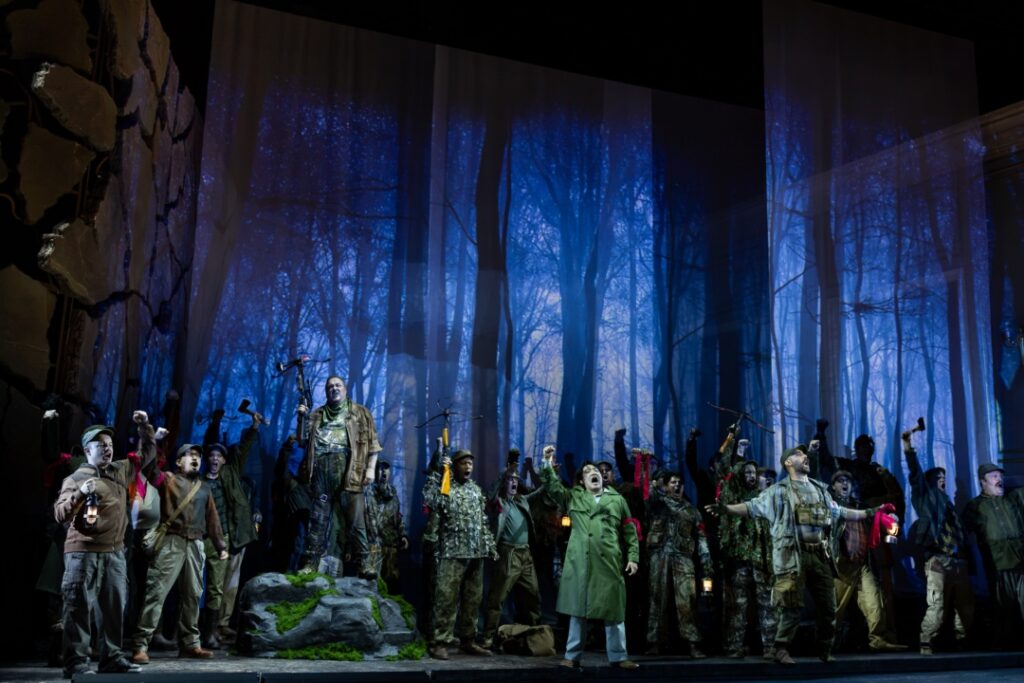
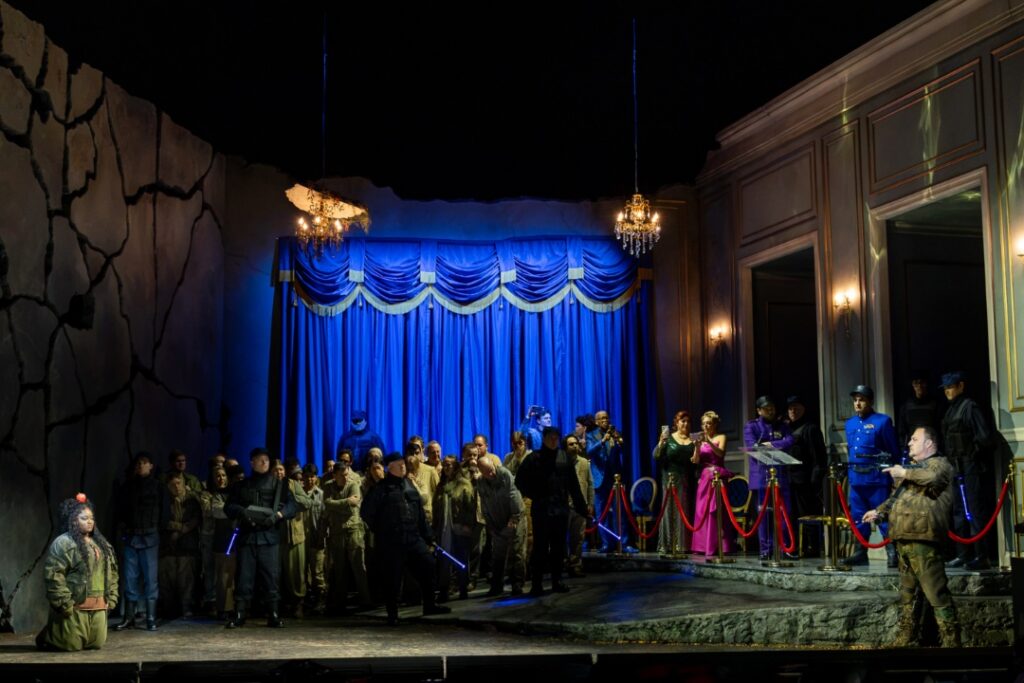
The main idea does read like a screenplay for Paul Verhoeven: in a not-so-distant future, the Swiss are oppressively colonized by a “Hunger Games” wannabe elite. So, basically, whatever Rossini, de Jouy and Bis’s opera presented as part of a mythical foundational past of Switzerland is transferred to a near technological future. Tell’s “offense” in the third Act, for example, is his refusal to allow his colonizers to harvest his biometric data.
(Photo: Nile Scott)
Production Details
Vita Tzykun and David Adam Moore’s production was dramaturgically cohesive without being musically coherent. The drama worked so well (by BLO standards) that I was not even mad when I realized they redacted more than an hour and a half of music from the score. While much of the character’s developments were gone, it was not bad to be able to leave the theater before midnight.
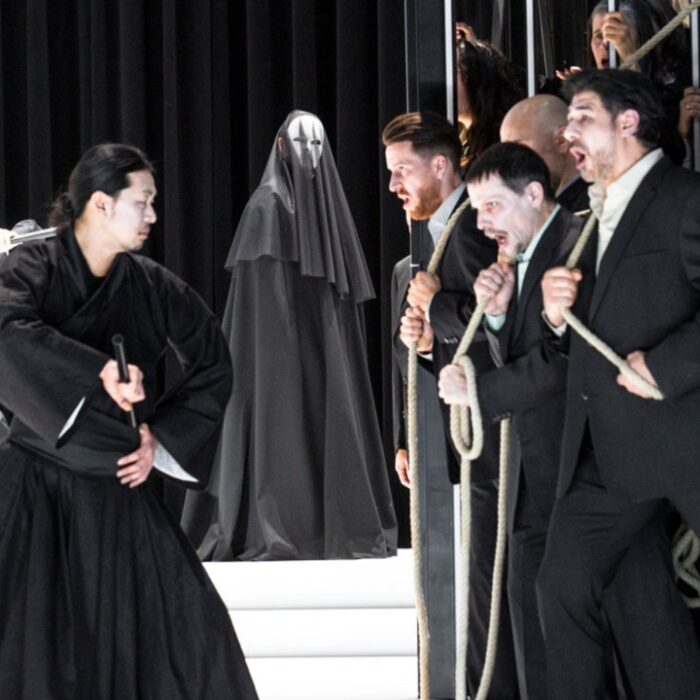
The new “edited” version of “Tell” was not seamless. Often the directors ignored (or were ignorant of) some grammatical rules of musical discourse, especially when it comes to affect and the expression of feelings. The pastorale that opens the opera, for example, was transformed into a performance by the colonized to please the oppressor, who holds everyone, including the poor boatman, at gunpoint during what is, in the score, his serene “Accours dans ma nacelle, / timide jouvencelle.”
Subversions of meaning in operatic librettos are more or less the norm nowadays. Yet, one must do it with some panache and erudition. It is always more compelling to discover new meanings in a certain musical moment than merely to subvert them. What Tzykun and Moore did, however, is much closer to writing their own libretto, hoping that the hat will fit the head. It turns out that the fit was not always impeccable.
In fact, Tzykun and Moore committed all the common theatrical sins that have haunted BLO for ages: a monolithic and impractical scenario; the use of projections that look cheap and A.I. generated; a projector fan louder than the orchestra in mezzo forte; figurative representation where theatrical abstraction would suffice (and look better); subpar acting from its leads.
Somewhere in Germany there must be a support group for theater directors addicted to lame video projections. The problem is that often they use the projections as a replacement for a scenario that for financial reasons were not built. Thence, there is never a true engagement with video as medium in itself. In my experience, the list of directors who know how to use projections is short: Christiane Jatahy, Barrie Kosky, Peter Sellars (especially when working with Bill Viola), and Daniela Thomas.
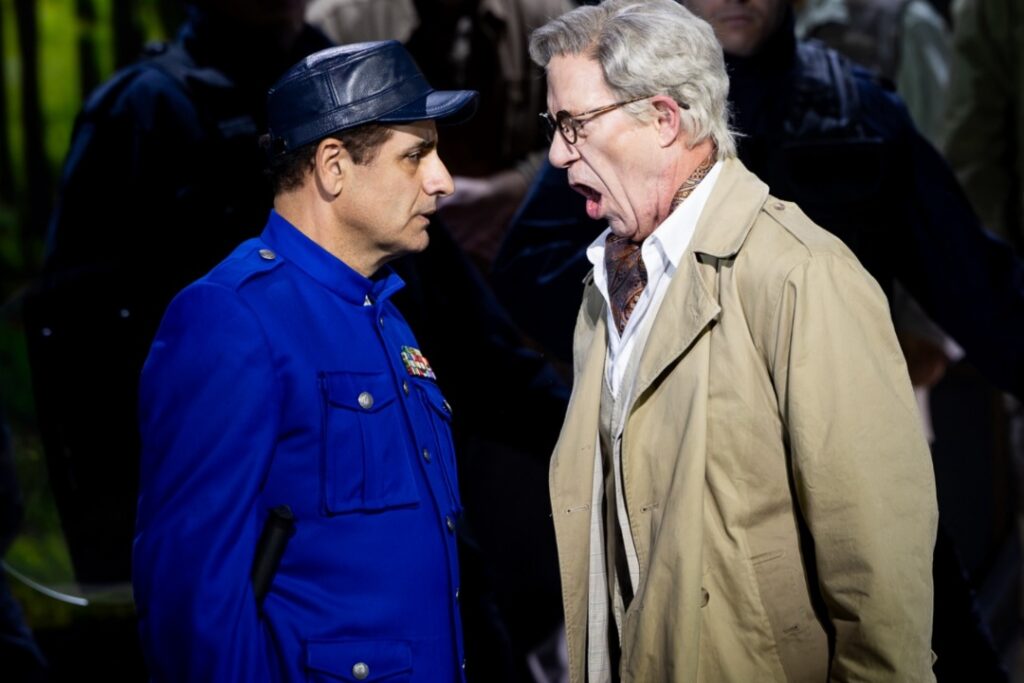
That said, among all the changes made to the libretto (often textually), one point seemed particularly poignant: how to combat authoritarian violence? During most of the opera, it is evident that Tzykun and Moore see “Tell” as far removed from any hint of pacifism. In fact, in one of their many interventions in the libretto text, at the end of Act three, they explicitly say: “only violence can fight violence.” Yet, in the opera’s finale (the sublime “Quoi! dans nos maux acceptant un partage”), they place a single woman holding a photo of her lost loved one, as Sophia Loren did in the first scene of Vittorio de Sicca’s “Sunflower.” Although emotionally manipulative, it actually made sense given their reading of the opera (and even made sense musically: there is something sacred but not peaceful in the music of the final scene). Moreover, if there is a place where sentimentalism and emotional manipulation are never crimes, is it not the opera house?
(Photo: Nile Scott)
BLO Chorus Highlights
The big star of the night, to me, was the chorus. Grand operas do go big on choral scenes. In “Tell,” sometimes it feels as if the chorus sings more than any of the leads. They occupy the stage for, more or less, three quarters of the opera. Beyond their physical presence, there is something about a great wall of vocal sound that is exhilarating in its loudness.
I personally appreciate it when an opera chorus has a somewhat “screamy” quality (as opposed to just loud), especially in the mid-nineteenth-century repertoire. Nowadays, opera houses’ professional choruses have a rather refined sound, aiming to sing Verdi with the same timbre and vocal clarity as monks performing a Bruckner Motet. There is much merit in such an artistic achievement. Yet, I like my opera choruses operatic even if it makes them sound a bit unvarnished.
The BLO chorus, surprisingly, made their voices echo off the walls of the Colonial theater with bravura. That does not mean they ignored the score’s dynamics. There was a clear distinction between a mezzo forte and a mezzo piano. What worked is that they understood their mission in the big scenes: to sound big and imposing.
(Photo: Nile Scott)
Vocal Performances
The cast, however, had its ups and downs.
A generalized problem was, of course, the complete lack of proper French pronunciation, but let’s just forget that for now. Who actually comes to opera in Boston to understand the words?
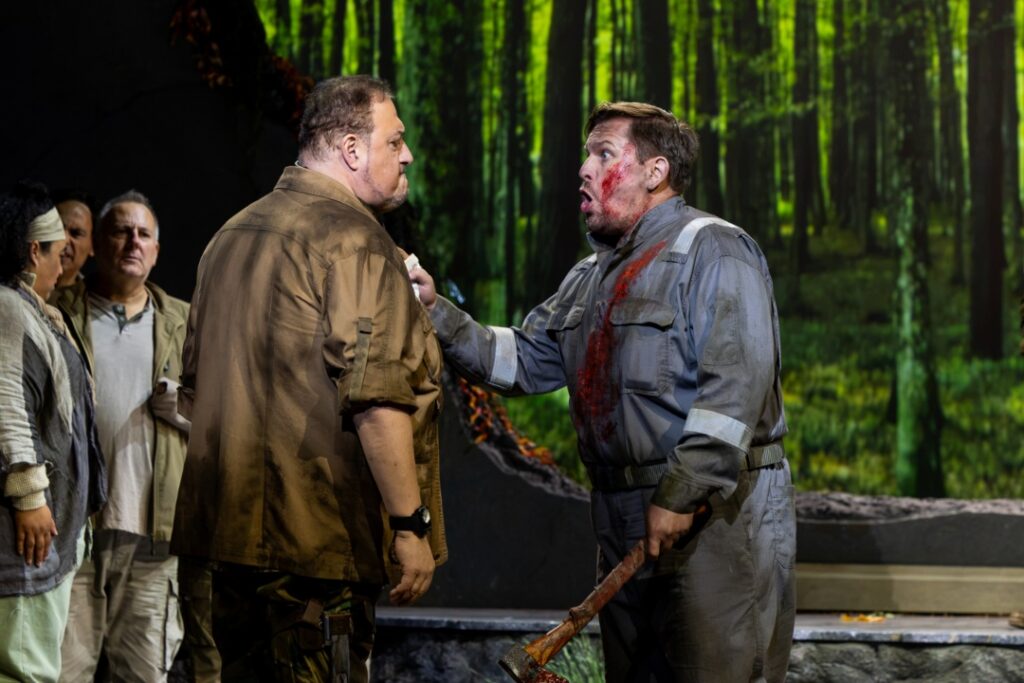
Let’s start with Mr. Tell himself: George Gagnidze. At least from the orchestra level, it was hard to recognize Gagnidze’s voice as particularly voluminous (though to be fair, I suspect it sounded better in the balcony; his acting is stiff and, in Tell’s great dramatic moment, the great aria “Sois immobile,” he was not in sync with the cello soloist (who was having problems in his own right).
But I should not be unfair. Tell is the title character of the opera, but his musical presence is significantly diminished next to other figures in the score. It is true that his only aria is one of those things that, once heard, can never be forgotten, but it is also true that it is a rather short and singular moment (especially compared to the importance of Arnold, Mathilde, and also Jemmy).
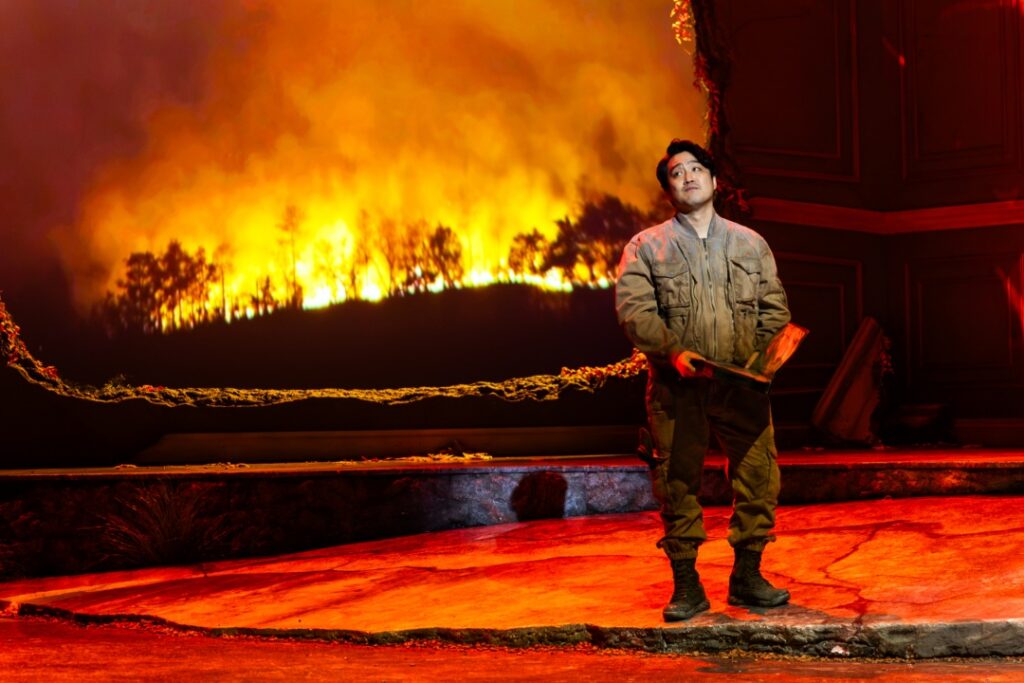
That said, to me “Guillaume Tell” should be named “Arnold.” The opera served as the star vehicle for at least two of the most consequential tenors of the nineteenth century: Adolphe Nourrit and the “inventor” of the chest high C, Gilbert Duprez. And, even though Arnold is on the stage at lot, it is his Act four aria “Asile héréditaire” (and even more its cabaletta, “Amis, amis”) that can make or break the night.
(Photo: Nile Scott)
Konu Kim is very aware of the power of Arnold’s role. Kim sings drastically. He is not always super precise, especially in softer dynamics, but he has an uncanny capacity for producing an explosive sound (especially above the passaggio) that is extremely enticing. That might be exactly what made Duprez so famous back in the day.
And then there is the sustained high C at the end of the aria… If you consult a reputable score of “Guillaume Tell,” you will find that Rossini wrote that Arnold is meant to close his mouth with the male chorus and leave the stage around measure 350. Tradition has it that the tenor lingers, holding an “aux armes” on a high C for a few measures more. While in the 1990s some conductors sought to sanitize performances of such a practice, as long as tenors have lungs, they will do it. Kim really knows the importance of showing that he can cry “aux armes” longer than Manrico sings “All’armi.” On the night I attended the opera, he kept singing his note for more or less ten additional measures with a very impressive tone. If I were picky, I would dwell a bit on the slight mistuning at the end of the note, but, by then, his voice was covered by the enthusiastic clapping of his audience. Like an action movie, “Tell” is an opera that thrives on its physical stunts.
(Photo: Nile Scott)
More Cast Highlights
Another great addition to the night was soprano Brianna J. Robinson as Jemmy. She has one of the most gorgeous and rich voices I have heard in a while. There were some small edges here and there (the high notes, if attacked “cold,” might be brighter than the core of her voice, for example), but when she was on stage, it was hard not to want to hear her sing more—especially in the big choral moments (such as the Act three finale).
It is a bit strange that such an adult and rich voice was cast in the role of Jemmy instead of Mathilde, but I was satisfied that she was Tell’s daughter instead of a mere gamin. Opera does require a suspension of disbelief, but, with such an amazing instrument, it was easier to imagine Robinson as a future Mimì or Countess than a Cherubino or Octavian.
For most of the night, I struggled to hear soprano Anya Matanovič‘s voice for reasons that were mostly not her fault. In her Act two aria, “Sombre forêt,” for example, she often aimed for a dynamic level significantly softer than whatever the orchestra could do. And, especially in the big scenes in Act three, her voice, by nature, was much lighter than Robinson’s or Nelsen’s, so it was a bit difficult to believe her as the strong woman who fought against her own roots. It also did not help that her scenic chemistry with Kim was nonexistent, but things like that happen.
Bass-baritone Hunter Enoch was also a pleasant surprise singing the role of the evil autocrat Gessler. While his voice might not be as big as those of some of his castmates, his tone was consistent and had a more baritonal resonance than anyone else on the stage.
Nina Yoshida Nelsen cast herself as Hedwige, and it really did not feel self-indulgent of her. Given the many musical cuts, the role seemed much smaller than I recollected from the score (but the truth is that Hedwige is a side role). Nelsen’s voice had something of Mamma Lucia, which is a perfectly reasonable solution for the role.
Morgan Mastrangelo has been on my radar for a while now. His voice has that “light tenor” metallic vibrato that flooded operatic stages especially in the 1990s. While I personally find it an unpleasant characteristic (I prefer a more velvet “tenor di grazia” tone), somehow Mastrangelo made it work. He has a textual and phrasal commitment to the text that is commendable. In his opening and solo aria as Ruodi, he was particularly expressive (in a good campy way) and charismatic.
David Angus & the BLO Orchestra
The orchestra and David Angus’s reading of the score were fine by Boston Lyric Opera standards. On the one hand, I believe that, now that the company has a stable rehearsal space, it will be easier to put together all the moving pieces essential to a grand opera; on the other, in this performance, there were a small number of problems that could easily have been prevented. “Tell’s” prelude is a standard piece in the cello repertoire (as is the cello solo in the “Sois immobile” aria); it was a hard pill to swallow that neither was played with smooth phrasing or immaculate intonation.
But there were good surprises. Angus might not be the subtlest of conductors, but he managed the big choral scenes of the opera very well. The brass section sounded particularly good this time and even though I was seated very close to the timpani, they never deafened me.
The very end of the opera, the striking and solemn final chorus scene, best showcases all that works so well in “Tell.” It is such a grandiose opera that, even in an imperfect performance, the mere fact of being presented with that wall of sound makes the opera almost immune to the shortcomings of any performance. Or, in better terms, “Tell” is such a great opera that it can be immensely satisfying to watch even in less-than-ideal circumstances. To me, that is one of the magical qualities of grand opera: like a marching herd of elephants or a swimming pod of whales, their magnificence relies on the mere fact that they are there, to be seen by our eyes.