Baltic Opera Festival 2025 Review: Winterreise
Bass-Baritone Łukasz Konieczny, Pianist Nikolaus Rexroth & Dancer Boris Randzio Produce Multiple Layers of an Inner Journey
By Zenaida des Aubris(Photo: KARPATI&ZAREWICZ)
The city of Gdańsk—formerly known as Danzig—dates back to the Middle Ages, but its more recent history is indelibly linked to the Solidarity movement. It was here that Lech Wałęsa led the opposition that ultimately brought down Communist rule in Poland and helped end the Cold War. Today, as one walks through the gentrified shipyards—now filled with bars, clubs, galleries, and cultural spaces—one cannot ignore the towering, rust-tinged cranes that loom overhead, silent witnesses to the past. Their presence lends gravity and historical depth to the creative endeavors presently unfolding beneath them.
It was in one of these cavernous shipyard halls that Franz Schubert’s “Winterreise” was performed—far from a derelict industrial relic, the space is an ongoing urban-art installation, teeming with sculptural, multi-colored painted, and collaged surfaces. With only a few hundred seats arranged on the same level as the performers, the setting fostered intimacy, though the lack of a podium or raised stage somewhat compromised visibility and theatrical impact.
The production, conceived and directed by bass-baritone Łukasz Konieczny, ventures beyond traditional recital into the realm of multimedia. Projected onto a towering screen above the performers were stark images and video excerpts, including pages from the original notebook of Kazimierz Fidler, a survivor of Buchenwald, and Konieczny’s great-grandfather. Interwoven with these deeply personal depictions were quotations from Krzysztof Kamil Baczyński, the Polish poet and resistance fighter killed at just 23 during the Warsaw Uprising. His verses, steeped in the agony of unfulfilled love and wartime despair, offered a resonant counterpoint to Wilhelm Müller’s own poetic vision.
The combination of voice, piano, dance, and visual media is hardly novel, yet when handled with sincerity and insight—as it is here—it can yield potent results. Konieczny, serving as both singer and guiding presence, stands firmly at the production’s emotional core. His voice—a dark, velvety bass with steel-edged resolve—conveys the torment and resignation of the wanderer with clarity of diction and dramatic intent. He is ably supported by pianist Nikolaus Rexroth, whose playing is nuanced and restrained, shaping Schubert’s stark piano writing with care and expressive economy.
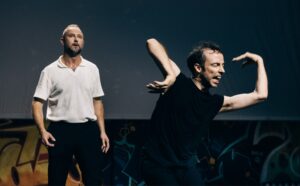
The third element of this triptych is dancer Boris Randzio, whose choreography seeks to embody the psychological and emotional contours of the protagonist’s journey. Randzio is a compelling physical presence—precise, intense, and attuned to the narrative arc of each Lied. His movements frequently mirror the text and music, often engaging directly with Konieczny in moments of striking visual harmony. Yet despite the dancer’s virtuosity, his constant motion diverts attention from the vocal line, diluting the stark intimacy that “Winterreise” so powerfully conveys when left to voice and piano alone.
Still, the production succeeds in forging an interdisciplinary meditation on solitude, memory, and mortality. The tragic figure of the wanderer—abandoned, aimless, and stripped of illusions—becomes a mirror for each of us, as we, too, face life’s inescapable descent into silence.

(Photo: KARPATI&ZAREWICZ)