National Theatre in Prague 2025-26 Review: Parsifal
By Zenaida des Aubris(Photo: Serghei Gherciu)
A week before Good Friday, the National Theatre in Prague premiered a “Parsifal” that seemed less a ritual of inherited faith than an inquiry into the architecture of knowledge itself.
Richard Wagner’s final work–his self-styled Bühnenweihfestspiel of 1882–has always invited metaphysical inflection. In “Parsifal,” Richard Wagner distills a vast philosophical meditation into a deceptively simple narrative: A naïve young man, Parsifal, stumbles into the closed world of the Grail knights, whose king, Amfortas, suffers from an unhealing wound presumably inflicted through desire and moral failure. Guided by the elder Gurnemanz, Parsifal gradually comes to understand the community’s spiritual crisis, while confronting the enigmatic Kundry–at once temptress and penitent–who embodies the restless pull of human longing. Only after undergoing his own inner awakening does Parsifal return, transformed, to heal Amfortas and assume leadership, suggesting that redemption lies not in ritual or dogma, but in compassion hard won through experience.
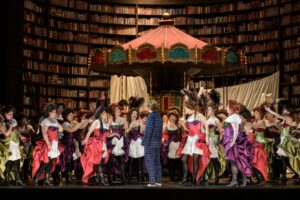
Yet in the hands of stage director Andreas Homoki, the piece contracts, paradoxically, into something both more human and more unsettling: a closed system, Kafkaesque in its logic, where meaning is archived, administered, and, perhaps, quietly suffocated. Homoki’s point of departure is not Bayreuth but the writings of the Czech Franz Kafka. The Grail knights become bureaucrats—custodians of a vast, impressive, library that may contain all of human knowledge, or perhaps only the illusion of it. The revolving set by Frank Philipp Schlössmann resembles a conical vessel: at once grail, archive, and containment unit. Its geometry dictates the dramaturgy. Private encounters occur at the exposed periphery, close to the stage’s edge; communal rituals retreat inward, into the bureaucratic sanctum. The visual metaphor is blunt but effective: enlightenment, here, is not revelation but administration, at least in the first and third acts. The second act unfolds as a grotesque divertissement: a colorful carousel-cum-brothel in which illusion is mechanized and desire put on display. Martin Bárta as Klingsor presided over a gaudy menagerie, the flower maidens circling and descending upon Parsifal in choreographed waves of seduction. Matthew Newlin’s stillness at the center of this whirl gave the scene its tension, resisting the centrifugal pull of the spectacle. The axis shifted decisively with the entrance of Ester Pavlů’s Kundry, who cut through the decorative artifice with a darker, more focused energy. Her intervention dispersed the maidens almost violently, collapsing the carousel’s superficial allure into a single, charged confrontation in which seduction became revelation and the drama briefly found its emotional core.
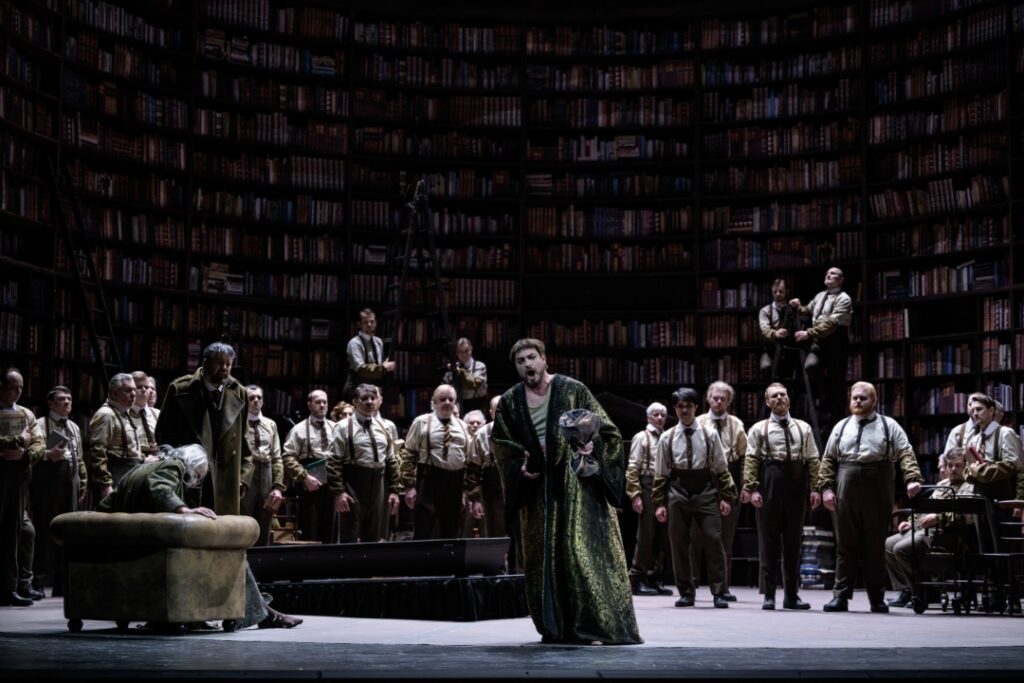
(Photo: Serghei Gherciu)
This reading aligned curiously well with Wagner’s own philosophical scaffolding–an amalgam of Arthur Schopenhauer’s pessimism and a generalized, Westernized notion of Buddhist renunciation. The wound of Amfortas becomes less a theological curse than a symptom of systemic exhaustion: desire without transcendence, ritual without renewal. Parsifal, the “pure fool,” enters as an anomaly–an unclassified variable in an otherwise hermetically sealed order.
In the pit, Markus Poschner led the State Opera Orchestra with a trajectory that mirrored the drama’s own arc from opacity to illumination. The opening notes showed a slight degree of uncertainty—textures slightly unsettled, balances not yet fully calibrated. Yet Poschner’s long-range sense of structure prevailed. By the third act, the performance had acquired a remarkable lucidity and depth: phrases breathed, harmonic tensions resolved with a natural inevitability, and the orchestral fabric glowed with a quiet emotional authority. One felt, in these final stretches, Wagner’s music achieving what the staging only tentatively suggests: a credible vision of redemption.
(Photo: Serghei Gherciu)
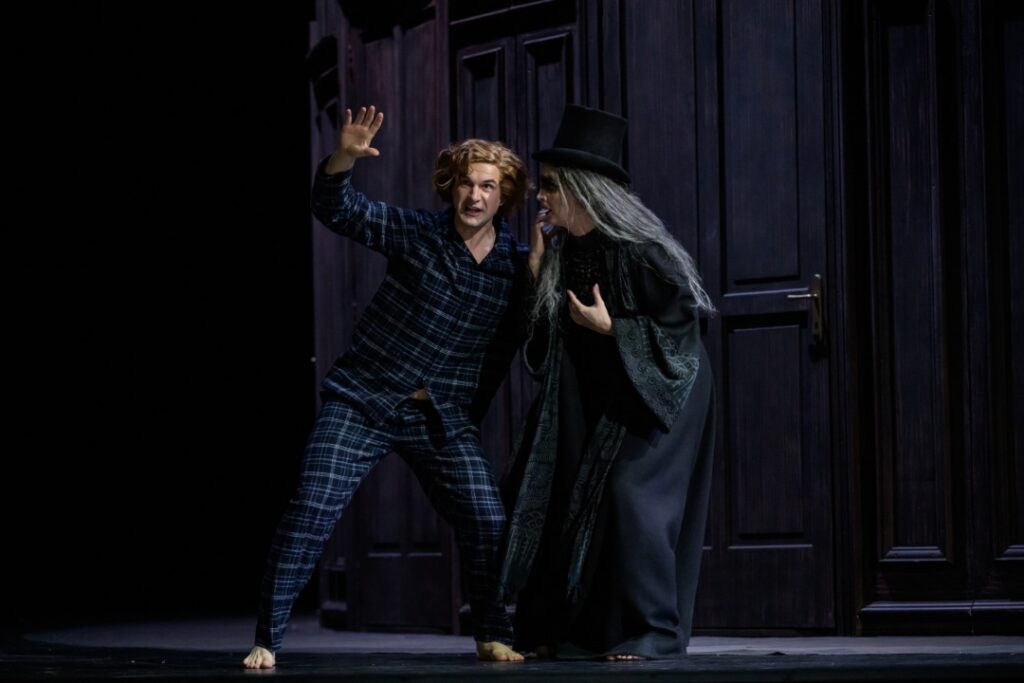
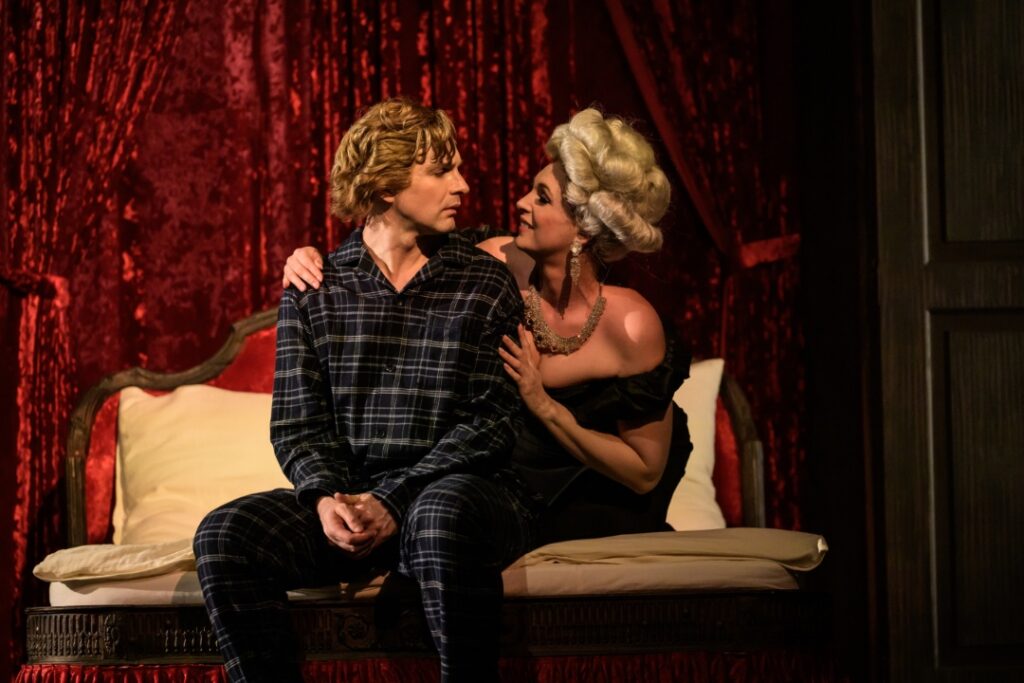
The American tenor Matthew Newlin approached the title role with a lyric instrument of appealing warmth. His Parsifal was that of a young man audibly grappling with the burden of self-recognition, aptly underscored by his wearing what could easily pass as a pair of checkered Pendleton pyjamas. The voice carried well, and Newlin shaped the central transformation scene with an increasing inwardness that avoided grandiosity. Finnish bass Timo Riihonen as Gurnemanz provided the evening’s moral anchor. His delivery combined vocal steadiness with good diction, allowing Wagner’s often unwieldy narration to unfold with clarity. Czech baritone Jiří Hájek as Amfortas was vocally firm, his anguish projected in broad, emphatic strokes; in Homoki’s staging, the character is granted death as release, a final gesture of closure that diverges from more traditional readings. Czech bass Ivo Hrachovec made a striking, if brief, impression as Titurel, emerging as a living corpse from his coffin with ritualistic gravity. Czech baritone Martin Bárta as Klingsor presided over a second act that veered toward the grotesque–a circus-brothel populated by Gibson-girl styled flower maidens. Bárta’s agreeable timbre, lacked the darker grain that can lend the character true menace; the act’s impact relied more on visual excess than vocal threat.
(Photo: Serghei Gherciu)
It was left to Czech mezzo soprano Ester Pavlů, the only female lead role, making her role debut as Kundry, to supply the evening’s most compellingly dramatic through-line. Pavlů’s performance was notable first for its physical commitment–barefoot, restless, oscillating between feral agitation and poised seduction–but more importantly for its psychological coherence. Her Kundry is not merely suffering under her own inner curse but self-aware, driven by a lucid desperation for release. In the second act, her narration of Parsifal’s past unfolded with an intimacy that cut through the surrounding spectacle; the erotic charge of the scene–and Parsifal’s refusal of it–generated a moment of genuine theatrical suspense. Although largely silent throughout the third act, Pavlů remained a central presence. Homoki’s decision to have Amfortas die in her arms compresses an entire history of longing into a fleeting tableau. Notably in this production, Kundry does not perish; instead, Parsifal’s final gesture suggests absolution rather than annihilation. It is a significant shift, and one that tilts the opera–often accused of terminal solemnity–toward a cautiously affirmative conclusion.
For all the mysticism and mystery innate in Parsifal, Homoki’s interpretation leaves room for thoughts of a happy-end, loose ends being tied up: the community of knights might regain their will to live and keep organizing the world’s knowledge, Parsifal has found his identity and purpose in life, Kundry her peace, Amfortas has died redeemed, and also Gurnemanz has fulfilled his lifelong purpose. Together with the truly sublime third act that Markus Poschner and the orchestra brought to life in the pit, the premiere evening of this production was very warmly received and applauded by the public in Prague.