Teatro Comunale Di Modena 2025-26 Review: La Carnaval
Lully’s Court Opera Receives Its First Italian Production Under The Masterful Direction Of Sardelli
By Alan Neilson(Photo: Roland Paolo Guerzoni)
Although Lully was a Florentine by birth, his entire professional career was spent in France in the employ of Louis XIV, where he rose to become the Superintendent of the King’s M usic and the leading figure in the development of French opera. In Italy, however, his theatrical works, including his operas, have never taken root and are rarely performed. In recent years, however, there have been moves by the Florence Institute Giovanni Battista Lulli to promote his work and to reclaim the composer as one of their own. To this end, the musical director Federico Maria Sardelli and Samuele Lastrucci of the Institute combined to create the first production of the revised version of the composer’s opéra-ballet “Le Carnaval, Mascarade Royale” since its premiere at the Louvre Palace in 1675.
It is not a work that a contemporary audience would automatically characterize as an opera; rather, it is a combination of dance and song in equal parts, without a narrative, and broken into discrete scenes linked together by the theme of the carnival. It is a light spectacle, consisting essentially of dance music, in which the singers perform largely unnamed roles that change with each scene, and there is little in the way of character development. It is a court opera, written to be performed for the king and his guests, and while on the surface it is primarily a form of entertainment, it was used as a means to project the splendor and power of the sovereign, and through him that of France. Thus, the overture for the piece is a paean, glorifying Louis’ kingship.
As well as the overture, the work is comprised of 11 scenes, each with a specific theme: scene one, for example, is entitled “The Spaniards” and includes songs of love in a variety of forms, such as its joy and the sorrow of lost love; scene five is dedicated to masks of the Commedia dell’Arte; and scene eight draws attention to the cultural range within the French court with its inclusion of Basque, Bohemian and Egyptian influences. Comedic characters in the form of the know-it-all Maestro Barbacola in scene two and the social aspirant Monsieur Pourceaugnac in scene three also make appearances. It all adds up to an easy, light and entertaining spectacle, which is held together by its overarching theme of carnival, with its focus on leisure, freedom, escape, and human fragility. The work is actually a pastiche arranged by Philippe Quinault, using Lully’s earlier work with texts by Molière, Benserade and Quinault himself.
Wonderful Dance Routines Ensure an Imaginative Staging
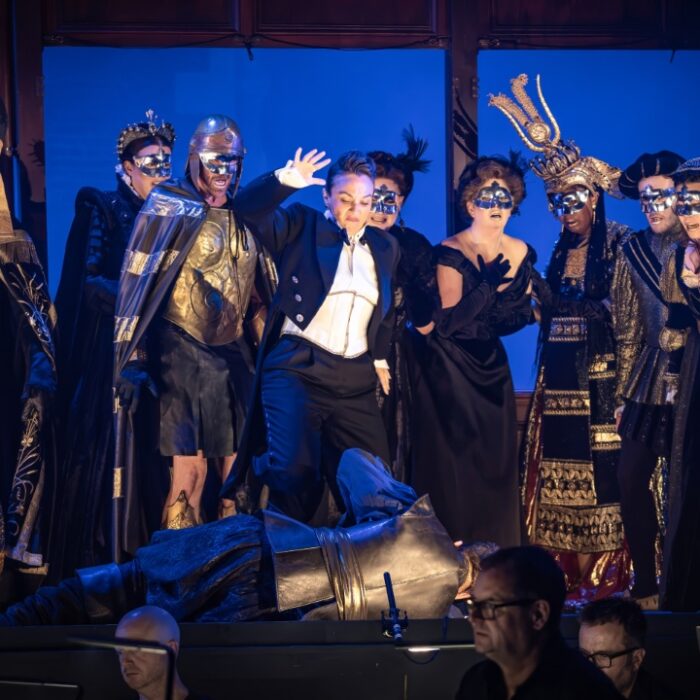
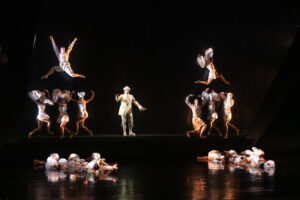
The director, Emiliano Pellisari, aided by scenographer Claudia Spoglia and costume designers Nora Bujdoso and Daniela Piazza, created a visually striking and fascinating staging that captured the spirit of 17th-century baroque theater with its emphasis on visual spectacle, reimagined for a 21st-century audience, with dance at its heart.
The singers were costumed in the traditional clothing of the period, although colored in a uniformly plain powdery white, which made them stand out clearly against the black staging to create a monochromatic effect. There were no props at all; rather, the stage was given over to a large mirror, angled to reflect the floor of the stage, upon which the dancers lay, clothed in cool-colored contemporary costumes that were occasionally adapted to reflect the changing nature of the scenes.
The dancers from the NoGravity Dance Company moved across the floor on their sides and backs, which, when reflected in the mirror, made them appear as if they were standing upright. Their choreographed movements created fabulous illusions; occasionally they appeared to be walking in the air; at other times, they tumbled downwards or upwards in slow motion or somersaulted high up across the stage, unconstrained by gravity; they climbed upon each other’s shoulders and then broke free to walk above the singers, who stood below at the front of the stage. Everything was managed beautifully to create a series of imaginative visual patterns and marvelous images that brought to mind the choreography of Busby Berkeley in his movies from the 1930s, albeit on a smaller scale. The dancers’ costumes added to the illusion, for example, they were used to create the idea of characters with elongated bodies standing 15 feet tall. It was a true spectacle, one certainly worthy of the baroque.
Fine Singing from the Six Soloists
The work was for six solo singers, who, in a nod to authenticity, were characterized according to 17th-century French vocal categories. Valeria La Grotta was cast as the première dessus, which corresponds to a light, high soprano voice; mezzo-soprano Giuseppina Bridelli played the part of the deuxième dessus, which was used to define a slightly lower, warmer voice; the tenor Cyril Auvity was defined as a taille; Philippe Talbot was cast as the haute-contre; baritone Biagio Pizzuti was parted as the première basse, used for noble, heroic figures; and bass-baritone Alexandre Baldo played the part of deuxième basse, a voice suited to authoritative and darker characters. Together, along with the chorus, Coro I Musici del Gran Principe, which sang from the pit, they provided a beautiful tapestry of vocal textures that ornamented Lully’s airs, duets, trios and choruses.
It was, perhaps, inevitable that the singers were occasionally pushed into the background, despite engaging positively with each scene to promote its effect. Not only did the nature of their roles restrict the opportunities for them to display their talent in developing characterization, but the refined, balanced and stately music also constrained their emotional reactions to the text so that they were never allowed to descend into melodrama.
La Grotta made an excellent impression, in which her vocal flexibility, attractive timbre and delicate phrasing impressed and contrasted nicely with Bridelli’s darker, more expressively oriented voice in the ensemble pieces.
The premiere basse, Pizzutti, possesses a strong stage and vocal presence, which he used to cast an air of confidence and control that provided his characters with an authoritative demeanor, while the deuxième basse, Baldo, sang his parts with a clear, refined, and articulate air that promoted the courtly nature of the performance.
The haute-conte Talbot gave the appearance of a typical 17th-century French aristocrat, complete with a well-placed mole on his cheek. He possesses a voice with an attractive timbre, and he sang with a pleasing sense of ease that allowed him to capture the full beauty of the melodies.
Auvity’s singing was clear, elegant and expressive, convincingly capturing his characters’ emotional states without any sense of overstatement, as one would expect in the cultivated court of the Sun King.
Federico Maria Sardelli drew a stately, elegant reading from the Orchestra Barocca Modo Antiquo, sensitively molded to support the movement of the dance and the voices of the singers, underpinned by a pleasing sense of understatement.
It is not very often that one has the opportunity to see a theatrical event created for the French court, at least not outside France, and for this reason alone, it proved to be an interesting and worthwhile experience. Its combination of dance and singing, underpinned by its visual spectacle and a refined aesthetic was very different from the normal operatic experience, including opera from the same period from other countries. Musically, it certainly possessed beauty, and it supported the dance perfectly, but it tended to be stately and reserved with little to set the pulse racing, while dramatically it had little to offer, which, of course, was never its intention. For those in the audience hoping to see a drama with a strong narrative and raging emotions, they would likely have been disappointed, regardless of the fact that they would have certainly been entertained by the magical effects of the dance.