Opernhaus Zürich 2025-26 Review: Cardillac
Hindemith’s Psychological Thriller Turns 100
By Laura Servidei(Photo: Monika Rittershaus)
Paul Hindemith’s “Cardillac” remains one of the most insightful operatic examinations of artistic obsession ever written. Premiered in 1926 amidst the cultural turbulence of the Weimar Republic, this psychological thriller follows a Parisian goldsmith so consumed by his creations that he murders to reclaim them, unable to tolerate his masterpieces in anyone else’s possession. Beyond its surface as a period thriller, “Cardillac” raises uncomfortable questions about artistic creation itself: when does devotion to one’s craft become destructive, and can an artist ever truly release their work into the world?
A Goldsmith Who Cannot Let Go
The opera, with a libretto by Ferdinand Lion loosely adapted from an E. T. A. Hoffmann story, unfolds in Paris and centers on the brilliant yet obsessive goldsmith Cardillac. Famous for his exquisite jewelry, Cardillac cannot bear the thought of his works belonging to others. After selling them, he secretly stalks his customers, murders them, and retrieves his creations. These crimes terrorize the city, where mysterious robberies and killings are blamed on an unknown attacker. Meanwhile, Cardillac’s daughter is romantically involved with an Officer, who grows determined to uncover the truth behind the murders.
As suspicion mounts, the Officer notices that every victim had recently purchased jewelry from Cardillac. When Cardillac attempts to kill the Officer, he fails, and the Officer exposes the goldsmith’s guilt. Though confronted, Cardillac refuses to abandon his obsession, insisting his art is inseparable from his identity and must remain exclusively his; he is captured and killed by an enraged mob. In the aftermath, his daughter must reconcile her love for her father with the horror of his deeds, while the opera closes ambiguously, questioning whether society truly grasps the destructive force of artistic obsession.
(Photo: Monika Rittershaus)
From 17th-Century Paris to a Modern Shopping Mall
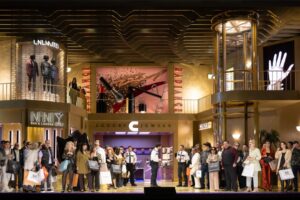
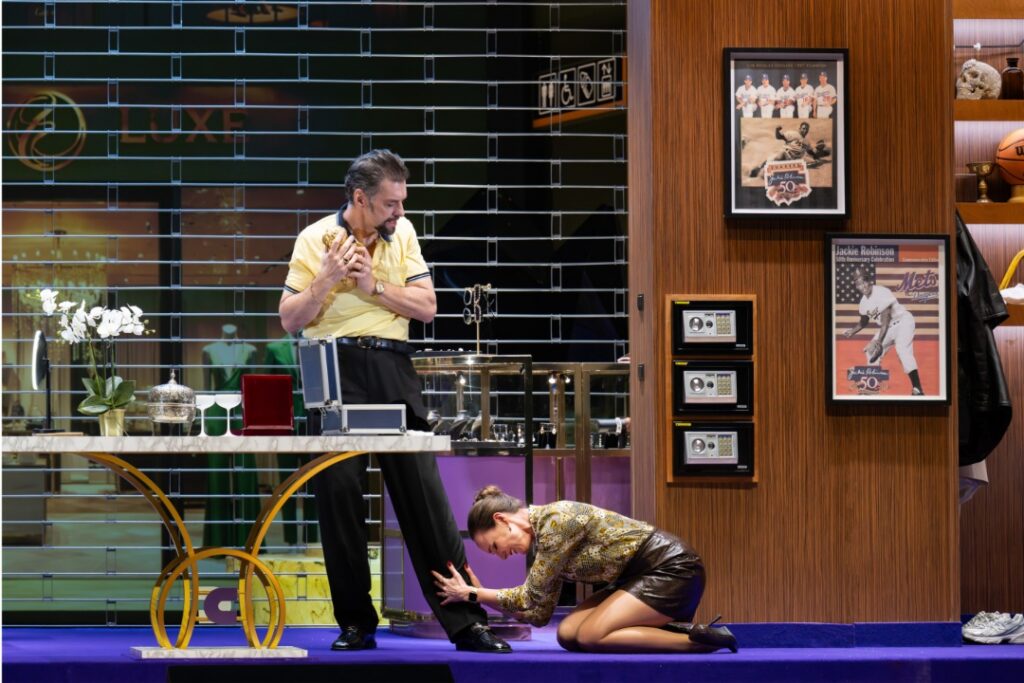
The Zürich Opernhaus presented a new production of Cardillac on the 100th anniversary of its premiere, directed by Kornél Mundruczó, who transplants the action to a modern shopping mall. The chorus assumes a central role in the opera, functioning almost as a Greek Chorus, commenting on and participating in events. The Zürich Opera Chorus, prepared by Klaas-Jan de Groot, performed magnificently, with precision, phrasing, and committed interpretation, filling the stage with detailed movement and an impressive wall of sound when required.
Channeling Hindemith’s Mechanical Energy
Hindemith developed his own tonal system based on the natural overtone series. His music is tonal yet untraditional: more astringent and dissonant than common-practice harmony, yet always feeling anchored and purposeful rather than atonal. Conductor Fabio Luisi delivered a compelling reading of the score; the Zürich Opera Orchestra reveled in the driving, mechanical energy of Hindemith’s music, with steady rhythmic pulse and perpetual motion. This resulted in a somewhat impersonal, objective interpretation, perfectly aligned with the reserved, intellectual character of Hindemith’s writing.
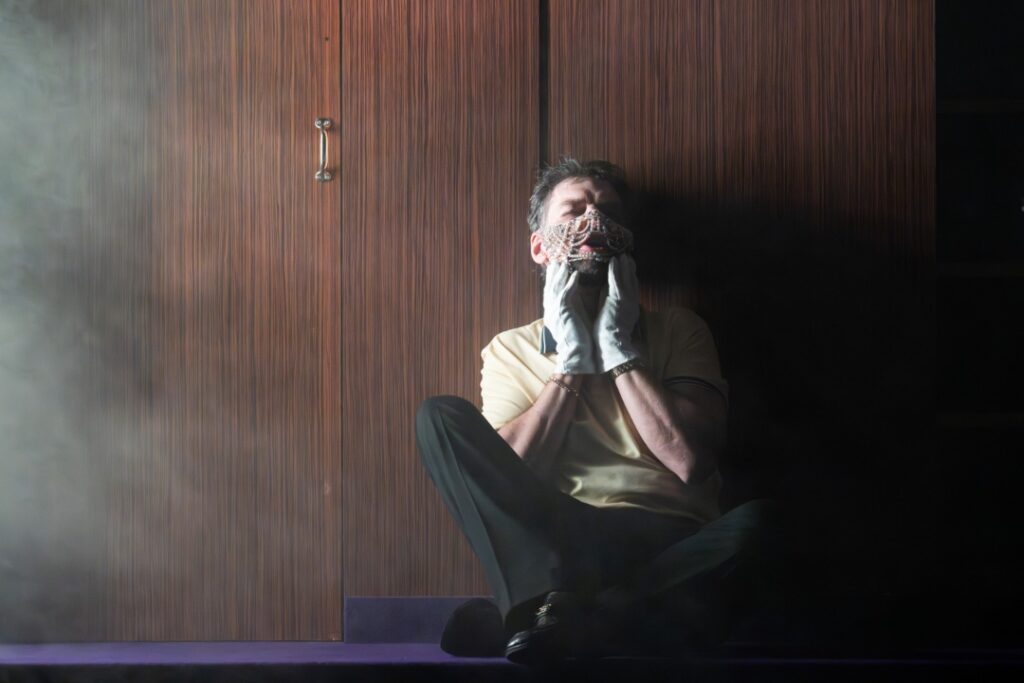
In the first act, Hindemith and Lion depict the dangerous side of a panicked crowd: the people accuse various “outsiders” of being the murderer, and only police intervention prevents a lynching. In this production, the crowd consists of posh shoppers in a mall, dressed in smart outfits and brilliant colors reminiscent of the 1980s (costumes by Monika Korpa), while the police are mall security. Two lovers—the Lady and the Cavalier—flirt while commenting on events; the Lady dares the Cavalier to buy her a jewel from Cardillac’s store, promising a night of passion in return. The Cavalier complies and brings the exquisite golden belt to the Lady’s chambers, only to be murdered by a masked assassin.
The Lady’s Aria: A Moment of Romantic Respite
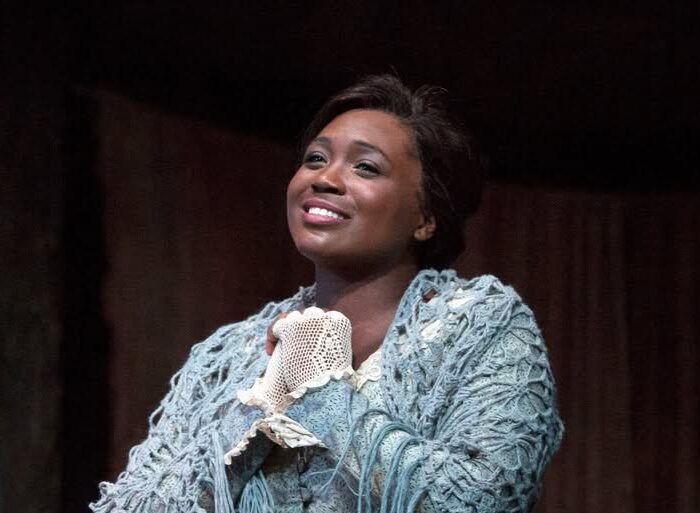
In this staging, the entire scene unfolds in the shopping mall after closing: we see the Lady undressing as if in her bedroom, singing the opera’s only aria, “Die Zeit vergeht,” while waiting for her lover to arrive with the jewel. Here, Luisi and the orchestra indulged in a touch of Romanticism in their performance, supporting the emotional interpretation of Dorottya Láng. Her voluptuous mezzo displayed tones of gold and bronze, with beautiful high notes and a sensual timbre.
(Photo: Monika Rittershaus)
The Goldmsith’s Confession: Bretz’s Compelling Portrait
Cardillac is portrayed as a popular VIP, loved and admired by all, with beautiful women fawning over him—contrasting with his description as a loner enamored of his work, oblivious to everything else. In the second act, in his workshop, we see him explaining his worldview, his fascination with gold, his perception of his creations as extensions of himself. Bass-baritone Gábor Bretz sang the goldsmith with a certain nobility in his interpretation; his vocal emission was occasionally rough, but the character emerged in all his facets, credible and engaging. His long monologue was emotional; Bretz used every edge of the melodic line to animate an obsessed, selfish, amoral character.
Strong Supporting Performances
Anett Fritsch was Cardillac’s daughter, who desperately craves the love and attention of her father, who shows her no affection or even acknowledgment. Fritsch’s soprano was high and silvery, with a very youthful timbre, perfectly suited to the role. She conveyed both the melancholy of her father’s detachment and the young love for the Officer, who wants her to elope and marry him. Michael Laurenz sang the Officer with a beautiful, powerful tenor, his excellent technique supporting him in the brilliant high notes of the part. His interpretation was at times heroic, fitting the character as the only one who escapes Cardillac’s dagger and exposes him as the murderer.
Stanislav Vorobyov was luxury casting as the Gold Merchant, his smooth, velvety bass showing great elegance and proving a perfect fit for the obsequious character, his interpretation committed. The cast was completed by Sebastian Kohlhepp, who sang the Cavalier with a high, pleasant tenor.
Overall, Mundruczó succeeded in making his concept clear, without straying too far from the libretto; moreover, the Personenregie was detailed and engaging. Yet the question remains why this story needed transposing to the present day: it didn’t seem to add any significance. The evening was a great success, especially musically, with enthusiastic cheers for Luisi and the orchestra.