OperaLombardia Teatro Sociale di Como 2025-26 Review: Don Quichotte
By Bernardo Gaitan(Photo: Giorgio Serinelli)
Composed in 1909 and premiered at the Opéra de Monte-Carlo in February 1910, “Don Quichotte” stands as the last great success of Jules Massenet and one of the most singular titles in his vast output. The work was born at a moment of full artistic maturity for the composer, who was fully aware of the proximity of the end of his life, and condensed into this score an extreme synthesis of his entire operatic experience.
Henri Caïn’s libretto, freely inspired by Cervantes’s “Don Quixote” through Jacques Le Lorrain’s theatrical adaptation “Le Chevalier de la longue figure,” selects only a few episodes from the original novel and substantially reshapes its dramatic axis, shifting the focus toward the triangular relationship between Don Quixote, Sancho, and Dulcinea. The musical structure is equally distinctive: far removed from both the grand-opéra model and that of opéra-comique, “Don Quichotte” defines itself as an atypical comédie héroïque, articulated in five autonomous tableaux–more evocative than narrative–in which action serves primarily as a pretext for delineating characters and emotional states.
(Photo: Giorgio Serinelli)
Production Details
An opera rarely staged in Italy, “Don Quichotte” appears today as a true musical testament: a score that intertwines imagined Spanish colorings by Massenet, who never visited Spain, with seductive melodies and a persistent vein of melancholy. OperaLombardia chose to revive this title within the northern Italian circuit, offering audiences a valuable opportunity to reconnect with a late, intimate, and profoundly human Massenet. This production also carried special significance as the first presented by the Teatro Sociale di Como under the superintendency of Dominique Meyer, who assumed the post in May 2025 after leaving his analogous position at Teatro alla Scala.
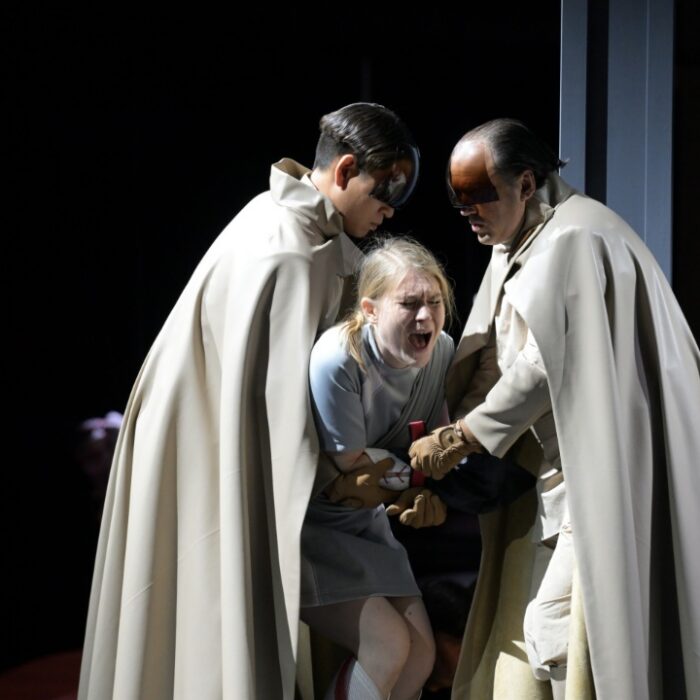
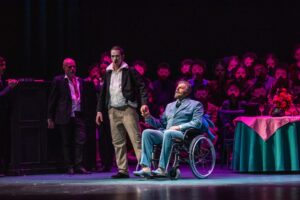
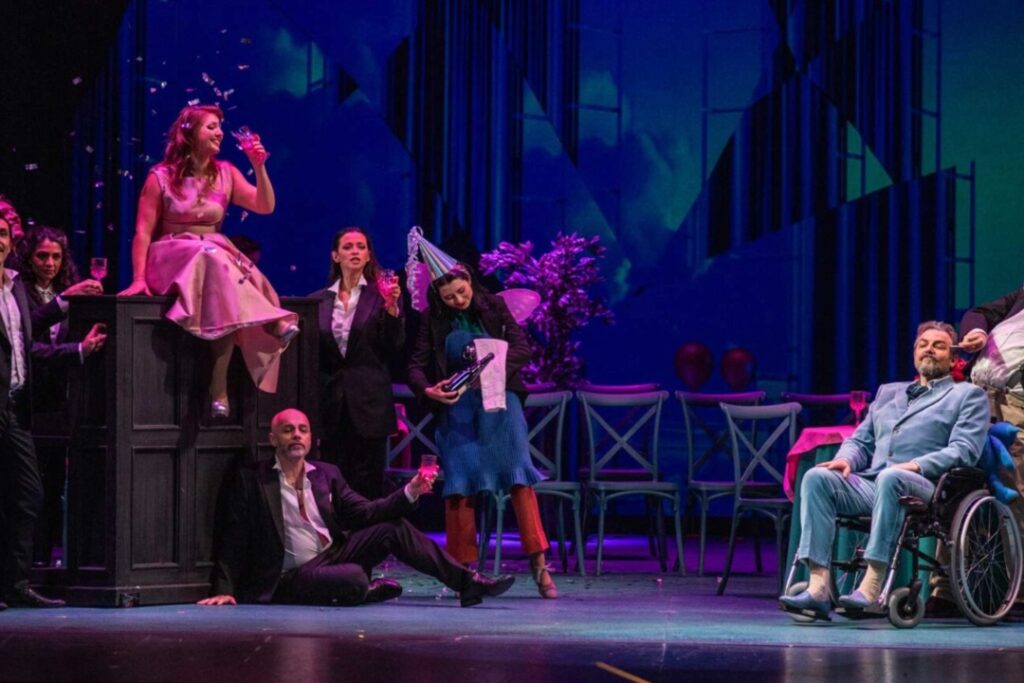
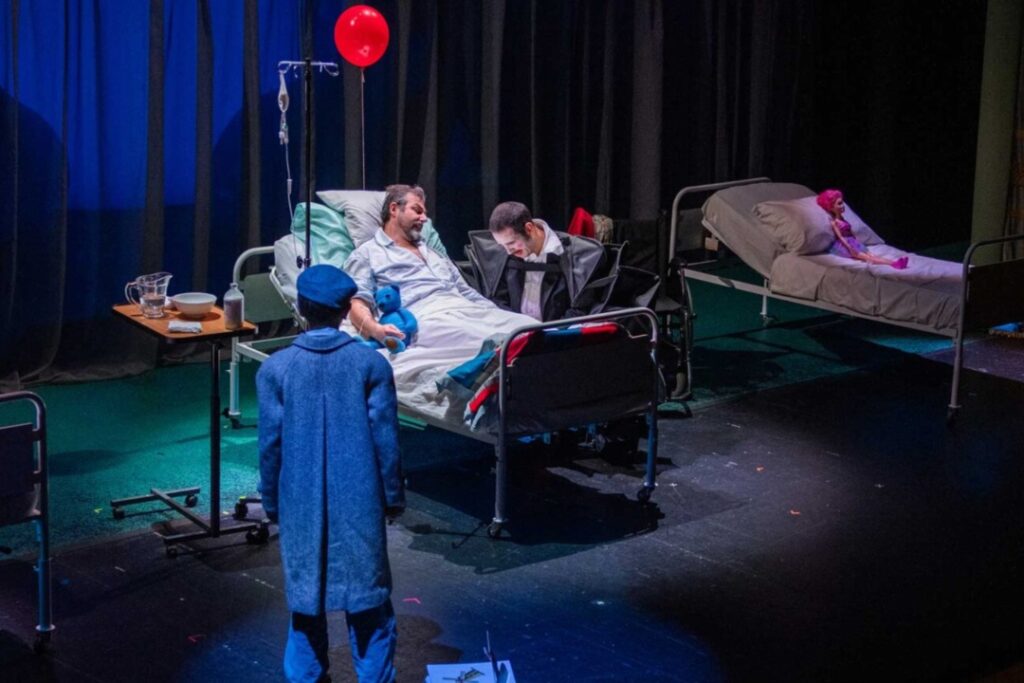
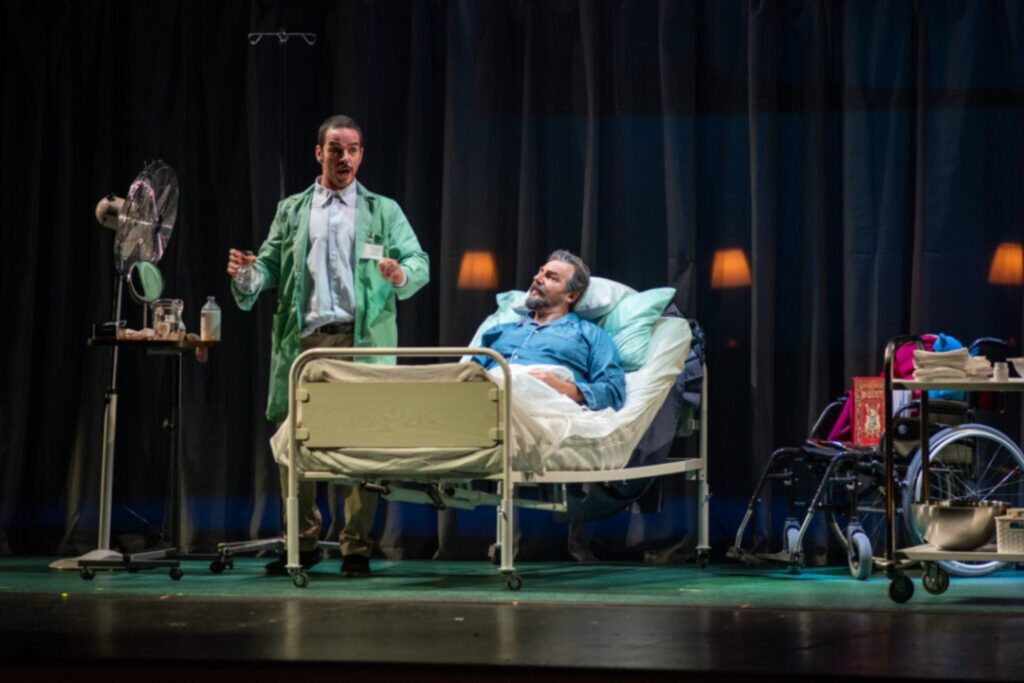
Kristian Frédric’s staging is built upon a strong and clearly metaphorical concept: Don Quichotte is portrayed not as a knight-errant in an idealized Spain, but as a cultured and sensitive former intellectual, now an elderly man confined to a nursing home, whose mind, sliding toward memory loss, transforms reality into dream. Rather than recounting chivalric adventures, Frédric’s vision becomes an inward journey, where nurses and patients take on heroic traits, everyday objects acquire symbolic weight, and the boundary between the real and the imagined remains deliberately blurred.
Don Quixote, whose memory slowly fades, lives in this medical residence perpetually bedridden or confined to a wheelchair, yet in his mind all borders dissolve. The French director offers a metaphysical reading that interweaves reality and subjectivity, playing with the scale of scenic objects. In the program notes, Frédric explains that he wanted this “Don Quichotte” to represent the inner journey of a man still searching for meaning in a world that is gradually unraveling; he chose not to depict the illness itself, but rather what it reveals: the resilient childlike core and the enduring power of dreams.
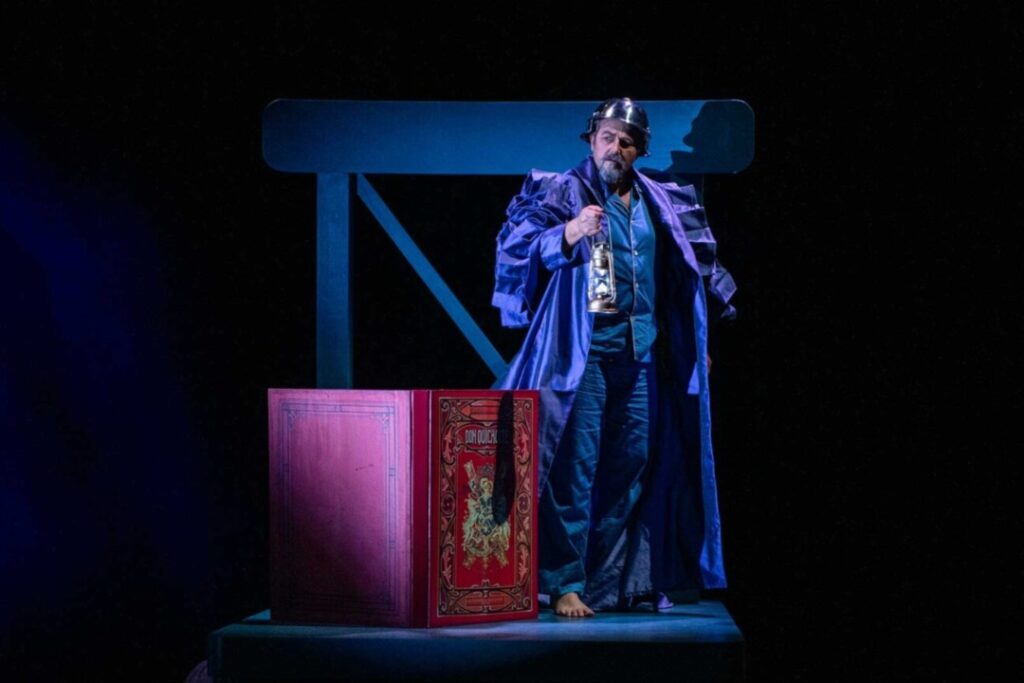
Marilène Bastien’s set design effectively translates this universe: the elegant nursing home alternately transforms into a castle or a child’s playroom. Particularly successful is the use of symbolic elements: a giant chair functioning as a castle, fans transformed into windmills, or a children’s book from which dreams emerge; elements that restore the distorted perspective of memory. Margherita Platè’s costumes, restrained and coherent, accompany the characters’ metamorphoses without ever lapsing into the picturesque; Rick Martin’s lighting design creates crepuscular atmospheres, while Antoine Belot’s video projections amplify the production’s oneiric dimension.
(Photo: Giorgio Serinelli)
Musical Highlights
At the head of the Orchestra i Pomeriggi Musicali, Jacopo Brusa approached the score as a form of theatrical painting. In the program notes, the conductor observes that Massenet, though a contemporary of Debussy and close to Stravinsky’s neoclassicism, incorporates baroque, Gregorian, and theatrical elements, creating a rich, agile, almost cinematic compositional language. His interpretation, precise and respectful of Massenet’s style, emphasized the work’s twilight character. Brusa’s baton proved particularly attentive to dynamics, especially to the pianissimi, always challenging to sustain due to their transparency, which exposes the orchestra’s vulnerabilities. The conclusion of the second tableau was especially spirited and emotionally charged, filled with Spanish colorings that Brusa conducted with notable skill. As the conductor himself notes, the Spanish dances, the fandango, and the chorus evoke an imaginary Spain that Massenet, like Bizet or Ravel, recreated in keeping with a fashion widespread in French salons at the dawn of the twentieth century. Some passages may lack that distinctly French sensuality that makes Massenet’s music vibrate; nevertheless, the overall balance is maintained thanks to a precise and committed orchestra.
(Photo: Giorgio Serinelli)
Stellar Cast
The true center of the performance is undoubtedly Nicola Ulivieri as Don Quichotte, marking his debut in the role. His portrayal stands out for its intelligence and theatrical instinct: far removed from any temptation toward self-indulgent protagonism, it is grounded in a supple vocal line, broad legato, and unfailing nobility. Ulivieri shapes a fragile knight who never asks for pity. His voice: substantial, homogeneous, and beautifully colored, especially in the central register, adapts naturally to Massenet’s writing, privileging emotional depth and mezza voce singing. A moment of particular intensity was in the Act four duet, where he delivered with veiled and deeply moving emotion; equally compelling is the final scene, conceived as a last breath dissolving into sleep, which Ulivieri renders profoundly touching.
Alongside him, Giorgio Caoduro offered a Sancho of notable theatrical substance. His vocality, oriented toward a lower register that he handled with assurance, allowed him to construct a more human figure, far removed from the rustic and naïve Sancho often portrayed. The first act was not his strongest, but in the second, and especially in the fifth, he impressed with the solidity of his interpretation. On stage, he established an effective connection with Ulivieri, becoming a fundamental support both metaphorically and theatrically, vocally as well.
Chiara Tirotta as Dulcinée convinced through the quality of her emission and the care devoted to her upper register. The aria “Lorsque le temps d’amour a fui” was delivered with elegance and control, revealing a solid artist. Her high register is unquestionably beautiful. Her Dulcinée relies less on overt sensuality than on a coquettish demeanor tinged with latent melancholy.
The roles of Juan and Rodríguez were also well balanced and convincingly interpreted by Raffaele Feo and Roberto Covatta, respectively, both notable for carefully honed vocal projection and effective stage presence. Marta Leung as Pedro and Erica Zulikha Benato as Garcias contributed precise and lively interventions, integrating seamlessly into the production’s dramatic fabric.
At the end of the performance, the audience responded with generous applause for the protagonists, particularly Ulivieri. From the balcony, a couple of misplaced spectators voiced unjustified boos toward the stage director, but their protests were quickly drowned out by applause for this title–timely rediscovered in Italy and unquestionably worth revisiting.
(Photo: Giorgio Serinelli)