Wexford Festival Opera 2025 Review: Le Trouvère
A Strong Production of a Verdi Rarity Does Not Quite Live Up to the Original
By Alan Neilson(Photo: Padraig Grant)
Verdi’s “Il Trovatore” premiered at Rome’s Teatro Apollo in 1853 and proved to be an immediate box office success that led to further productions across Italy, Europe, and the Americas. Following its Parisian premiere at the Théâtre Italien in 1854, Verdi was commissioned to adapt it for a production at the city’s Opéra, which required changes to meet the institution’s conventions and Parisian tastes. The most notable change was the inclusion of a ballet at the beginning of Act Three. There were also a number of minor changes: some of the numbers, such as Leonora’s “Miserere,” were shortened, while the role of Azucena was extended to take advantage of Adelaide Borghi-Mamo’s voice, who sang the role at its premiere. The orchestration was changed to reflect French preferences, and the vocal line was modified to accommodate the text, which had been translated into French by Émilien Pacini. It was premiered in 1857 under its French title of “Le Trouvère.” Although today it is not unusual for opera companies to incorporate some of the changes into their productions, performances of “Le Trouvère” are fairly rare. This rarity is, no doubt, what attracted the attention of Wexford Festival Opera.
Ben Barnes’ Compelling Direction Set in the Spanish Civil War
The well-known plot was given a 20th-century setting by director Ben Barnes, who opted to place it in the Spanish Civil War, and it worked very well! The fascist Count of Luna and the partisan Manrico find themselves on opposing sides of the political divide. Their conflict is thus born out of personal rivalry — for the love of Leonora — and a deep-seated hatred for each other’s political outlook. Both facets were highlighted within Barnes’ clearly constructed context.
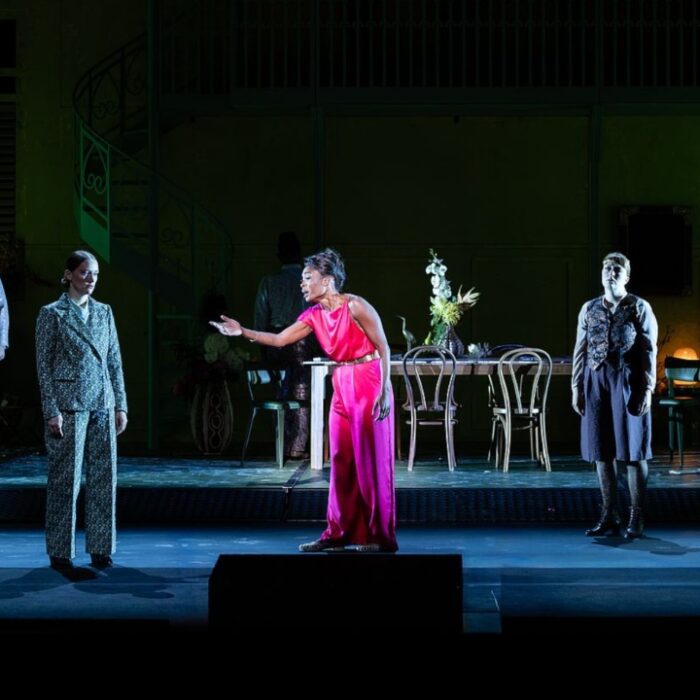
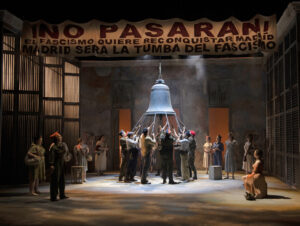
The sets, designed by Liam Doona, successfully captured the atmosphere of 1930s Spain, with the story opening in the room of a bomb-damaged villa somewhere close to the frontline. That Manrico would suddenly appear in an area where Luna and the nationalist troops were close at hand is therefore not surprising. The gipsy camp in Act Two becomes a partisan refuge, in which a banner across the top of the stage read NO PASARAN! — the cry of the partisans — and the rousing “anvil chorus” is turned into a soldiers’ camp song as they ready themselves for the coming battle. Act Three begins with a video of clips from the civil war, designed by Arnim Friess, which includes men marching to fight, the applauding crowds, the bombed cities, crowds cheering Franco, and people running in fear from the violence. In front of the projections the partisans dance. The final act is played out in what appears to be a courtroom, in which the monks sit in silent judgement as Luna passes the sentences on Manrico and Azucena and then watches as the tragedy plays itself out.
The costumes, designed by Mattie Ullrich, were in accordance with what one would expect in 1930s wartime Spain, with an added whiff of romantic bravura and plenty of army uniforms.
It all made for an aesthetically pleasing staging, one that never strayed from the fundamentals of the narrative and captured the sense of camaraderie, bravado, fear, and violence, upon which Manrico and Leonora’s love story and Azucena’s pursuit of vengeance were played out in bold strokes. The only negative was the choreographed dance routine, which felt entirely artificial. Fortunately, Barnes’ simultaneous use of videos managed to partially distract.
Four Excellent Principal Singers
The four principal roles boasted strong singers, all of whom produced excellent performances that ensured the ensemble pieces were delivered with a dramatic and musical flourish. The balance and sympathetic connection between them stood out. Particularly satisfying was the trio finale in Act One, in which Luna and Manrico confront each other while Leonora pleads for Luna to see sense. It was a scene that sizzled with emotional intensity as the passions of the three principals spiraled upwards. Similarly, the Act Two climactic scene, in which Manrico and Luna face each other, was a sparky affair wrought with high tension that dragged in Leonora, Inès, Ruiz, and others for a piece of gripping ensemble singing.
Soprano Lydia Grindatto created a pleasing, nuanced portrait of Leonora that brought out the strength, determination, and loyalty of a woman seeking to support her lover, Manrico, in extreme circumstances while subtly exposing the vulnerability of her position as a woman in a world surrounded by the violence of war. In her aria “La nuit paisible était silencieuse” (“Tacea la notte placida”), she gave voice to her feelings of longing after hearing the troubadour’s serenade, with a lyrically strong, secure, confident interpretation that showed off the beauty of her upper register, excellent phrasing and her ability to convincingly convey her ecstatic state. For the “Miserere” she voiced a very different emotion: terrified about losing Manrico, she voiced her fears in beautifully moulded lines, threaded through with a sense of panic, which wonderfully highlighted her rising state of anxiety.
Tenor Eduardo Niave possesses a voice that was well-suited to his role as Manrico. It is lyrically attractive and resonant, climbs easily above the orchestra, and is underpinned by a solid technique and beautiful timbre. He also added an appealing swagger that successfully captured the troubadour’s passionate and heroic nature. His rendition of “Seul sur la terra” (“Deserto sulla terra”) was delivered with a beautiful lyricism that perfectly captured the depth of his feelings for Leonora, while the famous cabaletta “De ce bûcher” (“Di quella pira”) was given a confident, swashbuckling reading that left no-one in doubt as to his fearless and determined nature.
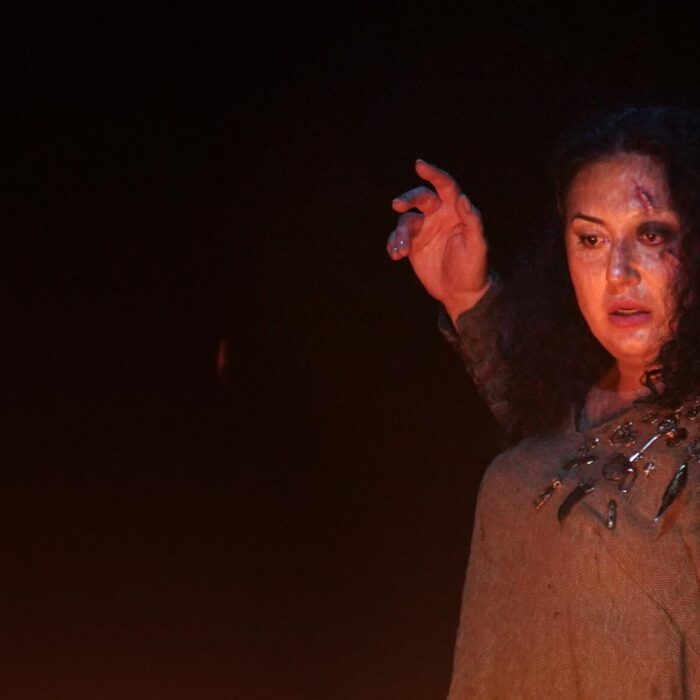
Mezzo-soprano Kseniia Nikolaieva possesses a remarkably beautiful palette boasting a kaleidoscopic array of rich, dark, and weighty tones in her lower register that she is able to contrast with the brighter, more luminous colors of the upper. It is a voice guaranteed to capture the attention and perfect for the role of Azucena. She created an emotionally strong and expressive characterization, in which she made full use of the variegated colors at her disposal, expertly ramping up the sense of foreboding and dread that any successful reading of the role demands. Her signature aria, “La flamme crépite,” (“Stride la vampa,”) which is fundamental in establishing her role, significance, and character, was superbly delivered as she inflected the voice with a myriad of dark colors and sinister emotions, brilliantly conjuring up a menacing atmosphere that flooded the stage.
Baritone Giorgi Lomiseli produced a strong performance in the role of Il Conte de Luna, whom he characterized as forceful, aggressive, and entitled. His singing was secure, firm, and expressive, underpinned by a confident demeanor that helped define his noble heritage. Arias were beautifully fashioned: his rendition of “L’éclat de son beau visage” (“Il balen del suo Sorriso”), in particular, showed off his ability to capture the emotional depth and melodic beauty of the voice. His ensemble singing, to which he again brought depth and expressive strength, was equally compelling.
Bass Luca Gallo as Luna’s senior officer, Ferrando, gave the appearance of an authoritative figure, but his singing sounded a little insecure, caused by too wide a vibrato, and did not fully convince in the role. Tenor Conor Prendiville can always be relied upon to give an animated and fully committed performance, no matter how big or small the role, which he did in this case with the small role of Ruiz. Soprano Jade Phoenix showed off her neatly crafted phrasing, pleasing tone, and fine acting in the role of Leonora’s confidante, Inès. The three relatively small roles of the Old Bohemian, A Messenger, and A Jailer were given solid performances by baritone Philip Kalmanovitch, tenor Vladimir Sima, and bass-baritone Conor Cooper, respectively.
The Chorus of the Wexford Festival Opera sounded vibrant, resonant, and expressive, and acted out their parts well. Although there was also plenty of energy in their singing, their words were not very clear at all, and often sounded somewhat muffled. To be fair, this is a criticism that could also be leveled at some of the singers, whose mastery of the French language was not always good.
Marcus Bosch, conducting the Wexford Festival Opera Orchestra, oversaw a detailed interpretation that balanced sensitivity, dramatic urgency, and vitality. It was also a reading that highlighted the more refined orchestration of the French version vis-à-vis the original Italian version.
How Does “Le Trouvère” Compare to “Il Trovatore?”
Overall, “Le Trouvère” proved to be a worthwhile choice for a Wexford production. It was certainly interesting to see a live performance of this well-known opera in its rarely performed French version. Is it superior to the original? I would have to say: absolutely not! The music lacks the rawness and drive of the Italian version, and the inclusion of the ballet does little more than break the tension and hold up the dramatic thrust. Furthermore, the French language sounds more sophisticated than Italian and thus is not as well-suited to the bold romantic emotions on display. Nevertheless, as a one-off performance, it was a very enjoyable experience. Given the choice, however, I would definitely opt for the Italian original.