Donizetti Opera Festival 2025 Review: Caterina Cornaro
By Bernardo Gaitan(Photo: Studio UV – Fondazione Teatro Donizetti)
At the beginning of the 1840s, Gaetano Donizetti was the most celebrated Italian opera composer in Europe. After conquering Paris with adaptations of his Italian successes and new works such as “La fille du régiment” and “La favorite,” his life unfolded in constant travel between the continent’s principal musical centers. He composed with a speed and productivity that astonished even his contemporaries.
It was in this context that “Caterina Cornaro” was born, inspired by the real-life figure of Caterina Corner, a Venetian noblewoman of the 15th century. The plot centers on her love for the young Gerardo, thwarted when the Republic of Venice forces her to marry Lusignano, King of Cyprus, to secure political influence on the island. Caterina accepts the marriage as a sacrifice of duty. When Gerardo returns to reclaim her, it is already too late: now she is a queen, and shortly thereafter her husband is murdered by conspirators. Caterina becomes trapped between her monarchical duty and the love she still feels for Gerardo. He tries to support her, but the Venetian political machinery prevails, and Caterina loses the throne. In the end, she accepts her fate with dignity and resignation.
Despite its dramatic interest and Donizetti’s fame, the Neapolitan premiere was a failure. Censorship had mutilated crucial elements: Gerardo’s affiliation with the Knights of Rhodes and the poisoning of King Lusignano. By eliminating these structural pillars, the plot lost force and the characters were stripped of powerful motivations. Missing were the scenes of jealousy, madness, and vengeance that had characterized Donizetti’s best theater. The result was a drama dominated by resignation and a finale the public deemed incomprehensible. After only a handful of performances—some even incomplete—the Teatro San Carlo withdrew the opera from the bill. Donizetti, who already feared disaster, received the news with profound discouragement.

(Photo: Studio UV – Fondazione Teatro Donizetti)
Production Details
The 2025 Donizetti Opera Festival presented for the first time an integral critical edition of the work, prepared by Eleonora Di Cintio. The musicologist restored the composer’s original design, including Lusignano’s death arioso and elements from the Parma version. The title became the festival’s flagship project, in a symbolic production marking the artistic handover between Francesco Micheli, stage director and former festival director, and Riccardo Frizza, the new artistic and music director.
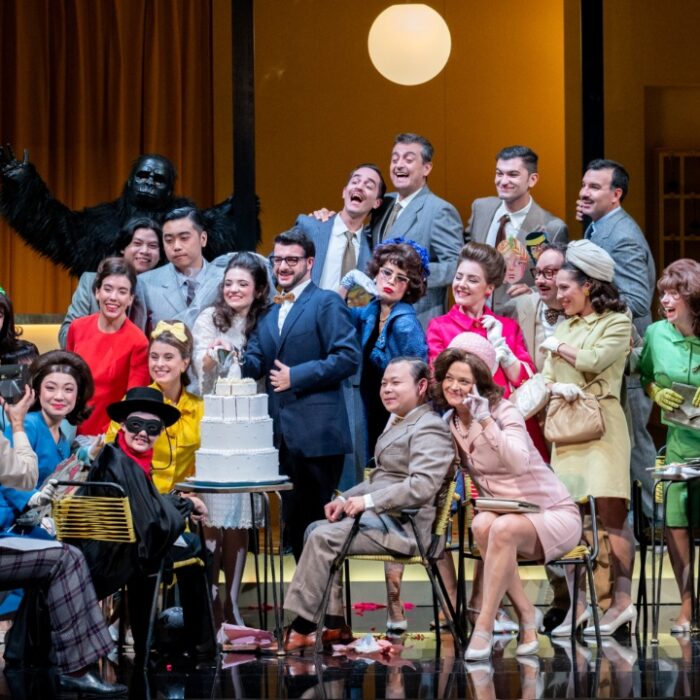
Taking risks is always admirable; when a gamble succeeds, it is celebrated, but when it does not… one pays the price of having avoided the safe, traditional path. In this case, Micheli conceived what many consider “the fourth Donizettian queen” through a reading articulated on three narrative planes: the historical Caterina, the melodramatic Caterina of the libretto, and a contemporary Caterina, a pregnant woman waiting in a modern hospital for the fate of her dying husband. On paper, the idea is ambitious. Onstage, the result is disastrous. Though aesthetically refined, Micheli fails to integrate these narrative levels convincingly, generating confusion and a mélange of scenic languages that dilute the dramatic force. Comments in the stalls were unanimous during intermission: “I can’t understand it,” “It makes no sense,” and “I’m confused.”
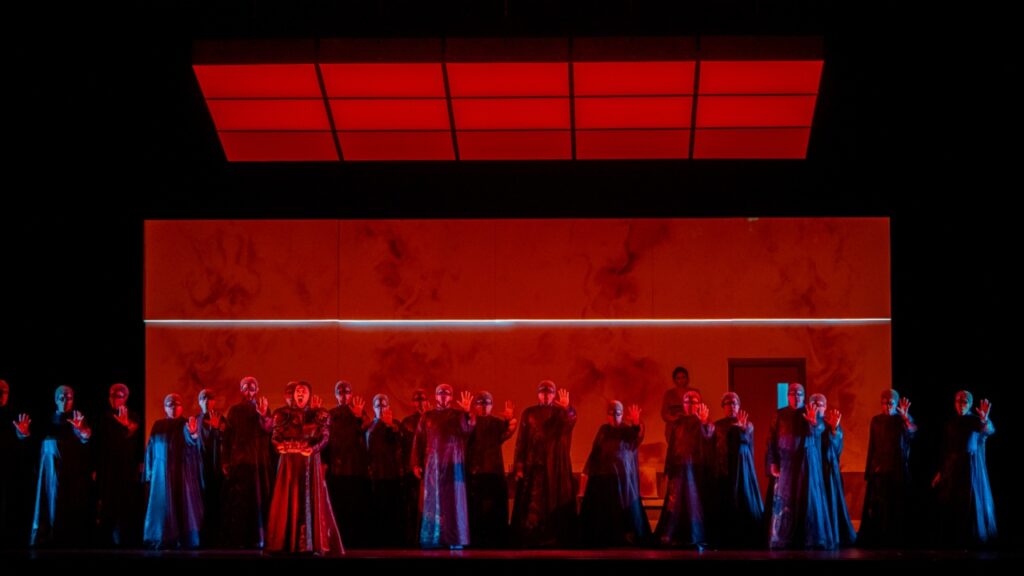
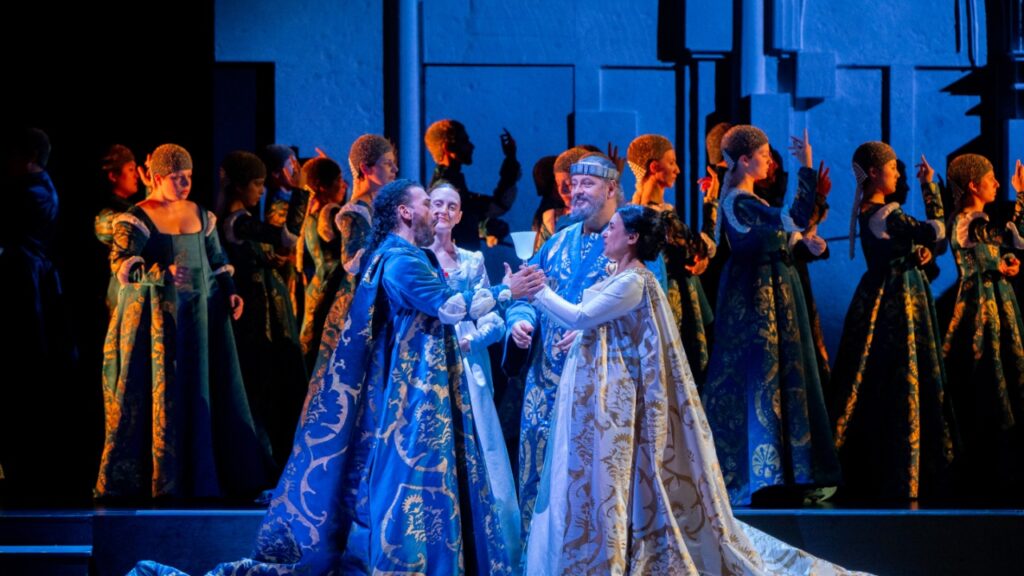
Matteo Paoletti Franzato’s rotating set alternates a contemporary clinical space: waiting room, X-rays, medical personnel, with Renaissance interiors enhanced by Matteo Castiglioni’s video projections and Alessio Rosati’s refined, though misplaced, costumes. The coexistence of eras aims to establish a dialogue between past and present, but the result is uneven and often confusing. The rupture of scenic logic is particularly evident in the alternative finale, where Gerardo appears as a surgeon rather than a warrior. Despite its visual care, the proposal proves dramaturgically inconsistent, unable to balance the historical, operatic, and modern planes.
(Photo: Studio UV – Fondazione Teatro Donizetti)
Musical Highlights
To the scenic confusion were added the adversities of the festival’s final performance. Minutes before the curtain, it was announced that Riccardo Frizza, scheduled to conduct, would be unable to appear due to an unforeseen personal matter. He was replaced at the last moment by Aram Khacheh, his assistant during rehearsals. The young conductor, of Persian heritage and born in Italy in 1997, assumed the responsibility with admirable courage. Despite the unexpected leap, he offered a solid reading at the head of the Donizetti Opera Orchestra, attentive to balance and to a rigorous Romantic style, underlining dynamic contrasts and the score’s somber character. His conducting, poised between dramatic impetus and bel canto nobility, highlighted the harmonic density and early Verdian touches that permeate the work. The chorus of the Accademia del Teatro alla Scala, led by Salvo Sgrò, delivered a competent performance.
Soprano Carmela Remigio, in the titular role, offered a dignified and elegant Caterina, with intense acting and great stage authority. Although her instrument shows signs of wear, Remigio compensates with musicality, attentive word-shaping, and a theatrical instinct that lends nobility to the character. Difficulties appear at the extremes of the tessitura, with veiled high notes and a noticeable disconnect between registers; nonetheless, the central range remains firm and expressive. The prologue’s cabaletta, “Deh! Vieni, t’affretta,” was among the highlights of her performance.
Enea Scala, a fiery tenor as Gerardo, displayed incisive accents and bright top notes. He offered a passionate, convincing Gerardo, with frank emission and a warrior-like cabaletta of genuine bel canto serio fire. The tenor was full of intensity and carried the second act with heroic force: an ideal quality for this type of role.
One of the most unexpected episodes of the night affected the role of Lusignano. Baritone Vito Priante began the performance with elegance and noble line, but during the aria “Da che sposa Caterina” he began to show almost imperceptible vocal difficulties. His voice suddenly gave out, and he left the stage. In the second act, the cover, Wonjun Jo, a young South Korean baritone, appeared and assumed the role with admirable professionalism. Though understandably nervous, he sang with stylistic nobility and expressive depth, especially in the restored final arioso, recovered in this critical edition and presented here in its first modern performance.
Bass Riccardo Fassi was an excellent villain. He delivered a solid Mocenigo, with a dark, rich timbre, cutting accent, and notable stage presence: of rare theatrical effectiveness. Fulvio Valenti as Andrea Cornaro, Francesco Lucii as Strozzi/Cavaliere, and Vittoria Vimercati as Matilde completed a balanced and musically solid cast.
Despite the scenic stumbles and last-minute adversities, the evening confirmed the vitality of the Donizetti Opera Festival and its capacity to respond with professionalism and courage. “Caterina Cornaro” in its complete critical edition represents a musicological achievement of great importance for the Donizettian repertoire. With a production carried out against all odds, the audience rewarded the effort with generous applause. The integral and critical addition of “Caterina Cornaro” closed the Donizetti Opera Festival successfully and one must wait eagerly for the 2026 festival.
(Photo: Studio UV – Fondazione Teatro Donizetti)